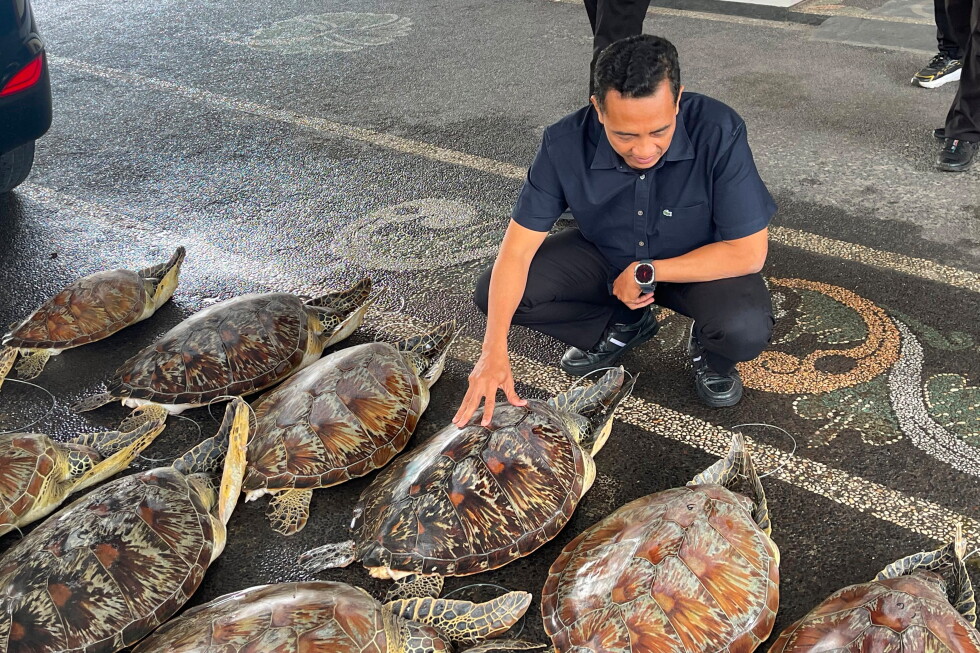
On Indonesia’s world-famous tourist island of Bali, law enforcement officials have successfully disrupted a large-scale illegal wildlife trafficking operation, seizing 21 live, protected green sea turtles and arresting one suspected ring member last week, Bali police announced publicly this Friday.
The operation was launched after local residents tipped off authorities about suspicious activity linked to wildlife trade along the island’s remote Pegametan coast. Acting on the tip, law enforcement teams carried out a targeted raid on the area on June 10, recovering all 21 live turtles before they could enter the illegal market, explained Nanang Pri Hasmojo, chief of law enforcement for Bali’s police force.
Officers took 67-year-old suspect—identified publicly only by his initials KS—into custody at the scene. Investigators say the man is accused of functioning as a storage point for the trafficked reptiles, holding them until they could be moved to other sellers for distribution to end buyers. During initial interrogation, the suspect allegedly told officials that the shipment of turtles was sent by a criminal associate who collected the animals from waters off Madura, an island off the coast of East Java province. Under the suspected trafficking chain, KS received the contraband directly on Pegametan Beach, where another co-conspirator was scheduled to pick the turtles up for resale.
Hasmojo confirmed that the investigation is still actively ongoing. “We are continuing to map out the full network and pursue all other co-conspirators connected to this smuggling ring,” he stated. The arrested suspect has already been formally charged under Indonesia’s strict national wildlife protection legislation. If convicted on all counts, he faces a maximum sentence of 15 years in prison plus substantial financial penalties.
All sea turtle species found in Indonesian waters have held formal protected status under the country’s conservation and fisheries laws since 1990. A 2018 regulation issued by the Ministry of Environment and Forestry further strengthened these protections, explicitly outlining prohibitions on harming or trading in six native sea turtle species, and additional government rules have fully banned all commercial trade of the animals nationwide.
The global crisis facing sea turtles has been well-documented by conservation researchers. According to the International Union for Conservation of Nature (IUCN), targeted poaching of both turtles and their eggs—carried out by both local community actors and large transnational criminal networks—is one of the leading driving forces pushing six of the world’s seven recognized sea turtle species into threatened or endangered conservation status.
A 2022 study conducted by researchers at Arizona State University, published in the peer-reviewed journal *Global Change Biology*, estimated that more than 1.1 million sea turtles were illegally killed across the globe between 1990 and 2020. Most of this killing is driven by demand for turtle meat, unproven claims that turtle products act as aphrodisiacs, and use of turtle parts in traditional cultural and spiritual practices. The study found that green sea turtles (scientific name *Chelonia mydas*), the same species rescued in the Bali raid, made up 56% of all sea turtles killed illegally during that 30-year period.
Historically, Bali emerged as a major trafficking hub for green sea turtles, a trend shaped in part by long-standing local cultural practices: for generations, Balinese Hinduism—the dominant religion on the 4.5 million-person island—has used turtle meat in religious offerings. In recent years, however, conservation outreach and stricter enforcement have significantly reduced illegal turtle trade on the island, though smuggling rings continue to operate to meet remaining demand.