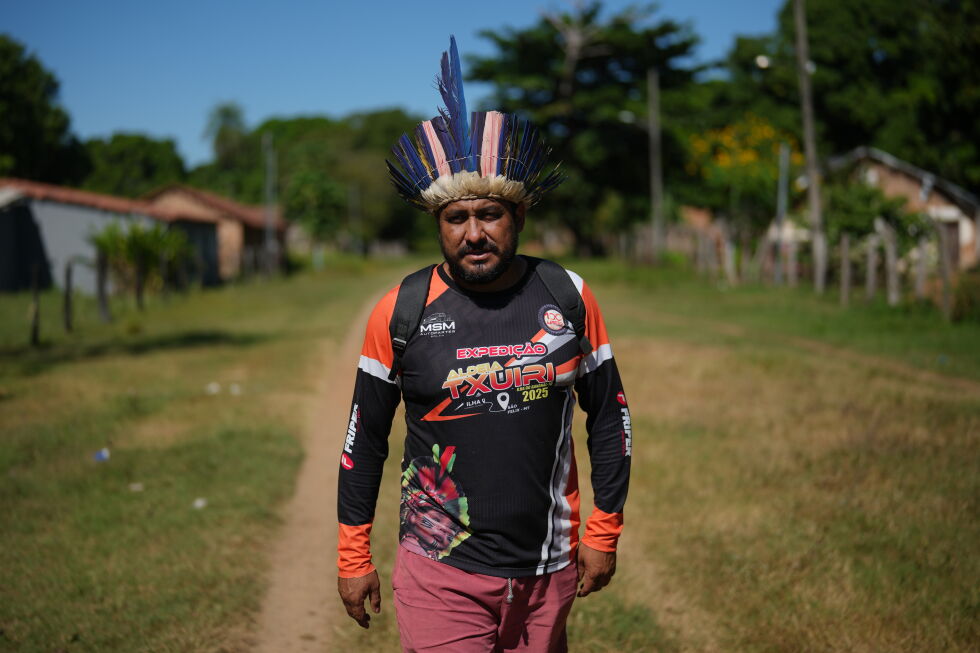
Nestled between the Javae and Araguaia rivers in northern Brazil, Bananal Island — the world’s largest river island — has become the epicenter of a contentious national debate that encapsulates the complex tradeoffs between environmental protection, Indigenous sovereignty and the economic power of Brazil’s massive agribusiness sector.
Last year, federal environmental authorities ordered all commercial cattle herds removed from the island’s legally protected Indigenous territory. The order argued that the land is permanently reserved for Indigenous communities and biodiversity conservation, and that unregulated cattle grazing by non-Indigenous ranchers was not only illegal under Brazilian law, but also a major driver of widespread habitat degradation across the island.
Wranglers successfully moved more than 100,000 cattle off the island during a period of low river levels to comply with the ruling, but the removal has triggered unforeseen economic upheaval for Indigenous residents who had become dependent on revenue from leasing tribal land to outside ranchers for decades.
The situation lays bare the persistent challenge of reconciling three competing priorities that define environmental policy in Brazil: curbing Amazon deforestation, upholding Indigenous territorial rights, and accommodating the demands of agribusiness — one of the country’s most politically influential economic sectors. As the world’s top beef exporter, Brazil accounts for roughly 20% of global beef production, with the industry contributing 6% to the nation’s total gross domestic product.
Conservation researchers widely recognize protected Indigenous territories as one of the most effective tools to reduce deforestation in the Amazon, the world’s largest rainforest and a critical global climate regulator. Even as Brazil has made notable progress cutting overall deforestation rates in recent years, cattle ranching remains the single largest driver of forest loss across the country. To create new grazing pastures, ranchers clear large swathes of native forest, replacing carbon-absorbing trees with methane-emitting cattle — a dynamic that accelerates global climate change while threatening native biodiversity. Data from MapBiomas, a non-profit land use tracking organization, shows Tocantins state, where Bananal Island is located, recorded among the highest deforestation rates in Brazil in 2025.
Brazilian law strictly prohibits large-scale commercial activity on designated Indigenous lands, allowing cattle rearing only for small-scale subsidence use by tribal communities. For decades, however, an informal leasing system operated openly on parts of Bananal Island. Non-Indigenous ranchers paid village leaders roughly 15 reais ($3) per head of cattle monthly — a fraction of the 60 reais ($12) per head typical for grazing leases outside the territory. At its peak, when more than 100,000 cattle grazed on the island, monthly leasing revenue reached 1.5 million reais ($290,000), which was distributed through tribal leadership to local community associations.
“Cattle, over the years, have covered many of our community’s expenses,” explained Cleiton Javae, chief of the Txuiri village, one of more than 40 Indigenous communities on the island home to roughly 5,000 total residents. Javae noted the revenue funded critical local needs including school supplies, medical care, transportation and traditional cultural festivals. But critics of the informal system point to deep structural inequities: much of the revenue was concentrated among a small group of tribal leaders, leaving many community members in poverty. “The law requires consultation and shared benefits,” said Leandro Milhomem, head of IBAMA, Brazil’s federal environmental agency, in Tocantins. “Instead, some chiefs had significant resources while, in the same community, children died of malnutrition.”
Indigenous residents also told the Associated Press that ranchers fenced off large sections of the island to contain their herds, blocking communal access to traditional subsistence farming areas. Even leaders who supported the original leasing agreements acknowledge the system spiraled out of control, with ranchers bringing far more cattle onto the island than they initially declared. “The situation became unsustainable, and removing the cattle was the only alternative,” Javae said.
Beyond economic inequality, unregulated cattle ranching caused severe environmental harm to the island. IBAMA investigations linked grazing activity to soil acidification and increased wildfire risk, as ranchers regularly use controlled burns to clear brush and refresh pasture land. Many of these blazes spread beyond grazing areas, destroying native habitat.
Bananal Island’s modern conflict has deep historical roots. When European colonizers arrived in the region in the late 18th century, they found the island already inhabited by Indigenous groups and covered in wild banana groves, which gave the island its Portuguese name Ilha do Bananal. The region remained largely undeveloped and overlooked by the Brazilian government until the 1950s, when it was formally designated a protected Indigenous territory. At the same time, federal officials encouraged non-Indigenous ranching through informal leasing arrangements with local communities, setting the stage for the current crisis.
Three Indigenous groups — the Javae, Karaja and Ava-Canoeiro — currently live on the island. The Javae, in particular, developed long-standing social and economic ties with non-Indigenous ranchers, with many outsiders settling on the island after marrying into local Indigenous communities. These connections allowed ranchers to gain access to develop commercial activity inside the legally protected territory, creating the mixed cultural landscape visible on the island today: modern brick homes stand alongside traditional thatched huts, children play with traditional bows and arrows near Protestant churches, and elderly tribal leaders prepare traditional meals while watching cooking tutorials on YouTube.
Following the cattle removal, Indigenous leaders on Bananal Island are now rethinking their approach to economic development, working to craft a new model that balances income generation with territorial and environmental protection. The Javae community is partnering with The Nature Conservancy, a global non-profit conservation organization, to develop a comprehensive community-led land management plan that integrates the tribe’s social, economic and environmental priorities.
In May 2026, Javae leaders traveled to the northern Amazon state of Roraima to study the successful model developed by the Macuxi people, who have become a national example of balancing collective economic development with land rights protection. Starting in the 1980s, the Macuxi developed a community-owned cattle operation to help reclaim their territory from encroachment by farmers, miners and land grabbers, decades before their land was officially demarcated as Indigenous territory in 2005. Today, the Macuxi collectively own more than 45,000 head of cattle, generating sustained shared revenue for the community while protecting their territorial sovereignty.
The Macuxi and Bananal Island experiences reflect a growing national conversation among Indigenous communities across Brazil about how to balance sustainable economic activity with protection of territorial rights and natural ecosystems, a debate that has also extended to mining. In February 2026, Brazilian Supreme Court Justice Flávio Dino ruled that the Cinta Larga people, whose territory spans the Amazonian states of Mato Grosso and Rondonia, have the legal right to conduct mining operations within their own territory.
Ivo Aureliano Macuxi, an Indigenous rights advocate and member of the Indigenous Council of Roraima, argues that there is no one-size-fits-all solution for Indigenous economic development. “You can’t apply a single model as a template for other Indigenous lands,” he said, emphasizing that frameworks must be tailored to “each region, each territory, each people.” What works for one community, he added, may not work for another, requiring flexible legal frameworks that respect the self-determination of Brazil’s 391 distinct Indigenous peoples.
This coverage of climate and environmental issues from the Associated Press receives financial support from multiple private foundations. AP maintains full editorial control over all content.