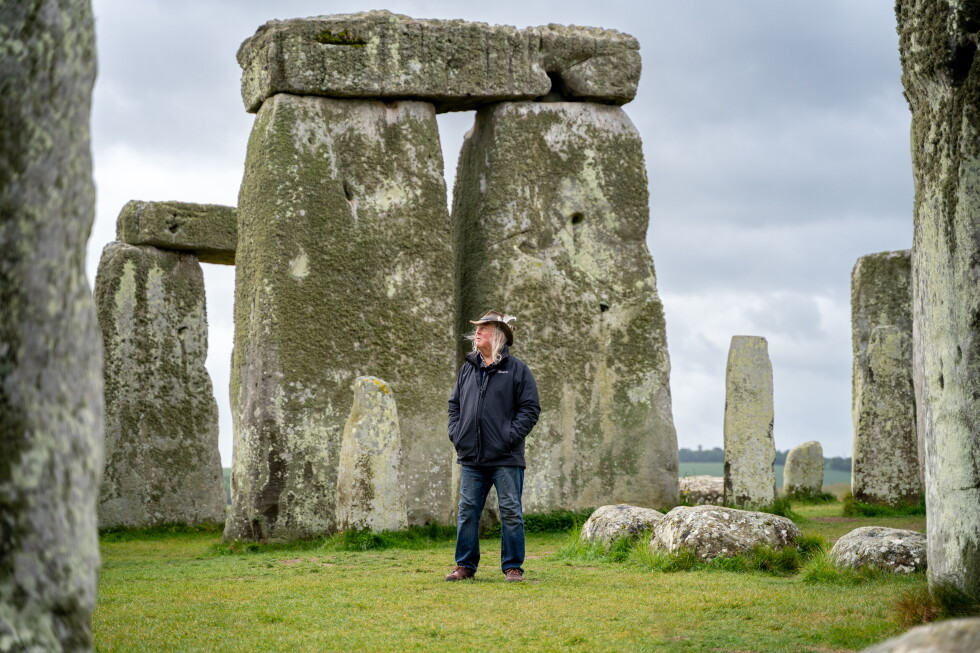
Archaeologists have announced a groundbreaking discovery near England’s iconic Stonehenge: a 5,500-year-old wooden structure that researchers believe may have served as an early prototype for the famous prehistoric stone monument, predating it by roughly five centuries. The announcement was made Thursday, just days ahead of this year’s summer solstice, the annual event that draws tens of thousands of visitors to the Stonehenge site each year.
The find was made by a team from British archaeological firm Wessex Archaeology, led by veteran archaeologist Phil Harding, a household name in the UK from his decades of work on the popular Channel 4 television series *Time Team*. The dig site is located in Bulford, just 3.1 miles from the main Stonehenge circle on Salisbury Plain, and was carried out between 2015 and 2017 as part of pre-construction archaeology for the UK Ministry of Defense’s troop relocation program. The Ministry is moving thousands of service personnel back to the UK from Germany after decades of large British military presence there, and the Bulford area already hosts a major military barracks within one of the country’s largest training grounds, located near the Stonehenge World Heritage Site.
According to the team’s analysis, the ancient structure was made up of two massive wooden poles set 394 feet apart, positioned to align directly with the rising sun on the summer solstice and the setting sun on the winter solstice — matching the same solar alignment that defines the later Stonehenge stone circle. Along with the remains of the wooden structure, archaeologists uncovered a rich collection of prehistoric artifacts at the site, including Neolithic pottery, ancient animal bones, and a rare disc-shaped stone tool. Harding, 76, said the site was almost certainly a gathering place for large ceremonial religious events held by Neolithic communities 500 years before the iconic stone circle at Stonehenge was completed.
For Harding, a career archaeologist approaching the end of his decades-long fieldwork career, the discovery is a once-in-a-lifetime find. “Opportunities like this probably only come once in a career, in a lifetime,” he said. “I’m probably towards the end of my career now, but thank God I’m still in archaeology long enough to be part of this discovery, because it’s certainly the highlight of my career.”
After the initial excavation wrapped up in 2017, researchers spent years conducting detailed analysis, radiocarbon testing, and site mapping to confirm the structure’s age, alignment, and purpose before announcing their findings to the public. The timing of the announcement, just days before this year’s summer solstice on Sunday, puts a new perspective on the annual celebration that brings druids, pagans, and tourists from across the globe to Stonehenge to mark the longest day of the Northern Hemisphere.
Stonehenge, one of the United Kingdom’s most recognizable cultural symbols and top tourist attractions, is a UNESCO World Heritage Site constructed in stages beginning around 5,000 years ago, with its famous circular stone arrangement erected around 2500 BCE. For decades, scholars have debated the original purpose of the monument. The most widely accepted theory holds that it was a sacred temple intentionally aligned to track the sun’s movement through the annual solar cycle. Other competing theories put forward over the years range from claims it was a coronation site for early Danish kings, a prehistoric healing cult center, a druid ritual site, or even an early astronomical computer capable of predicting solar eclipses and other celestial events.
This new discovery sheds fresh light on the long history of solar ritual practice in the region, showing that Neolithic communities were marking the solstices at the same landscape long before Stonehenge took its current form. As thousands of visitors prepare to gather at Stonehenge to watch the summer solstice sunrise this Sunday, Harding noted that the tradition stretches back far further than many realize. “What few will realize is that 5,000 years ago on a nearby hillside overlooking modern day Bulford, people were doing the exact same thing — revering and celebrating the sunrise on Midsummer’s Day,” he said.