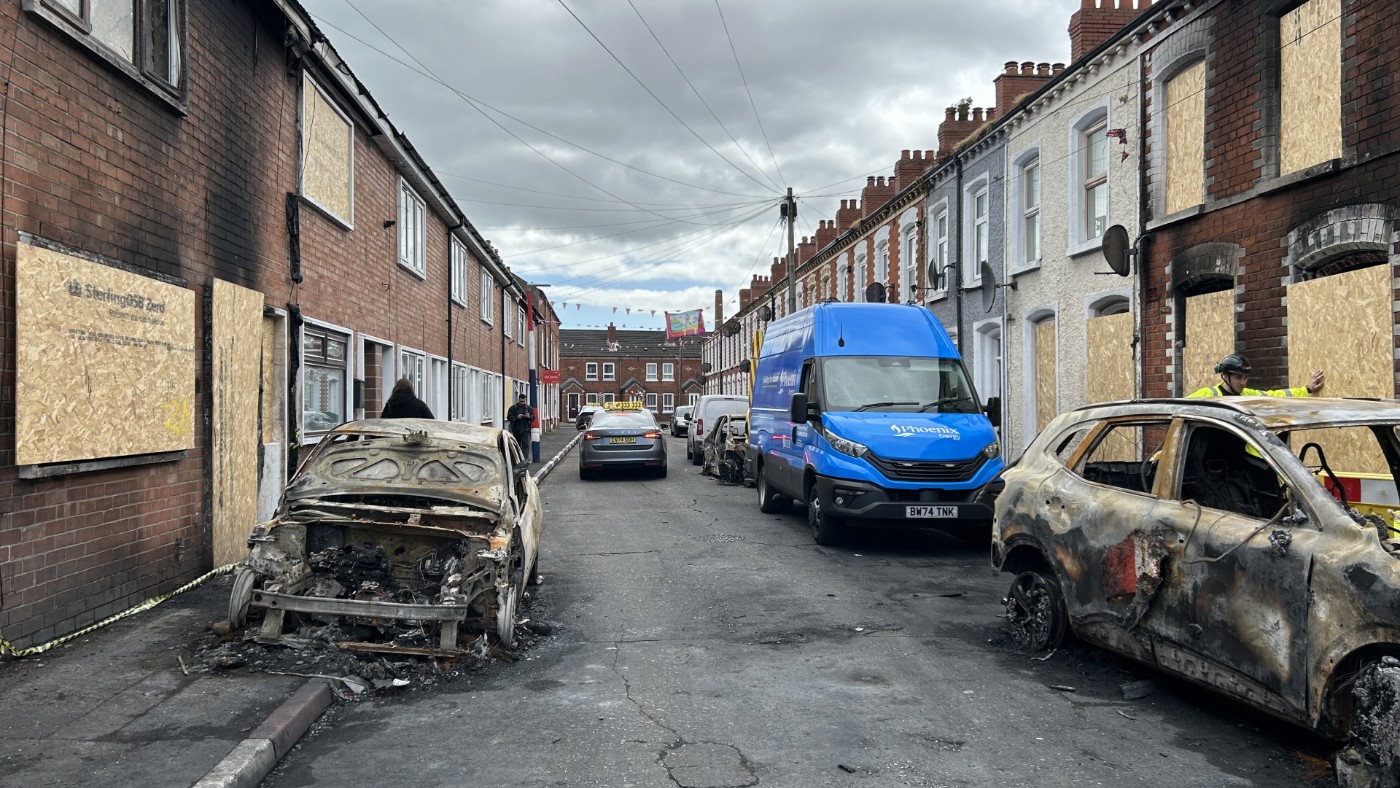
In the residential streets branching off east Belfast’s Newtownards Road, the aftermath of last week’s brutal sectarian-tinged riots hangs heavy. Charred, boarded-up house facades line the road, burned-out car shells sit abandoned at curbsides, and the acrid scent of ash still lingers in the air. What began with the stabbing of local man Stephen Ogilvie quickly exploded into coordinated violence targeting migrant and immigrant communities, leaving dozens of families displaced and a city already grappling with historic divisions confronting a fresh wave of racial hatred.
The violence unfolded almost exclusively in loyalist Protestant working-class areas, where pro-British paramilitary groups that first formed during Northern Ireland’s 30-year Troubles have maintained a persistent, though altered, presence decades after the 1998 Good Friday Agreement ended large-scale conflict. Investigations and local testimonies reveal the riot was not a spontaneous outburst, but a coordinated action: rioters were instructed to wear black, cover their faces, disable doorbell surveillance, and avoid carrying personal phones that could identify them. Migrants’ home addresses were circulated across social media platforms and encrypted WhatsApp groups, forcing many minority families to send their children to stay with white neighbors for safety.
Among those who lost their homes to arson were a Ukrainian woman who fled Russia’s full-scale invasion of her country, a Polish family, and a Romanian family. The Sudanese man charged with the attempted murder of Ogilvie has been identified as Hadi Alodid, but a subsequent Belfast Telegraph investigation has exposed a stark hypocrisy at the heart of the rioters’ justification: Ogilvie himself was a longtime target of loyalist paramilitaries linked to the Ulster Volunteer Force (UVF) and the notorious Shankill Butchers unit, who had tortured him repeatedly and forced him out of Northern Ireland years before the stabbing. Ogilvie’s family has publicly expressed disgust that his attack was exploited to justify racist violence.
While the stabbing served as the immediate trigger, campaigners, academics and local residents who spoke to Middle East Eye say this wave of violence was the predictable outcome of years of growing far-right extremism, anti-immigrant disinformation, and the merging of historic paramilitary networks with modern far-right ideology. Unlike the Troubles, when intercommunal violence targeted Catholic communities, this new wave of violence has reoriented old sectarian hatred toward foreign-born residents.
Multiple actors have been linked to enabling and emboldening the unrest, mirroring a pattern seen in recent racist riots across mainland Britain from Southampton to Southport. Far-right agitator Tommy Robinson, whose legal bills are currently covered by X owner Elon Musk, shared details of planned demonstrations within days of the stabbing, framing the incident as “yet another invader attack on our people.” Musk, the world’s first trillionaire, reposted the call to action on his own platform with the caption: “Only by protesting REPEATEDLY and LOUDLY will there be any change!” The post came just weeks after Robinson met Musk’s father in a luxury Moscow hotel.
Mainstream far-right political figures have also amplified rhetoric that local activists say laid the groundwork for violence. Traditional Unionist Voice MP Jim Allister decried what he called “an importation of an alien culture that thinks it is appropriate to behead someone within the United Kingdom,” while Reform UK leader Nigel Farage warned that “if there is no urgent action taken to remove discriminatory and dangerous anti-White policies, we will see another Belfast.” Critics point out that this rhetoric of collective blame stands in stark contrast to the silence from these same figures when 30 women were violently killed across Northern Ireland over four years ending in 2024 – a case where the vast majority of attackers were white.
Data underscores how unfounded many of the anti-immigrant claims circulating in Belfast are. Northern Ireland is over 96 percent white, a higher proportion than England, Wales or Scotland, and hosts just one percent of all asylum seekers housed in UK hotels. Still, systemic failures have created a vacuum that disinformation has rushed to fill. Luqman Saeed, a Pakistan-born lecturer at Ulster University, notes that most working-class loyalist residents have little daily interaction with immigrants, so their perceptions are shaped almost entirely by skewed media coverage that only highlights immigrants in the context of crime or asylum claims. Few are aware that temporary migrants pay a mandatory health surcharge to access the NHS, or that many work in critical frontline health and social care roles across the region.
For Saeed, who has lived in Belfast since 2022 and raises children born there who attend local schools, the rise in racism has been tangible and worrying. “Things are definitely worse now,” he says. “That sense of security has faded away. It’s hard to know how to re-establish it. There is a co-ordinated, systematic campaign in the media to demonise immigrants.”
Official bodies have previously warned of the link between persistent paramilitary structures and rising racist violence. In December 2025, the Independent Reporting Commission – a joint UK-Irish body created to monitor post-Good Friday Agreement disarmament – found that “the intimidation, coercive control, and threats linked to paramilitary groups persist, and the structures of paramilitary groups that continue intact can be used to facilitate organised crime and other forms of violence.” The commission specifically noted that “a particularly serious manifestation of that reality over the last two years has been the link between paramilitarism and racist violence connected to the issue of immigration.”
Amnesty UK’s head of nations and regions Patrick Corrigan says paramilitary involvement is the unique factor that distinguishes Belfast’s current unrest from far-right violence elsewhere in the UK. “Paramilitaries are the element that exists here but nowhere else. It is clear they have been involved in racist violence,” Corrigan says. Local residents also note that paramilitary-linked organised crime groups stand to profit from the unrest, exploiting social division for their own gain.
Not all local loyalist leaders agree that paramilitary groups centrally controlled the riots. Mervyn Gibson, grand secretary of the Protestant Orange Order and a Presbyterian minister who has negotiated with paramilitaries for decades, acknowledges that individual members took part, but argues the violence was not formally directed by paramilitary leadership. He describes much of the unrest as “recreational rioting” where teenagers and young men were drawn to the chaos for an adrenaline rush, directed by older men with ties to fringe fascist groups as much as traditional paramilitarism.
Gibson also points to long-simmering grievances in working-class loyalist communities that have created fertile ground for division. He notes that the UK government often places migrant and asylum-seeking families in working-class neighbourhoods without any advance consultation or explanation to existing residents, leaving a information gap that disinformation fills. Systemic housing failures also exacerbate tension: Northern Ireland has more than 20,000 vacant homes, but more than 50,000 people remain on social housing waiting lists. Local residents report that private landlords routinely rent properties to migrant families because the government pays a premium rate, feeding a perception that existing residents’ housing needs are being sidelined.
Community organiser Conol Matthews says these economic and social grievances are deliberately diverted toward immigrants instead of the political leadership that created the housing crisis. His approach when working with local residents is to redirect anger toward “the boys in suits” in government who have failed working-class communities on all sides of the historic divide. Still, he acknowledges the weight of Belfast’s violent history, noting: “Realistically, what this place is always teetering on the edge of is war.”
Kashif Akram, an executive committee member at the Belfast Islamic Centre, echoes calls for systemic change to reverse rising hatred. “The government needs to educate them. The importance of migrants needs to be understood. Why are people not being educated about this?” he asks. He notes that for paramilitaries, little has changed except the target of their violence: “it looks like the same individuals and same leaders. The target has changed but the ideology is the same. The violence is directed not at Catholics but people of colour.”
Despite the wave of violence, many Belfast residents remain optimistic that unity can push back against hatred. Over the weekend following the riots, thousands of people from across all communities took to the streets of central Belfast for an anti-racism march. Akram, a lifelong Belfast resident, puts it simply: “There’s more decent people than racists. We can stop it, but all communities need to come together.”