Global equity markets traded mixed on Wednesday, with benchmark oil prices holding below the $80 per barrel threshold, as market participants closely monitor developments around a tentative U.S.-Iran interim agreement to end their ongoing conflict and prepare for a highly anticipated interest rate decision from the U.S. Federal Reserve.
In early European trading session, regional benchmarks displayed divergent performance. Britain’s FTSE 100 slipped 0.2% to settle at 10,471.84, pulled down after official inflation data revealed U.K. consumer price growth held steady at 2.8% in May despite rising fuel costs. Germany’s DAX index retreated 0.3% to 24,829.58, while France’s CAC 40 bucked the downward regional trend to climb 0.2% to 8,465.32.
Across the Asia-Pacific, most major stock indices closed higher, with Japan and South Korea notching fresh all-time record highs. Tokyo’s Nikkei 225 rose 0.7% to end the session at 69,902.25, after hitting an intraday peak of 70,125.75. The rally was fueled by stronger-than-expected trade data showing Japanese exports surged 17% year-over-year in May, driven largely by robust global demand for the country’s high-tech manufactured goods.
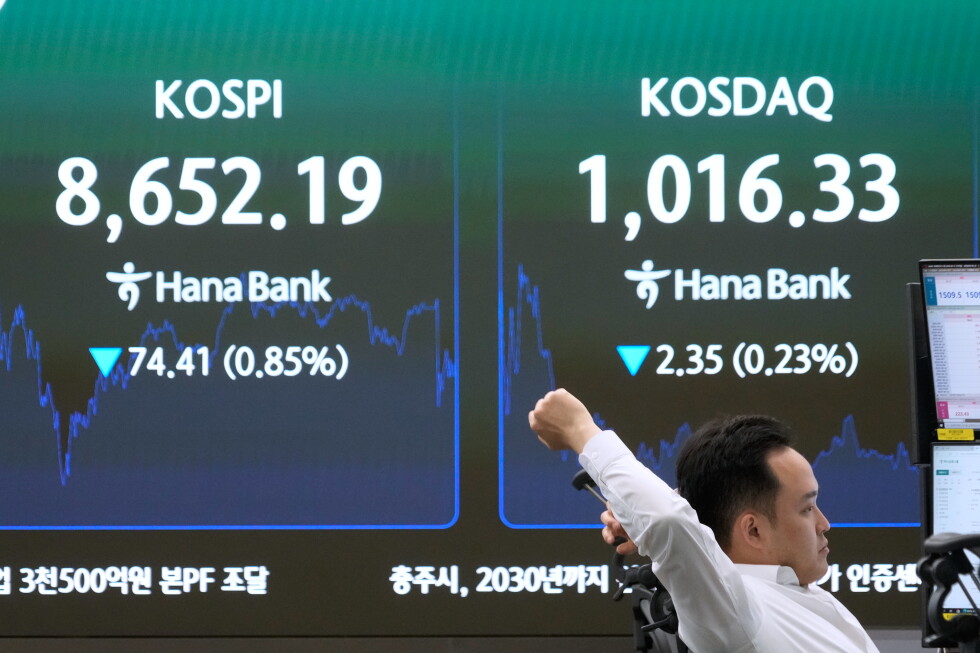
South Korea’s benchmark Kospi index gained 1.6% to close at 8,864.24, also marking a new record closing high. Large-cap technology and semiconductor stocks led the upward move, even as AI-related equities faced a broad sell-off on U.S. markets a day earlier. Samsung Electronics, South Korea’s most valuable public company, added 1% to its value, while top memory chipmaker SK Hynix jumped 5.8%. Hong Kong’s Hang Seng Index fell 0.7% to 24,312.16, while mainland China’s Shanghai Composite Index rose 0.4% to 4,108.08. Other regional indices also posted modest gains: Australia’s S&P/ASX 200 climbed 0.5% to 8,966.30, Taiwan’s Taiex added 0.2%, and India’s Sensex gained 0.3%.
Global oil markets stabilized on Wednesday after a sharp sell-off the previous session, as optimism over a potential end to the U.S.-Iran conflict and the reopening of the Strait of Hormuz — a critical chokepoint that handles a large share of global oil and gas trade — pulled prices sharply lower. Uncertainty remains over key terms of the tentative deal, however, including whether it requires Israel’s full withdrawal from Lebanon. Brent crude, the global benchmark for oil pricing, edged 0.1% higher to $79.05 per barrel early Wednesday, after tumbling more than 5% in the previous session. Even with the drop, the price remains above the roughly $70 per barrel level seen in late February, before the conflict began. U.S. benchmark crude traded nearly unchanged at $76.02 per barrel.
HSBC economists noted in a recent research note that returning global oil supply flows to pre-conflict norms will take months to achieve, citing multiple significant hurdles including mine clearance in shipping lanes, reinstatement of commercial insurance coverage for oil cargos, drawing down excess stored crude in Gulf storage facilities, repositioning of global oil tanker fleets, and restarting idled oil production fields.
Later Wednesday, the Federal Reserve is set to conclude its two-day monetary policy meeting, the first gathering led by new Fed Chair Kevin Warsh. Market analysts broadly expect the central bank to hold its benchmark interest rate steady, despite repeated pressure from former U.S. President Donald Trump to push through rate cuts. Persistent inflation concerns tied to energy price volatility from the Iran conflict have reinforced the Fed’s cautious stance, as lower interest rates could further stoke upward pressure on consumer prices.
Preston Caldwell, chief U.S. economist at Morningstar, argued in a recent commentary that underlying economic conditions point to slowing inflation once energy market shocks fade. “With weak wage growth and rent growth, underlying forces are pointing to inflation falling sharply once the energy price shock recedes. We don’t expect the Fed to hike rates in 2026,” Caldwell wrote, adding that his team forecasts the Fed will begin cutting rates again in 2027.
In currency markets, the U.S. dollar weakened slightly against the Japanese yen, dipping to 160.15 yen early Wednesday from 160.42 yen in the prior session. The euro also edged lower, trading at $1.1601, down fractionally from $1.1608.
On Tuesday, U.S. equity markets also posted mixed results. The benchmark S&P 500 fell 0.6%, while the Dow Jones Industrial Average gained 0.6% to hit a new all-time high. The technology-focused Nasdaq Composite dropped 1.2% to 26,376.34, dragged down by losses across large technology stocks fueled by renewed investor concerns over a potential valuation bubble in AI-related equities. Chip giant Nvidia fell 2.4%, Broadcom dropped 4.4%, and memory chipmaker Micron Technology lost 6.2%. Against the broader tech sell-off, Elon Musk’s SpaceX gained 4.8% to extend its winning streak to three consecutive trading days following its recent public debut on Wall Street. Restaurant conglomerate Yum Brands rose 1.9% after announcing it would sell its Pizza Hut brand to U.S. private equity firm LongRange Capital for $2.7 billion.