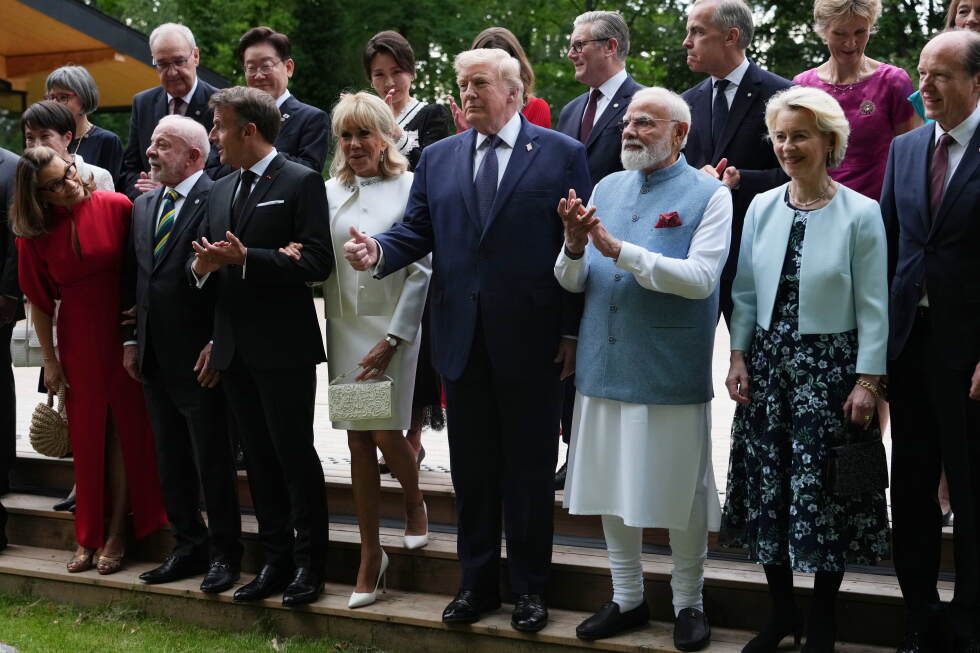
EVIAN-LES-BAINS, France — On Wednesday, U.S. President Donald Trump concluded formal working sessions of the Group of Seven summit at the scenic Alpine lakeside resort, capping off days of diplomatic talks dominated by his push to win global backing for a still-unseen tentative nuclear agreement with Iran. Even as allied leaders and domestic stakeholders openly question the pact’s lack of detail, Trump has framed the unsigned deal as a historic breakthrough that will permanently block Iran from developing or acquiring a nuclear weapon.
The G7 gathering of the world’s leading industrialized nations wrapped up its formal agenda with focused discussions on two pressing global priorities: the long-term governance of artificial intelligence and strategies to stimulate sustained inclusive economic growth across major economies. Before departing for Washington D.C., Trump is set to attend a lavish one-on-one dinner hosted by French President Emmanuel Macron at the Palace of Versailles outside Paris, an honor marking the upcoming 250th anniversary of American independence that Trump has openly welcomed.
The core controversy overshadowing Trump’s final summit day remains the Iran deal. Neither the White House nor Iranian officials have publicly released the full text of the agreement, which is scheduled for a formal signing ceremony this Friday at a luxury resort on Switzerland’s Lake Lucerne. Despite the lack of transparency, Trump lauded the still-unpublished memorandum to reporters, saying “It’s a great document. Here’s what it says: Iran will never have a nuclear weapon. It won’t have one to buy, to develop — it will not have a nuclear weapon. And I would say that’s about 99.9% of what I wanted.”
Skepticism runs deep on multiple fronts. Key U.S. ally Israel has openly expressed unease over the terms of the agreement, while Republican lawmakers in Trump’s own party have raised doubts that the deal goes far enough to curb Iran’s nuclear ambitions. The international community is also waiting for concrete proof that the pact will deliver on a critical secondary promise: reopening and permanently securing the Strait of Hormuz, the vital maritime chokepoint that Iran has effectively closed to commercial oil traffic since the outbreak of the recent conflict. Before the war, roughly 20% of the world’s traded oil and natural gas passed through the strait.
Complicating the agreement further, U.S. and Iranian officials have publicly offered conflicting interpretations of the deal’s terms. Iranian Foreign Minister Abbas Araghchi has stated that Israel’s ongoing military presence in southern Lebanon, where Israeli forces have been targeting Iran-backed Hezbollah militants, would count as a violation of the pact. “Without the withdrawal of Israeli forces from the territories they occupied during this war, the war has not fully come to an end,” Araghchi said. For his part, Trump acknowledged Tuesday that an Israeli strike on Hezbollah would not automatically derail the deal, but criticized Israel’s prolonged military campaign, noting “Israel’s fighting Hezbollah too long, and too many people are being killed.” Israeli strikes in Lebanon have killed nearly 4,000 people, hundreds of whom are civilians, and forced more than 1 million people to flee their homes since March 2.
Beyond the Iran nuclear debate, Trump scheduled a series of key bilateral meetings on his final G7 day, including a sit-down with Indian Prime Minister Narendra Modi that comes at a fraught moment for U.S.-India ties. Tensions have risen in recent weeks after three Indian sailors were killed in a U.S. military strike on a commercial tanker in the Gulf of Oman, carried out as part of Washington’s blockade of Iranian oil shipments. New Delhi has formally protested the incident, and relations have already been complicated by Trump’s back-and-forth tariffs on Indian goods over India’s continued purchases of discounted Russian oil, as well as Indian concerns that Trump’s recent trade truce negotiations with China could weaken India’s position as a rival manufacturing hub. The two leaders enjoyed a close relationship during Trump’s first term in office, but the dynamic has shifted significantly since his return to the White House.
Trump also planned to hold one-on-one talks with Egyptian President Abdel-Fattah el-Sissi, one of three Middle Eastern leaders invited to the summit by host Macron. On Tuesday, G7 leaders held a working lunch with el-Sissi, Qatar’s ruling emir, and the president of the United Arab Emirates focused on developing alternative energy supply routes that bypass the Strait of Hormuz. French Foreign Ministry spokesperson Pascal Confavreux explained that discussions centered on planning and financing overland infrastructure to redirect Gulf energy exports away from the closed chokepoint.
For Trump, the high-profile Versailles dinner is a particularly anticipated stop. The U.S. president openly shared his excitement for the event, saying that the opulent historic venue, the former royal residence of French kings from Louis XIV to Louis XVI, was enough to convince him to extend his post-summit stay in France. “I’m a fan of beautiful places, and I was leaving in the afternoon, and then the French president who happens to be a very nice man, invited me to dinner at Versailles,” Trump said. “And Versailles is not gold leaf — Versailles is the real deal. And I said I’d like to do it.”
The reporting was contributed by AP correspondents based in Evian-les-Bains, Geneva and Washington, with original reporting from Madhani in Geneva.