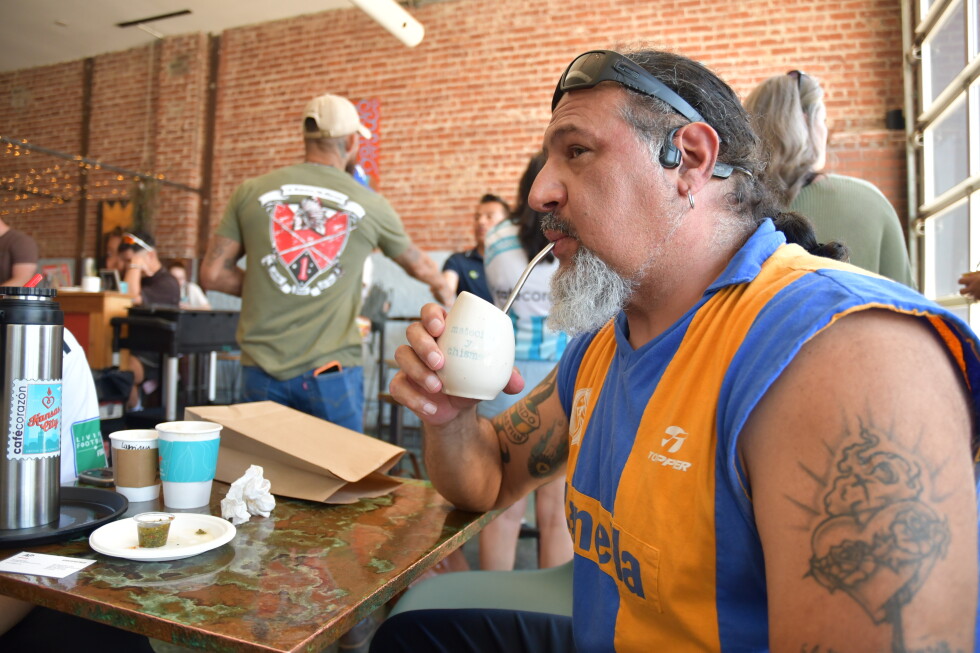
As the FIFA World Cup kicks off matches in Kansas City, Missouri, soccer fans from across the globe have brought more than just team flags, jerseys, and chants to their matchday celebrations – they’ve brought a centuries-old cultural tradition: yerba mate. The caffeinated South American staple, long embedded in the daily life of countries like Argentina, Uruguay, Paraguay, and southern Brazil, has ridden soccer’s multicultural wave to grow in popularity across the United States, even becoming a go-to beverage for top professional athletes both on and off the pitch.
When the reigning World Cup champions from Argentina arrived at their Kansas City hotel ahead of their opening group stage match, hundreds of fans gathered outside, passing around traditional hollowed gourd cups fitted with metal bombilla straws – the signature tool that filters the steeped yerba leaves while sipping. Just blocks away, at Cafe Corazon, one of the Midwest’s largest yerba mate importers, a line of fans clad in Argentina’s iconic sky-blue and white striped jerseys stretched out the door on the eve of the team’s first 2026 World Cup match.
“Our mate has been flying off the shelves,” shared Dulcinea Herrera, co-owner of the local cafe. “So many new people are coming in to try it. Non-Argentinian visitors want to experience the tradition for themselves, while Argentinian expats tell us sipping here reminds them of home.”
The drink’s connection to elite world soccer is no secret, with many of the sport’s biggest names counting themselves as lifelong fans. Uruguay’s Luis Suarez is known to be an avid drinker, and Argentina’s Lionel Messi cemented the beverage’s place in sports pop culture after the 2022 World Cup final, when he shared a photo of himself holding the World Cup trophy in one hand and a traditional mate gourd in the other.
Yerba mate has a rich history stretching back centuries, originating with Indigenous communities in South America before being adopted by the region’s iconic gaucho cowboys, explains Christine Folch, a Duke University cultural anthropologist and author of *The Book of Yerba Mate*. Today, it has been adapted across the globe, with different cultures putting their own unique spin on preparation and serving. Regional preparation customs even act as cultural identifiers when fans gather for matches, with drinkers from different South American nations preferring distinct vessels and brewing methods. Folch herself maintains an extensive collection of mate vessels, including pieces crafted from cow hooves and horns, hand-stitched leather-wrapped metal cups, and traditional hollowed gourds.
The drink’s global spread took an early turn in the 20th century, when it gained widespread popularity in Syria and Lebanon – a history that explains why traditional dried yerba mate leaves have long been available at Middle Eastern grocery stores across the United States, Folch notes. For mainstream American consumers, yerba mate is most often sold in refrigerated canned form, marketed as a natural energy drink infused with fruit flavors. Cuban American communities have developed their own sweetened, carbonated version of the beverage, while in Berlin, the carbonated brand Club Mate is a popular mixer for alcoholic drinks.
Unlike coffee, which often leaves drinkers feeling jittery from high caffeine concentrations, traditional yerba mate carries a mild smoky note from its traditional leaf-smoked preparation, with an earthy, grassy flavor profile that delivers steady energy without the unpleasant crash. For first-time buyers, Folch adds, the correct pronunciation is “MAH-teh” – not the English word for a soccer teammate.
Beyond its caffeine boost and unique flavor, yerba mate is fundamentally a social beverage, making it a perfect fit for large sporting gatherings. By longstanding tradition, drinkers share a single cup among a group, passing it around to build connection. “When somebody offers you mate and you accept, you’ve stepped into a relationship,” Folch explained. “It’s a way of bonding with people.”
That social tradition played out in full at Cafe Corazon this June, as traveling fans connected over shared cups of mate ahead of the match. Sebastian Cufre and his father Rene, a native Argentinian who now lives in Albuquerque, drove cross-country to Kansas City in search of last-minute match tickets, and ended up bonding with fellow Argentina fans over a round of mate at the cafe. “It’s something you always pass around during games,” Rene Cufre said. Though he’s seen the mass-market canned American version of the drink, he is not a fan: “Honestly, I don’t even consider that to be mate. That’s a completely different type of beverage.”
No matter the preparation style, mate fans across Kansas City are encouraging North American fans to give the traditional drink a try when it’s passed around at cafes, watch parties, or stadium concourses. For many, it is far more than a drink to boost matchday energy – it is a way to connect across boundaries. “It’s not only a drink, but a social thing,” said Fernando Villagran, an Argentinian fan who traveled from California to support his national team. “It is about friendship.”