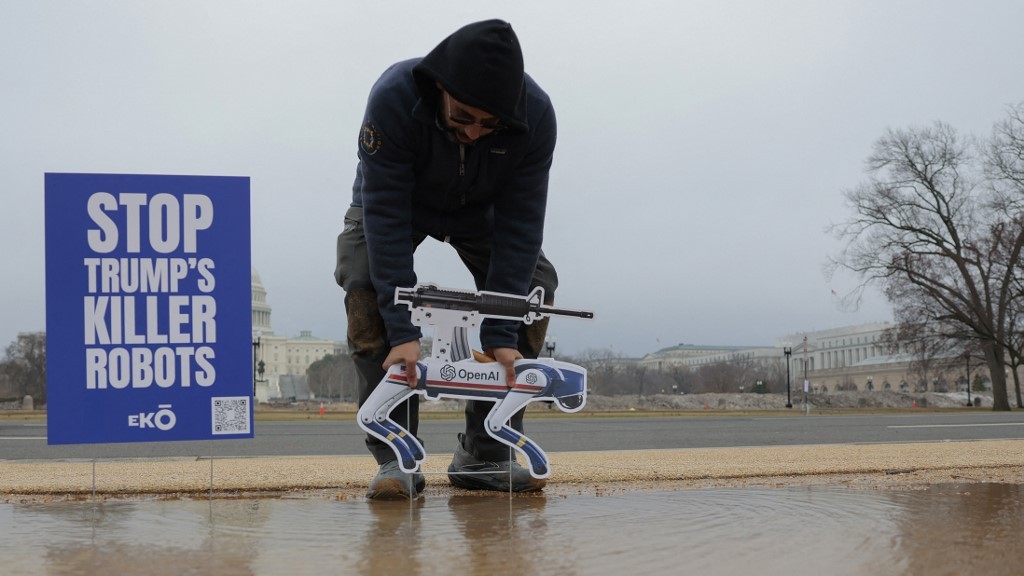
A broad coalition of more than 100 global human rights organizations and technology activists has issued an urgent warning about the accelerating integration of artificial intelligence into military operations, pointing to Israel’s military campaign in Gaza as a catastrophic and dangerous precedent for the future of warfare. The joint statement, signed by prominent groups including Amnesty International, Access Now and the Stop Killer Robots Campaign, warns that expanding AI’s role in end-to-end military kill chains carries severe risks of escalating civilian casualties and eroding mechanisms for holding perpetrators of violence accountable for human rights violations.
The coalition specifically highlights the widespread deployment of AI-powered targeting systems by the Israeli military during its ongoing operations in Gaza, where more than 73,000 Palestinians have been confirmed killed, with thousands more still trapped and presumed dead beneath the rubble of destroyed residential and infrastructure sites. Three AI tools in particular — named Lavender, Gospel, and Where’s Daddy — have been leveraged to generate air strike targeting lists, drawing on massive Israeli mass surveillance datasets collected on Palestinian residents of Gaza. Rights groups argue that this AI-driven targeting process, which selects targets with little to no active human oversight, is a key contributing factor to the unprecedented scale of death and displacement in the territory.
“The adoption of AI targeting systems in this campaign follows the example of the Israeli government’s weaponisation of data analysis and machine learning tools, powered by mass surveillance, in its genocidal attacks on Gaza,” the statement reads. “By diluting human responsibility for life-and-death decisions, Israel’s use of systems such as Lavender, Gospel, and Where’s Daddy may contribute to the obfuscation of international crimes behind a veneer of perceived algorithmic objectivity while also obfuscating accountability.”
The coalition has issued a clear call to action for global technology companies to immediately end all provision of AI and related technical support to the Israeli military and other state armed forces, warning that unregulated deployment risks normalizing and accelerating the proliferation of AI-powered tools of war. In recent years, many of the world’s largest technology firms have deepened their institutional ties to military establishments, particularly the U.S. Department of Defense (DoD). OpenAI has publicly confirmed it provides AI services to the DoD, while Google holds a DoD contract to “develop prototype frontier AI capabilities to address critical national security challenges across warfighting and enterprise domains.” Microsoft, Google, and Amazon have also all secured contracts to provide cloud data storage, processing capacity, and other core enterprise infrastructure to support the DoD’s warfighting programs.
These corporate military partnerships have triggered significant internal backlash from technology workers, who fear they are being forced to participate in projects that enable human rights abuses. Last month, hundreds of employees at Google DeepMind’s UK artificial intelligence division voted overwhelmingly to unionize, driven by growing concerns over the company’s technology being used by the U.S. for military action against Iran and by Israel against Palestinians in Gaza. UK-based DeepMind staff formally requested that Google management recognize the Communication Workers Union (CWU) and Unite the Union as their official workplace representatives, a move organizers say marks the first unionization drive at a major global frontier AI research lab. In the internal vote among CWU members at DeepMind, 98 percent of participants supported the unionization push. Beyond union representation, DeepMind workers are demanding an end to the use of Google AI by Israel and the U.S. military, the restoration of a previously scrapped corporate commitment not to develop AI-powered weapons or surveillance tools, the creation of an independent ethics oversight body to review high-risk projects, and formal legal protection for workers who refuse to participate in projects on moral grounds.