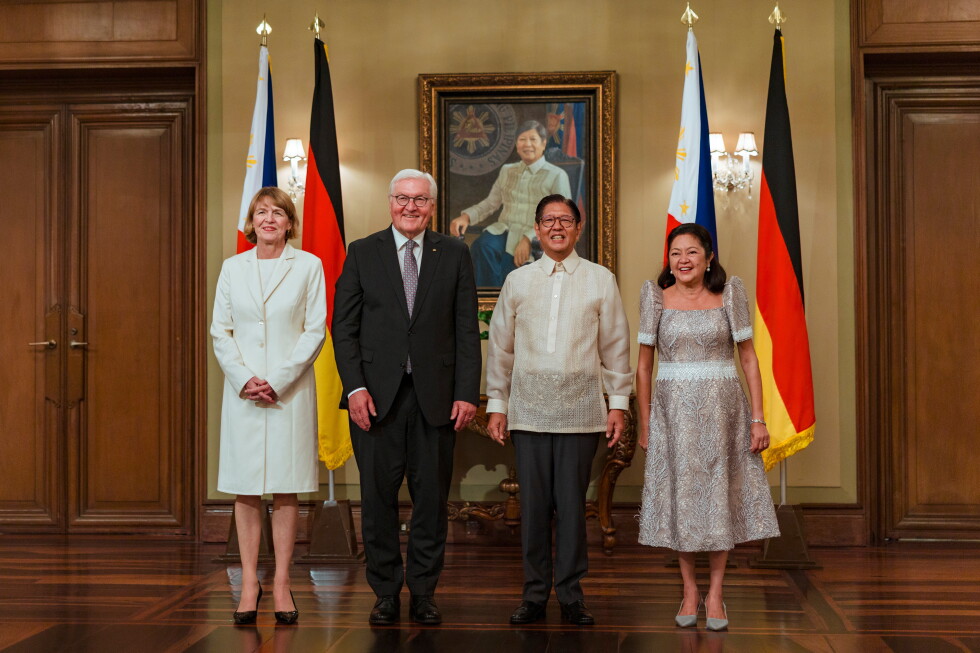
During an official state visit to the Philippines on Tuesday, German President Frank-Walter Steinmeier has publicly articulated Europe’s deep anxiety over rising frictions in the disputed South China Sea, warning that a major escalation in the critical waterway could threaten global freedom of navigation, echoing disruptive disruptions seen in the Strait of Hormuz.
Speaking alongside Philippine President Ferdinand Marcos Jr. at a joint press briefing in Manila, Steinmeier drew a parallel between the South China Sea situation and past blockades of the Strait of Hormuz amid the Iran conflict, noting that European leaders are particularly focused on ongoing territorial standoffs between Manila and Beijing. He emphasized that the Indo-Pacific, and Southeast Asia in particular, stands as one of the most economically dynamic regions on the planet, making any instability here a pressing concern for European economies and security.
“If any disruptive incident occurs in that part of the world, it will trigger profound alarm across Europe,” Steinmeier stated, speaking through a professional interpreter. “Breaches of international maritime law endanger unimpeded navigation, a lesson the recent Hormuz blockade drove home to us in the most dramatic way possible.”
The closed-door bilateral meeting between the two leaders covered multiple topics of mutual concern, including the fallout of potential Strait of Hormuz disruptions, which have previously driven sharp global spikes in fuel and fertilizer prices.
While Steinmeier stopped short of directly naming any single party as responsible for the ongoing South China Sea tensions, Germany’s long-held position reaffirms that China’s activities in the disputed waters violate the sovereign and economic rights of coastal states including the Philippines, while jeopardizing open navigation for all countries. This stance aligns with comments made by then-German Foreign Minister Annalena Baerbock during her 2024 visit to Manila, when she highlighted that high-risk maneuvers by Chinese vessels that have led to minor collisions with Philippine craft threaten the economic development prospects of the Philippines and other regional coastal states. Baerbock also explicitly stated that China’s expansive territorial claims in the South China Sea have no basis under international law, and called for a peaceful negotiated resolution to the disputes. During that 2024 visit, Baerbock toured the Philippine Coast Guard headquarters and inspected a German-donated surveillance drone aboard a Philippine patrol vessel.
On his visit, Steinmeier doubled down on Germany’s commitment to supporting the Philippine Coast Guard, which has operated as Manila’s front-line agency safeguarding the country’s territorial claims and has been involved in multiple direct encounters with Chinese maritime forces in the disputed waters.
In his response, Marcos expressed his gratitude to Germany for its consistent public backing of the Philippines’ efforts to uphold the rule of law in the South China Sea, including its repeated calls for all parties to honor the 2016 binding South China Sea Arbitral Award. The 2016 ruling, issued under the framework of the 1982 United Nations Convention on the Law of the Sea, formally invalidated China’s sweeping historic claims to nearly the entire South China Sea. Beijing refused to participate in the arbitration process initiated by Manila, has rejected the ruling outright, and continues to disregard its provisions.
The South China Sea dispute involves multiple claimant parties beyond China and the Philippines: Vietnam, Malaysia, Brunei, and Taiwan also hold overlapping territorial and maritime claims in the region. The United States, which maintains no territorial claims of its own in the waterway, has repeatedly reaffirmed its mutual defense treaty obligation to the Philippines — its longest-standing Asian ally — stating it will come to the Philippines’ defense if Philippine forces, vessels, or aircraft come under armed attack. China has consistently issued warnings opposing any U.S. intervention in the regional disputes.