LONDON – In a landmark ruling that has ignited fierce debate over the balance between national security and civil liberties in the United Kingdom, the London Court of Appeal confirmed on Monday that the British government acted within legal bounds when it designated protest group Palestine Action as an official terrorist organization.
Leading the panel of judges, Chief Justice Sue Carr rejected the group’s core framing of itself as a legitimate civil disobedience movement focused on political advocacy. Instead, Carr emphasized that Palestine Action operates through a network of secretive, decentralized cells, which have targeted and destroyed property belonging to UK defense contractors and on British military installations.
“To describe Palestine Action as a non-violent movement is not a defensible claim,” Carr wrote in the court’s judgment. “That core premise of the group’s argument is fundamentally and irreparably flawed.”
Monday’s ruling reverses an earlier February decision issued by three senior High Court justices. In that initial ruling, judges acknowledged that the group had engaged in criminal activity to advance its political goals, but concluded the scope of those actions did not meet the threshold required for a full proscription as a terrorist organization. The government’s ban on the group remained in effect throughout the appeals process, pending the court’s final decision.
In response to the ruling, Palestine Action co-founder Huda Ammori said the group would continue its legal challenge to the ban “all the way” to the UK Supreme Court, and if needed, to the European Court of Human Rights. Ammori called the proscription “one of the most extreme attacks on free speech and the right to protest in modern British history.”
The British government first moved to outlaw the group in 2025, after activists breached security at a Royal Air Force base in June of that year to protest the UK’s ongoing military support for Israel’s military campaign against Hamas in Gaza. The Gaza offensive has killed more than 45,000 Palestinians, according to Gaza health authorities, and that base break-in followed a string of earlier vandalism incidents carried out by the group across the UK.
Under the terms of the proscription, Palestine Action is now listed alongside designated terrorist groups including al-Qaida and Hamas. Membership in the group, or even public support for it, is a criminal offense punishable by a maximum 14-year prison sentence.
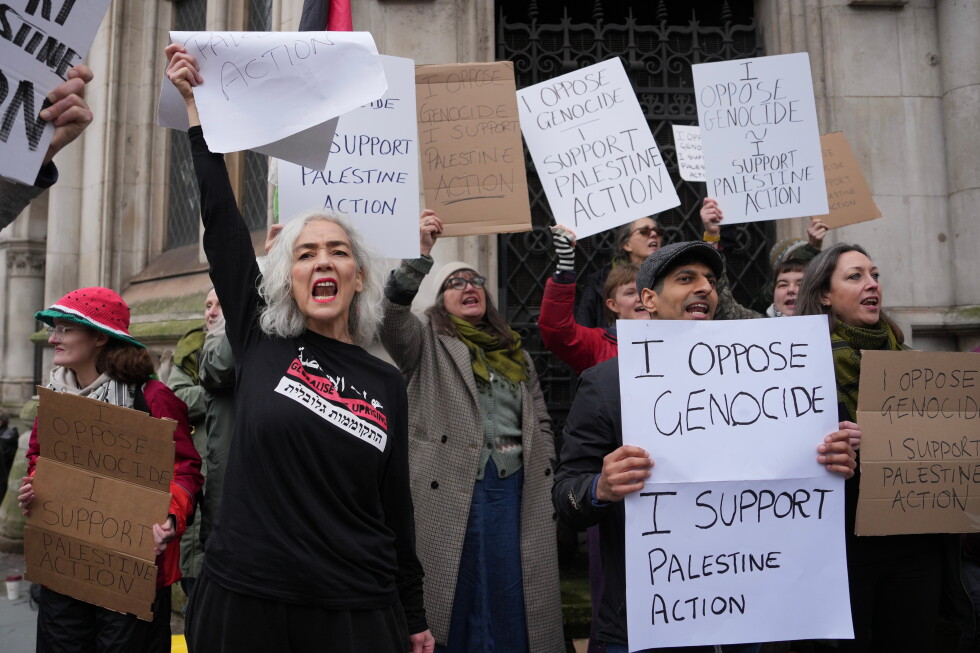
Already, law enforcement data shows more than 3,300 people have been arrested at protests across the UK simply for holding signs that read “I oppose genocide. I support Palestine Action.” More than 700 of those individuals have been formally charged under the UK’s Terrorism Act, though none have yet been convicted of any offense related to those charges.
Civil liberties advocates and supporters of Palestine Action warn that the widespread arrests of peaceful demonstrators represent a clear violation of long-standing rights to free expression and peaceful protest in the UK. The grassroots group Defend Our Juries issued a statement warning that the Court of Appeal’s ruling will lead to even more misallocation of police resources, wasting public funds on locking up ordinary people engaged in peaceful political advocacy. “It appears the courts have been instrumentalized to suppress opposition to genocide, when they should be doing the precise opposite,” the group said.
Founded in 2020, Palestine Action has organized hundreds of direct action protests at military and defense industry sites across the UK, including repeated break-ins at facilities owned by Elbit Systems UK, an Israeli-owned arms manufacturer. UK government officials estimate the group’s actions have caused millions of British pounds in property damage, and argue that the disruptions pose tangible risks to UK national security.
Even in its earlier February ruling, the High Court acknowledged that some of the group’s acts met the legal definition of terrorist activity, but judges held that those individual acts could be prosecuted through standard criminal law without needing to ban the entire organization.
Just days before Monday’s appeal ruling, four Palestine Action members who broke into an Elbit Systems factory in Bristol, southwest England, in 2024 and damaged manufacturing equipment were sentenced to prison after a judge ruled their actions qualified as terrorist activity. More than 100 Palestine Action supporters were arrested outside the London court holding the sentencing hearing for holding a peaceful demonstration in solidarity with the activists.