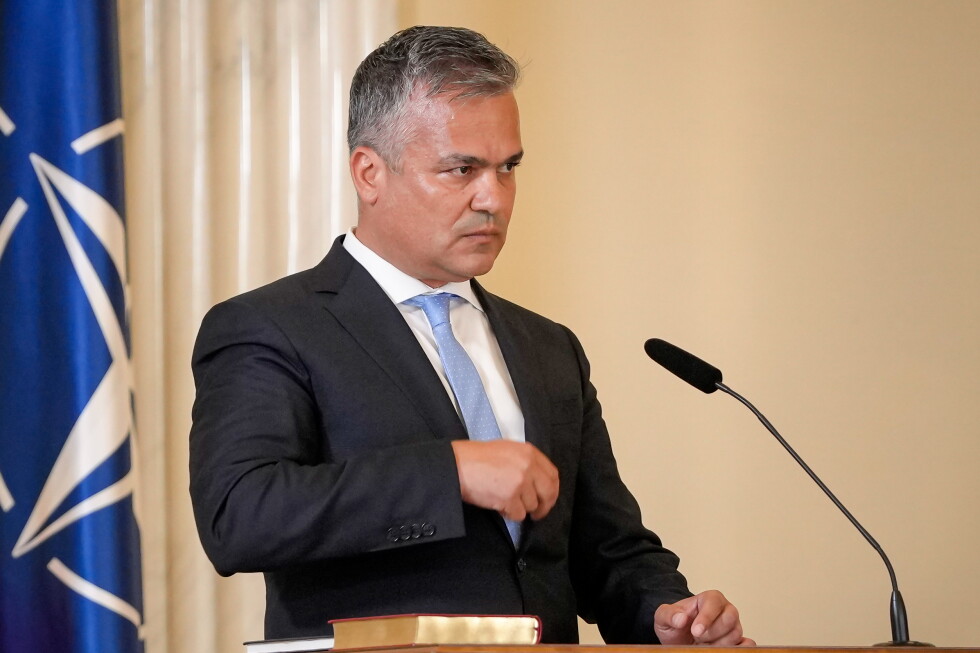
BUCHAREST, Romania — A fresh chapter in Romania’s ongoing political turbulence has opened after President Nicusor Dan announced a new prime ministerial nominee on Sunday, turning to seasoned pro-Western politician Adrian Vestea in a bid to break the deadlock that has gripped the nation since his first pick collapsed earlier this month.
The 53-year-old Vestea, a long-standing member of the National Liberal Party with deep roots in administrative politics from central Romania’s Brasov County, is the president’s second attempt to put forward a viable head of government in just four weeks. His predecessor in the nomination process, Eugen Tomac, was forced to step back earlier Sunday after he failed to secure enough cross-party backing to put forward a full cabinet list to the Romanian Parliament within the mandatory 10-day negotiating window.
“Eugen Tomac withdrew his mandate this morning, and … I nominate Adrian Vestea as prime minister,” Dan told reporters during a formal announcement at Bucharest’s iconic Cotroceni Presidential Palace. Like all prime ministerial nominations in Romania, Vestea’s appointment will require a vote of approval from sitting lawmakers to move forward.
Dan laid out his reasoning for tapping Vestea, highlighting the nominee’s decades of hands-on experience across multiple levels of Romanian governance — a track record he argued makes Vestea uniquely suited to tackle the country’s pressing economic and political challenges. Vestea has climbed the ranks of domestic politics starting from the lowest administrative level: he served as mayor of a small local town, then went on to become president of the Brasov County Council, a role in which he successfully secured substantial European Union development funding for the region. He most recently held the post of Minister of Development between 2023 and 2024.
“He was a successful mayor, he was a successful county council president, he was a successful minister,” Dan said of Vestea. “He is a categorically pro-Western person … a person who has worked for a long time with budgets. So I am convinced that he will successfully fulfill this task.”
Speaking after the formal nomination, Vestea laid out his core priorities, saying he intends to form a unified government that delivers long-delayed structural reforms while maintaining Romania’s firm commitment to its Western alignment. “We are the sixth largest country in Europe, and we need to put a major emphasis on development,” Vestea said from the Cotroceni Palace. “Which I will do from day one.”
Sunday’s nomination marks the latest turn in a political crisis that has stretched across months. The current instability began when a parliamentary no-confidence vote ousted Prime Minister Ilie Bolojan in May, less than a year after he took office. Bolojan was originally sworn in to resolve one of the deepest political crises Romania has faced since the fall of communism in 1989, after the previous coalition government collapsed in 2025. The next scheduled general election in Romania is not set to take place until 2028, leaving a years-long gap that political leaders are scrambling to fill with a stable governing administration.
Beyond the immediate political deadlock, the next Romanian government will face urgent economic challenges: the country currently carries one of the largest budget deficits in the European Union, alongside persistent high inflation and an ongoing technical recession. When the ruling coalition took power in June 2025, cutting the ballooning deficit was its top policy priority — a goal that remains unfulfilled amid repeated government turnover.