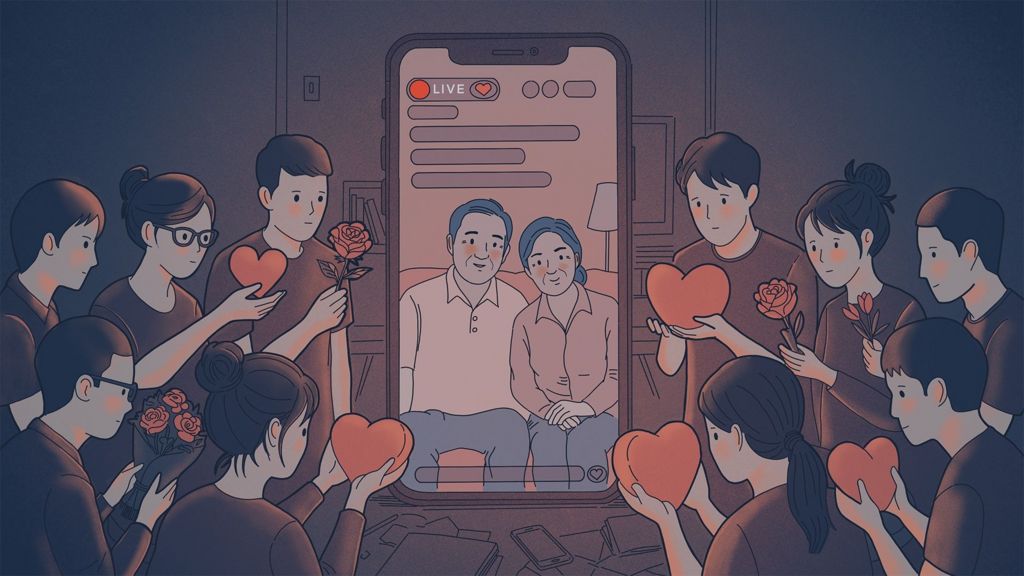
Against a backdrop of cutthroat economic competition and strained intergenerational relationships, a new niche of Chinese social media creators has captured the hearts of millions of young users: self-styled “virtual parents” who offer gentle, unconditionally supportive words to any follower who calls them mom or dad.
Among the most popular of these creators are Pan Huqian and Zhang Xiuping, a married couple who have amassed nearly 2 million followers on Douyin, China’s domestic counterpart to TikTok. In one of their most widely viewed clips, the pair leans into the camera, soft-voiced and warm: “Have you been worn out from work and school lately? Don’t push yourself too hard. Mom and Dad know you’ve already endured so much.”
For followers like 33-year-old Shanghai-based tech worker Vincent Zhang, this simple, affirming message fills a gap that his own biological parents have never managed to close. Zhang has a daily habit of pulling out his phone during mealtimes to check in on the couple’s latest updates, and like thousands of other young followers, he regularly leaves comments sharing updates on his life and requesting birthday or life blessings from them. “My real parents are never the ones to tell me not to overwork, or that I’m already good enough the way I am,” Zhang explained. “But these virtual parents always ask whether I’m happy today.”
Pan’s own life experience laid the foundation for the content he creates today. In a 2024 interview with Douyin, he opened up about his own difficult childhood that left him deeply familiar with the pain of growing up without parental encouragement. When he was just 14 years old, Pan left home to become the main breadwinner for his family after his mother was paralyzed. For 33 years living away from home, he said, his biological parents never once offered him a word of encouragement. After his daughter was born, Pan made a promise to himself to build a different, more affectionate family dynamic – a promise that eventually expanded into his virtual parent project, where his daughter even appears regularly in his and Zhang’s videos.
For many young Chinese, strained dynamics with their biological parents stem from a clash of generational experiences and unmet expectations. Today’s young people came of age amid China’s decades-long economic boom, growing up with far greater stability and prosperity than their grandparents, who survived the 1950s famine and the upheaval of the 1960s Cultural Revolution, and their parents, who came of age as China slowly emerged from those crises to open its economy to the world. But this era of growth has also brought unprecedented pressure: in recent years, particularly following the COVID-19 pandemic, a sluggish national economy has left youth unemployment stuck above 15% for years, intensifying competition for every job, every promotion, and every marker of success.
Many young people report feeling burnt out from the constant rat race, and many more carry hurt from what they describe as unforgiving “tough love” from their parents, who often hold rigid traditional expectations. For Zhang, even weekly phone calls with his parents have become a source of chronic stress: they routinely criticize his choice to work in the tech industry, pushing him to pursue a more stable government job, and badger him about when he will settle down with a partner. “From the second the call starts, every choice I’ve made is wrong, something that needs to be corrected by them,” he said.
This widespread frustration has sparked a broader public reckoning among young Chinese around unhealthy intergenerational dynamics, a conversation that resonates across cultures globally. Discussions online run the gamut from young people venting about controlling parental behavior to those exhausted by pressure to excel academically or conform to traditional expectations of filial piety. Even state media has waded into the conversation, urging young people to show more understanding for their parents’ perspectives and uphold traditional family values – a framing that many young people reject, pointing to their own unaddressed generational trauma.
“I can understand why my parents think the way they do, I know they grew up with their own hardships,” Zhang said. “But I have my own generational struggles and pain too.”
The depth of this frustration has even spawned a viral cultural meme trend called “gourd soup literature,” named after a viral one-minute skit that perfectly captures the common dynamic of dismissed young people’s autonomy. In the skit, a son politely turns down a bowl of gourd soup his mother offers him – and ends up being labeled ill-tempered and ungrateful for his boundary-setting. For 28-year-old Zhao Xuan, the meme hits so close to home that she has muted her family’s WeChat group chat to avoid the constant stream of this dynamic in her own life. Where she once spent hours lamenting to friends trying to process her parents’ behavior, she now uses “gourd soup literature” memes to process her frustration through humor. “I even went to therapy, but I gradually realized crying wouldn’t change anything,” Zhao told the BBC. “My mom isn’t going to change, so the only thing I can change is my own mindset – I just treat all of it like a joke now.”
Even followers who recognize that the “virtual parent” trend is a commercialized social media product still find genuine comfort in the small doses of warmth it offers. Zhang acknowledges that Pan and Zhang’s content is likely mass-produced under a media company, and that it is far easier to offer gentle, unconditional support to thousands of “virtual children” than it is to navigate the messy history of a real biological family. Still, the content fills an emotional void he cannot ignore. Recalling a recent clip of the couple browsing a supermarket together, he said the simple, low-pressure scene brought back long-lost memories. “I really miss when I was little and would go grocery shopping with my parents ahead of Spring Festival,” he said. “We haven’t had this kind of pressure-free conversation in so, so long. A little bit of warmth is better than nothing, after all.”