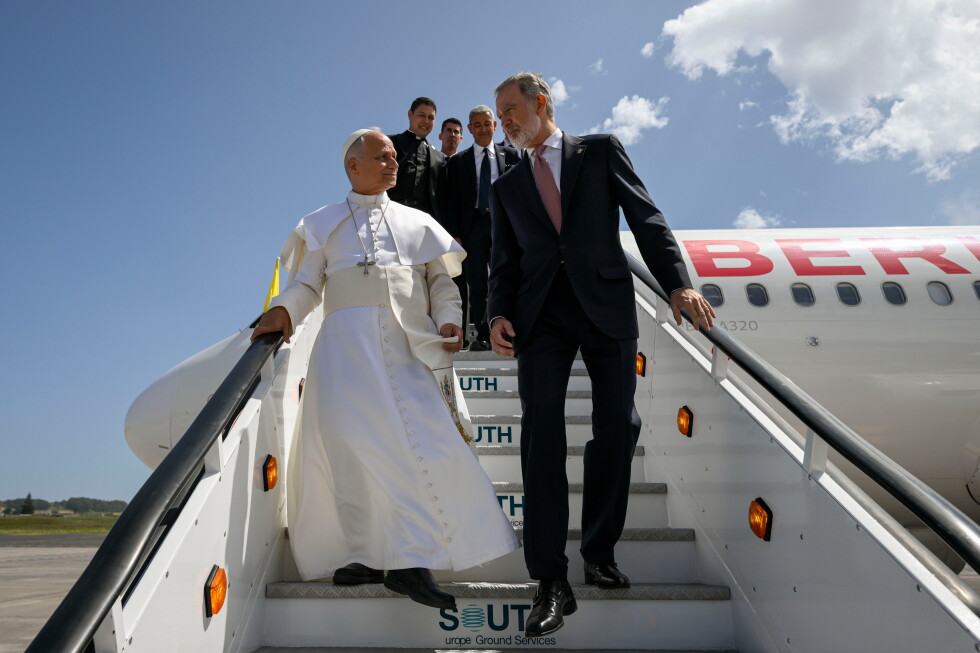
After a busy seven-day apostolic visit across Spain that carried a strong message on migration policy and marked a historic milestone for Barcelona’s iconic Sagrada Familia, Pope Leo XIV’s journey back to Rome hit an unforeseen snag Friday at Tenerife North–Ciudad de La Laguna Airport in Spain’s Canary Islands. The Iberia Airlines charter jet scheduled to carry the pontiff and his delegation home developed a critical mechanical issue that grounded the aircraft, leaving the Vatican team stranded before a last-minute act of generosity from Spain’s monarch resolved the crisis.
The problem emerged after Pope Leo had already boarded the plane: the aircraft’s engine failed to start, and initial attempts by the ground crew to repair the fault were unsuccessful. All passengers were required to exit the aircraft, and an investigation into the root cause of the malfunction was launched immediately. With the Canary Islands located off the northwest coast of Africa, far closer to the African continent than to mainland Spain, sourcing a replacement aircraft locally was not feasible. In response to the emergency, King Felipe VI extended an offer of his personal private jet, a Falcon, to transport the pope back to the Vatican.
The Spanish king accompanied Pope Leo to the aircraft on the airport tarmac, where the pontiff and his core delegation boarded the jet. The plane departed more than three hours behind the original scheduled departure time, marking an unusual end to a visit that had otherwise proceeded without a hitch. The remaining passengers, including approximately 70 Vatican correspondents and support staff, were set to be picked up by a backup Iberia jet dispatched from Madrid, the airline confirmed.
The unplanned aircraft swap is an extremely rare event in modern papal travel. Veteran Vatican journalists who cover papal visits could only recall a handful of similar disruptions during the decades-long pontificate of St. John Paul II. In 1986, a snowstorm closed Rome’s airports en route back from India, forcing John Paul II to divert to Naples before completing the journey by special train. Two years later, severe weather forced an unscheduled landing in South Africa during a trip to Lesotho – a country the pontiff was visiting as part of a tour that intentionally excluded apartheid-era South Africa over its policy of racial segregation.
Papal air travel follows longstanding standard protocols: typically, Italy’s national carrier ITA Airways transports the pope to his destination, and the host country’s national carrier handles the return flight. For particularly long journeys or trips to nations without the capacity to host large papal charter flights, ITA Airways often handles the full round-trip. Papal charters are structured with the pope, his delegation, and security detail in the forward section of the aircraft, while traveling journalists occupy standard economy seating.
Earlier in the visit, Iberia had publicly celebrated its role as the host carrier, releasing official video footage of Pope Leo sitting in the cockpit of the jet during his flights between Madrid, Barcelona, and the Canary Islands. In the clips, the pontiff is seen smiling and waving to Spanish military escort pilots – a traditional honor provided by the host nation for visiting top dignitaries.
During the week-long visit, Pope Leo prioritized advocacy on migration issues, delivering multiple sharp speeches calling out global indifference to the plight of migrants crossing dangerous Atlantic routes to reach the Canary Islands. He also made history by inaugurating the completed final tower of the Sagrada Familia, Antoni Gaudí’s unfinished architectural masterpiece that has been under construction for more than 140 years.