LONDON – Iconic 20th-century artist David Hockney, best known for his luminous paintings of sun-drenched California swimming pools that defined mid-century modern art, passed away Thursday at the age of 88, just weeks shy of his 89th birthday, his publicist Erica Bolton confirmed.
Born in the industrial northern English city of Bradford in 1937, Hockney spent his formative years in the region’s textile manufacturing hub before earning a spot at London’s Royal College of Art. Even before graduating, his bold, distinctive style caught the attention of the art world, and leading dealer John Kasmin signed him to his roster in 1961. By his late 20s, Hockney had become a defining figure in the swinging art scenes of 1960s Britain and the United States, recognizable by his signature round glasses and bleached-blond hair.
After first visiting the U.S. in 1963, Hockney fell in love with Southern California’s bright, clear light and settled there for much of his life, turning sun-baked suburban landscapes and shimmering swimming pools into his most iconic motifs. He once told the Los Angeles Times in 1979, “London has lots of dreary parts but I never find anything dreary in Los Angeles.” His signature works rendered dreamlike worlds of patterned light bouncing off water and glass, with simplified human forms rendered in matte acrylic that felt both fresh and timeless.
As an openly gay artist working at a time when same-sex relationships were still criminalized across much of Britain, Hockney broke new ground by centering tender, celebratory depictions of gay intimacy in his work. Early pieces including *We Two Boys Together Clinging* and *Two Men in a Shower* normalized queer relationships at a time when they were rarely depicted in mainstream art, with friends and lovers often serving as his models.
Drawing from a vast range of influences spanning Renaissance portraiture, J.M.W. Turner’s Romantic landscapes, Pablo Picasso’s cubist experiments, and 20th-century American pop art, Hockney developed a style that defied easy categorization. Though he incorporated pop art’s focus on everyday modern life — even including a British Typhoo Tea box label in his 1961 work *Tea Painting in an Illusionistic Style* — he long rejected being labeled a pop artist, telling the *New York Times* in 1964, “I’m just an ordinary artist,” while noting he always considered himself rooted in the English artistic tradition. He compared his move to chase California’s light to earlier generations of English artists who traveled to Italy for inspiration, drawing a throughline between historic artistic practice and his own modern work.
Over a seven-decade career, Hockney never limited himself to a single medium. Beyond painting and drawing, he designed costumes and sets for opera and theater, including a celebrated 1987 production of *Tristan und Isolde* at the Los Angeles Opera. He pioneered the use of photo collage, assembling hundreds of individual snapshots into sprawling composite works like *Pearblossom Highway, 11-18th April, 1986*, which blurred the line between photography and painting. His insights from photographic experimentation even led him to publish the 2001 scholarly book *Secret Knowledge: Rediscovering the Lost Techniques of the Old Masters*, which argued that Renaissance and Old Master artists had used optical tools and lenses to refine their work far more widely than art historians had previously acknowledged. Late in his career, he embraced digital technology, making the iPad his primary drawing tool, creating vibrant, spontaneous landscapes that reached new audiences.
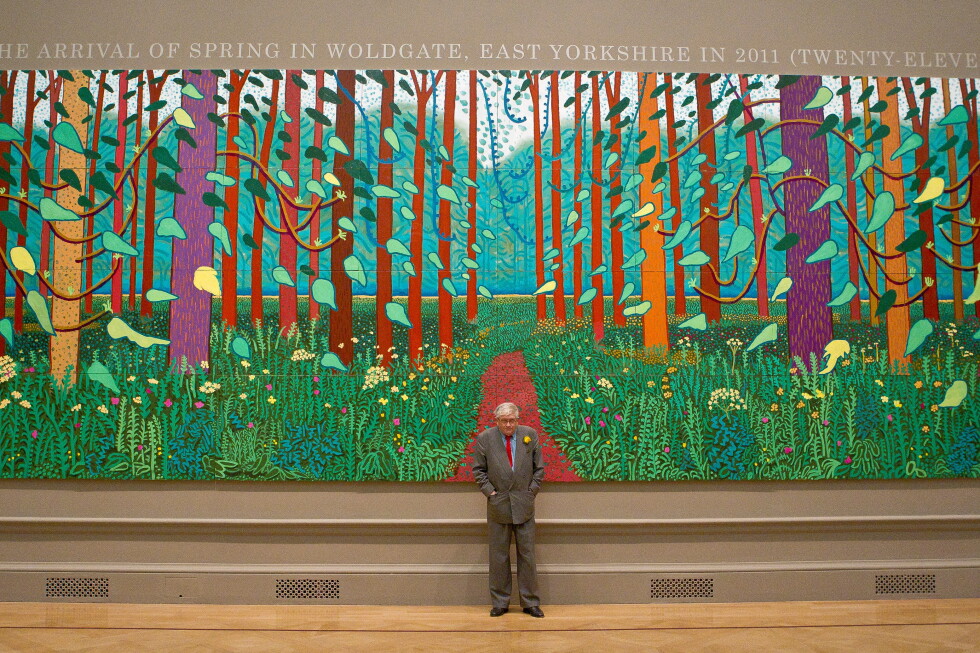
Later in life, Hockney returned to his European roots, drawing new inspiration from the rolling wooded hills of his native Yorkshire and the rural landscapes of Normandy, France, where he relocated in 2019. During the 2020 COVID-19 lockdown, he created a series of joyous iPad drawings of Normandy’s spring landscapes, paired with the hopeful message: “Do remember they can’t cancel the spring.” The phrase became a global rallying cry, and was featured prominently at a major retrospective of his work that opened at Paris’ Fondation Louis Vuitton in 2025.
Hockney’s work earned both critical acclaim and enormous commercial success, with his pieces selling for record-breaking prices at auction. In 2018, his 1972 masterpiece *Portrait of an Artist (Pool with Two Figures)* sold at Christie’s for $90.3 million, at the time the highest price ever paid for a work by a living artist. Four years earlier, his 1966 pool painting *The Splash* fetched $30 million at Sotheby’s. Beyond auction houses, his work entered public life: he painted a permanent mural on the bottom of the swimming pool at Los Angeles’ historic Hollywood Roosevelt Hotel, and designed the Queen’s Window, a stained-glass window at Westminster Abbey honoring Queen Elizabeth II’s long reign, completed in 2018.
Art world figures have long praised Hockney’s enduring ability to bring joy to audiences worldwide. Art historian Simon Schama wrote in an essay for the 2025 Paris retrospective, “His work is admired — loved is not too strong a word — by the millions who, worldwide, flock to see it because it presupposes an expectation of pleasure.” Curator Norman Rosenthal, who organized the 2025 exhibition, called Hockney “the Picasso of our times,” noting, “David Hockney is also an incredibly popular artist whose work changes how we see things.”
Hockney often said his commitment to daily work was what kept him vital. After a minor stroke in 2012, and experiencing increasing hearing loss in later life — which he said actually improved his ability to perceive visual space — he continued creating every day. “It’s my work that keeps me young,” he told the *Sun* newspaper in 2017. “I’ve been a professional painter for 60 years. Sixty years of getting up every day and doing exactly what I want to do.” He also once told the Associated Press, “You are a rich man if you do the things you want to do” — a philosophy he embodied throughout his decades-long career.