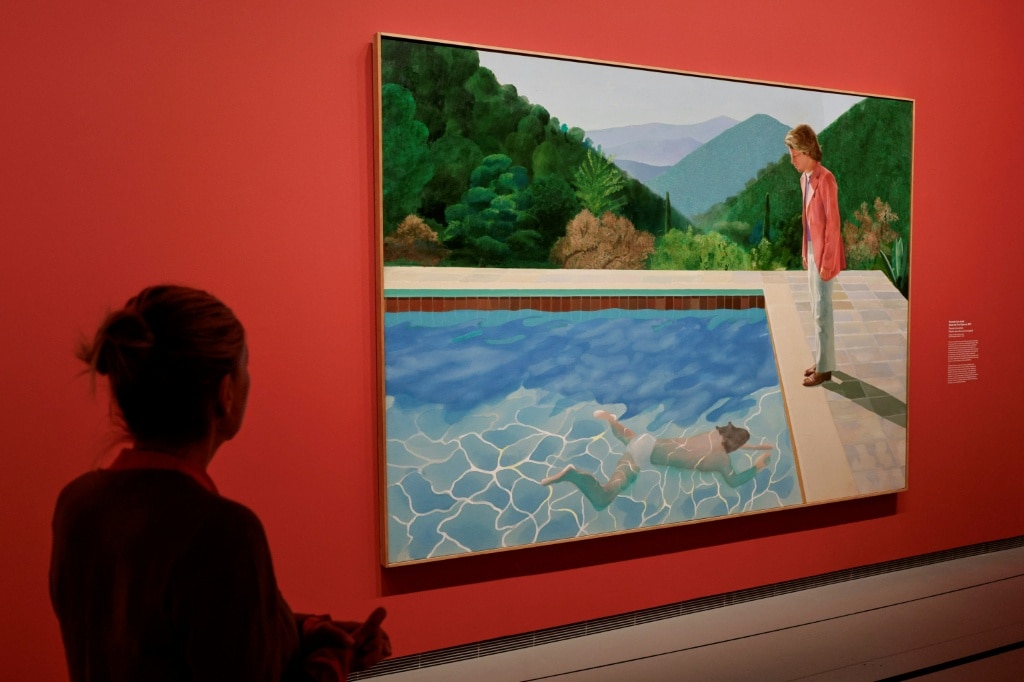
The global art community is mourning the loss of one of the most influential contemporary artists of the last two centuries, British icon David Hockney, who passed away peacefully at his London home on Thursday, just one month shy of his 89th birthday. Hockney leaves behind a sprawling, decades-spanning body of work defined by its bold, electrifying color palettes that transformed everything from sun-drenched California pools to rolling English countryside into unforgettable cultural touchstones.
Born to working-class parents in the northern English industrial town of Bradford in 1937, Hockney defied the rigid social conventions of post-WWII Britain from a young age. Openly embracing his identity as a gay man at a time when same-sex relations were criminalized and widely taboo across much of the Western world, he also committed himself early to a career in art, rejecting the expectations placed on working-class young men of his era. As a young adult, he served as a conscientious objector during military service, working as a hospital orderly before pursuing formal training first at the Bradford School of Art, then at London’s prestigious Royal College of Art starting in 1959.
Even in his student years, Hockney’s work broke new ground. His 1950s piece *We Two Boys Together Clinging* made an unapologetic, public statement about same-sex attraction at a time when such themes were excluded from mainstream galleries. It was his abstract work *Doll Boy*, a subtle tribute to his crush on pop star Cliff Richard, that first caught the attention of influential London art dealer John Kasmin, who purchased the piece for just £40. Kasmin later recalled reaching out to the young, shy, cash-strapped student — then recognizable for his black crew cut and National Health Service glasses — to invite him for tea, and began selling small drawings for just £7 to £8 apiece to launch his career. Shortly after Hockney graduated from the Royal College with a gold medal, Kasmin hosted his first solo exhibition, which sold out entirely. Almost overnight, Hockney emerged as a defining cultural figure, famous for his signature bleached blond hair, round-rimmed glasses, and bold, playful personal style.
In 1964, Hockney relocated to California, where he created the bright, sun-drenched, minimalist scenes that cemented his status as a leading figure in the global pop art movement. His 1967 masterpiece *A Bigger Splash*, which captures the split second after a diver disappears beneath the surface of a backyard swimming pool, remains one of the most iconic artworks of the 20th century. Over the following decades, his jet-set lifestyle took him across the globe, from the south of France to Morocco, New York, and London, and he painted intimate portraits of the designers, dancers, and artists that made up his wide social circle. By the end of the 1960s, the once shy art student had transformed into a global art star, moving in elite social circles while retaining the mischievous charm and occasional blunt combativeness that defined his personality.
A relentless innovator across mediums, Hockney’s work extended far beyond canvas painting. He designed stage sets for theater and opera, experimented with printmaking, and reimagined photographic collage in the 1980s with his invention of “joiners” — assemblages of slightly offset snapshots that created a cubist-inspired patchwork effect, echoing the work of his lifelong artistic hero Pablo Picasso. Always an early adopter of new technology, he embraced tools from Polaroid cameras to video recorders, and in his 70s began creating art on an Apple iPad. Large-scale prints of his tablet-created works headlined his 2012 *A Bigger Picture* exhibition at London’s Royal Academy of Arts.
Later in his career, Hockney returned repeatedly to his Yorkshire roots to care for his mother, and over time he began painting the region’s rolling, bucolic landscapes, reinventing himself once again as a leading contemporary landscape artist. After relocating back to the UK from the United States, he fell in love with the lush, green landscapes of northern France — the same region that inspired impressionist master Claude Monet — and moved there, where he created one of his late-career bodies of work, *A Year in Normandy*. During the COVID-19 lockdowns, Hockney framed his enforced isolation as an opportunity, throwing himself into painting the unfolding spring season in Normandy with his signature explosive palette of bright hues. He told AFP during a 2021 Paris exhibition of his Normandy work, “If you look at the world, it’s very beautiful.”
In 2023, Hockney returned to London to escape constant unwanted attention from visitors in Normandy. Even as his health declined, leaving him frail and reliant on a wheelchair, he remained actively engaged in curating a major retrospective of his decades-long career, which opened in Paris in April 2025.
Hockney’s place in art history was cemented in 2018, when his iconic work *Portrait of an Artist (Pool with Two Figures)* sold at auction in New York for $90.3 million, breaking the record for the most expensive work sold by a living artist. His agent Erica Bolton remembered him this week as “one of the most important figures in contemporary art in both the 20th and 21st centuries,” while London’s Tate Gallery once called him “perhaps the most popular and versatile British artist of the 20th century.” Throughout his life, he retained the broad Yorkshire accent of his upbringing, and never lost his lifelong fondness for simple pleasures: fish and chips, and cigarettes, once joking in a 2015 interview with The Guardian, “It used to be you couldn’t be gay. Now you can be gay but you can’t smoke. There’s always something.”