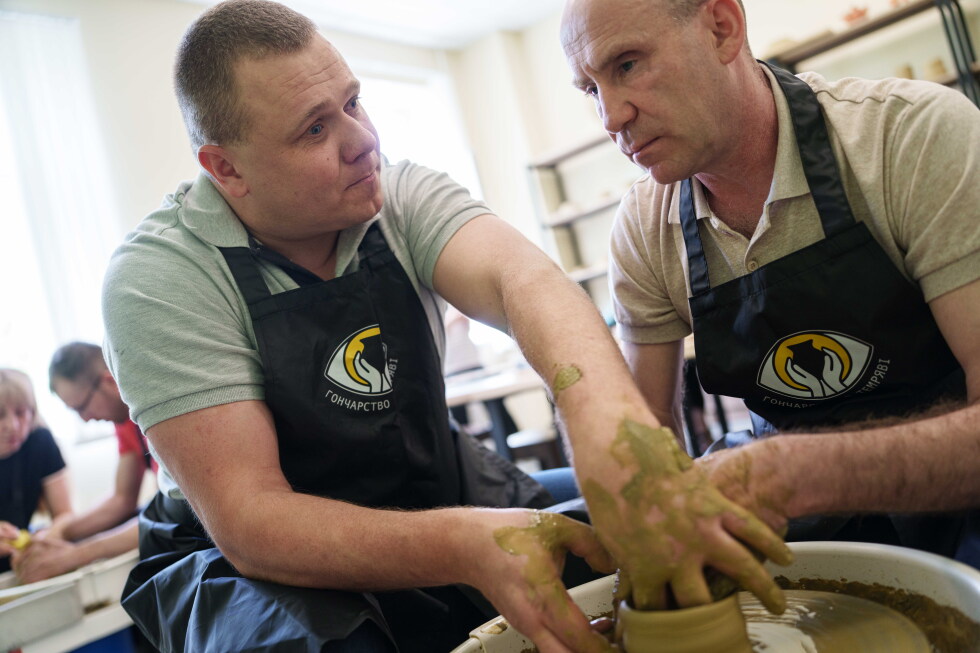
In a sunlit apartment workshop in central Ukraine’s Vinnytsia, two broad-shouldered men stand focused before a spinning pottery wheel, their hands woven together deep in soft, malleable clay. For both men, connection and direction come not through sight, but through the quiet pressure of touch. One is Ivan Shostak, a 37-year-old combat veteran who lost his vision on Ukraine’s front lines, and now devotes himself to guiding other visually impaired veterans through the healing craft that remade his own life.
Shostak’s journey to the pottery wheel began long before he lost his sight. A veteran of the 2014 Donbas conflict, he chose to delay reenlistment when Russia launched its full-scale invasion in 2022, waiting to welcome his second son into the world before returning to duty. Just a few months into his second tour, in March 2023, a rocket-propelled grenade detonated inches above his head during the brutal, months-long Battle of Bakhmut. The blast robbing him permanently of his vision, and left him with a concussion, traumatic brain injury, and damaged neck vertebrae.
The physical pain was overwhelming, but the hardest trials came after Shostak returned home. Unable to cope with the weight of his injury, his then-wife left, leaving him to navigate his new darkness alone. “There was a family, and after the injury there was no family,” Shostak reflected. Only his parents remained close, standing by him through the darkest days. For six months, he was confined to bed, numbing physical agony with medication, but no drug could ease the crippling despair that settled over him.
A turning point came when a fellow soldier on home leave stepped in, bringing Shostak to a local rehabilitation center for visually impaired people. In just four weeks, center staff taught him to navigate daily life: how to use a smartphone, how to move with a cane, how to reclaim small acts of independence. It was there that Shostak first learned a life-changing truth: “It turned out you could live even in total darkness.”
A group visit to a local pottery workshop would spark the new path that would redefine Shostak’s life. As he shaped his first simple plate on the wheel, a long-lost feeling rushed back: the thrill of creating something tangible, of proving he could still contribute, still build. “After that came the thrill that I could still do something,” he recalled.
Shostak began attending classes regularly, slowly honing his craft, and eventually started selling his handcrafted pieces—everything from mugs and plates to candle holders. When the UN Development Program and Swedish supporters launched the “Pottery in the Dark” rehabilitation project in Vinnytsia, designed to support war veterans who lost their sight in combat, Shostak stepped into the role of instructor. What began as a personal rehabilitation exercise has since grown into a thriving small business and a peer support network for other traumatized veterans.
Today, Shostak works from a small workshop his older brother—also a serving soldier—built for him in his apartment, running his business with a small team of three who help market and sell his work primarily through his Instagram page. He keeps no rigid schedule, noting that pottery demands emotional alignment: “Clay is that kind of material, and pottery is that kind of work, where if you feel bad, there’s nothing to do here. It won’t come out at all. Everything breaks, comes out crooked. Only when you feel good, you sit down, you work, and it all turns out great.” While firing and glazing are completed at a separate offsite studio, Shostak personally selects every glaze color, guided by his sense of touch and imagination. Every piece he creates bears the emblem of the air assault forces he served in: a dome, wings, and a sword, alongside the unit’s motto “Nobody but us” and Shostak’s name.
For Shostak, the work is about more than making a living to support his two children—it’s about setting an example. “I have two kids I have to help through life and show by my own example that you have to fight for your life,” he said.
The project has already transformed lives beyond Shostak’s. Roman Shtohryn, director of the Podillia rehabilitation center hosting the program, reports that six of the 11 veterans who completed the training now earn a steady income from their pottery work. Shtohryn explains that pottery serves unique therapeutic roles for traumatized veterans: it pulls creators into a meditative state of flow, drawing focus away from pain and trauma, and delivers an immediate, tangible reward for their effort—a finished piece they can hold and sell.
On a recent workday, Shostak guided 47-year-old fellow veteran Viacheslav Sadovskyi, who was injured when a drone exploded near him in 2024, leaving him blind after five reconstructive surgeries. Laughing as he checked in, Shostak reached for Sadovskyi’s hands, guiding them to the spinning clay, walking him through how much pressure to apply, which angles to use, his hands never leaving Sadovskyi’s the whole time. “There, I can feel it,” Sadovskyi said.
For program leaders, the peer-to-peer model is what makes the work so powerful. “It matters that a veteran teaches a veteran,” Shtohryn said. “We’re equals. We understand and support each other.” To date, Shostak has created more than 1,000 one-of-a-kind pottery pieces—none of which he has ever seen, but every one of which carries the mark of his resilience, and helps build a new future for other veterans walking the same path.