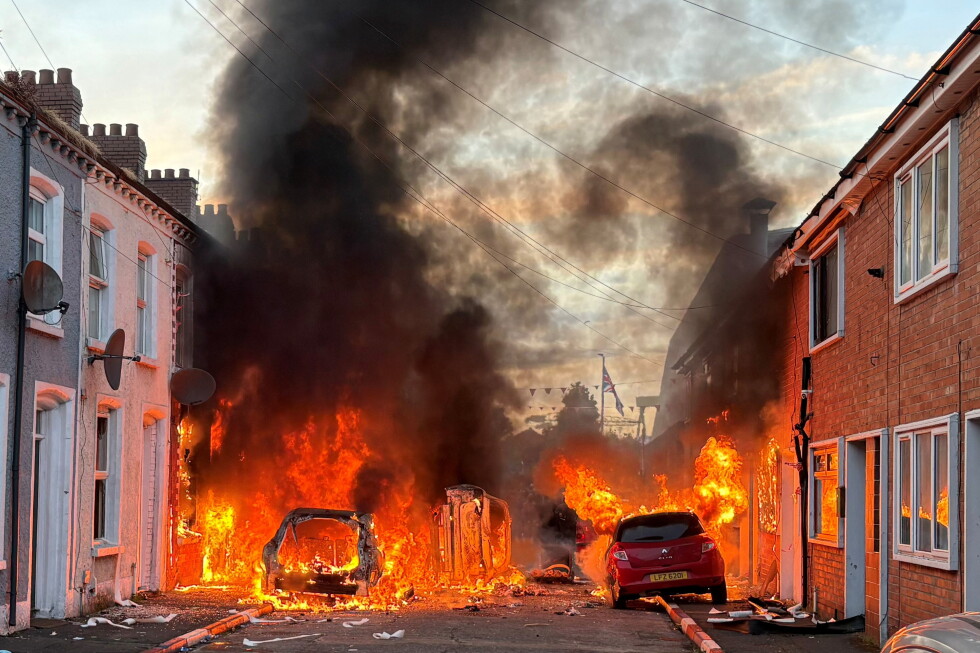
BELFAST, Northern Ireland — A single suspected stabbing has triggered days of chaotic, racially-charged unrest across Northern Ireland, after anti-immigration and far-right activists exploited a violent criminal attack to stoke community tension and mobilize violent street protests.
Authorities confirmed Thursday that a 30-year-old Sudanese asylum seeker is scheduled to appear before a Belfast court to face charges of attempted murder. The suspect entered Northern Ireland from the neighboring Republic of Ireland in 2023, filed a successful asylum application, and was granted a five-year residency permit. The stabbing, which occurred Monday in north Belfast, left a 40-something male victim hospitalized with severe, life-altering injuries to his face, eyes and back. Graphic mobile phone footage of the attack spread rapidly across social media platforms in the hours after it occurred, giving anti-immigration groups immediate ammunition to frame the incident as a failure of the region’s immigration policy.
Police have formally ruled out any connection to terrorism and confirmed they are not searching for any additional suspects in connection with the stabbing. Even so, calls for public action circulated online among far-right circles within 24 hours, drawing crowds to the streets Tuesday night.
Masked rioters targeted residential properties believed to house immigrant families, setting multiple homes ablaze. Local garbage bins and a public Belfast bus were burned, and officers attempting to restore order were pelted with bricks and other projectiles. Firefighters were able to extract multiple trapped residents from the burning buildings before the blazes spread, though no fatalities linked to the unrest have been reported to date.
The violence drew unified condemnation from all levels of government across the United Kingdom and Northern Ireland’s cross-community power-sharing administration. First Minister Michelle O’Neill, leader of Irish nationalist party Sinn Fein, labeled the unrest “thuggery” in a public statement Wednesday. “Groups of masked men burning families out of their homes is nothing less than disgusting cowardice,” O’Neill said.
Her counterpart, Deputy First Minister Emma Little-Pengelly of the pro-British Democratic Unionist Party, echoed the criticism, noting that “taking frustration at the evil actions of a person out on those who had no part in it is utterly wrong.” UK Prime Minister Keir Starmer called the original stabbing “sickening” and added that the government would not “tolerate abhorrent scenes of violence like this on our streets.”
Northern Ireland Justice Minister Naomi Long called out external far-right agitators for exploiting the incident for political gain, noting many of the online organizers “yesterday would have struggled to find Belfast on a map.” Long told the BBC that the targeting of immigrant families amounted to overt racism. “If you’re driving people from their homes based on nothing but the color of your skin, you can’t dress that up any other way, it’s racism, and those bad faith actors need to take a step back,” she said.
The unrest is the second high-profile incident in the United Kingdom in recent weeks where a violent criminal attack has been weaponized by anti-immigration figures, including high-profile American political actors. Last week, the conviction of a murderer in the December stabbing death of a university student in Southampton, England, was seized on by activists and U.S. Vice President JD Vance, who framed the killing as evidence of dangers tied to open immigration.
The victim, 19-year-old Henry Nowak, was stabbed to death with a Sikh dagger by Vickrum Digwa, who falsely told responding officers that Nowak had assaulted him in a racist attack. Police initially misidentified Nowak as the aggressor before recognizing his fatal injury and attempting life-saving resuscitation. Digwa was convicted of murder and sentenced to life in prison with a minimum 21-year term before he is eligible for parole. A protest held over Nowak’s death later turned violent, with participants attacking police with chairs and rocks, and multiple attendees have been charged with violent disorder.