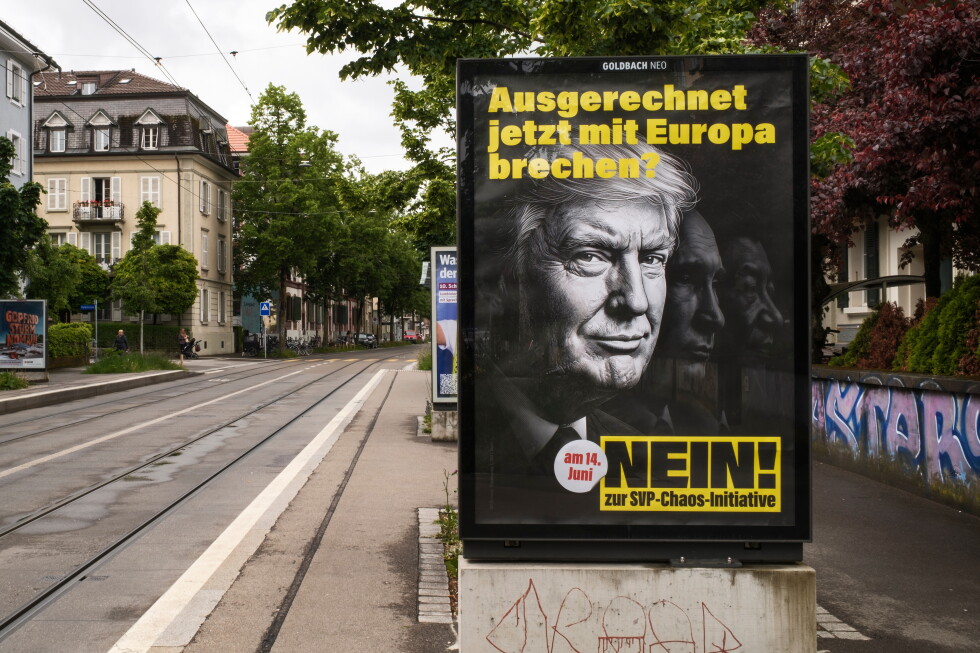
GENEVA — On Sunday, Swiss voters will head to polling stations to decide on an unprecedented national proposal that would put a hard cap on the Alpine nation’s total population, capping decades of anti-immigration advocacy led by the country’s most prominent right-wing political bloc. If approved, the initiative would lock in a maximum population of 10 million for Switzerland by the middle of the 21st century, marking the first time any national electorate has ever voted on an explicit legal limit to a country’s total population.
Switzerland’s direct democratic system gives citizens the power to force national votes on policy changes through signature collection, with national referendums typically held four times annually. The measure is championed by the populist Swiss People’s Party, the largest faction in the country’s federal parliament, which has built decades of political support on stoking isolationist sentiment around immigration. Pre-election polling from leading Swiss research firm gfs.bern indicates the outcome will likely be an extremely close contest, leaving the final result uncertain ahead of voting.
Proponents of the initiative argue that decades of open border policies with the neighboring European Union have stretched Switzerland’s housing stock, public infrastructure, social welfare systems, and natural resources thin, eroding the country’s distinct way of life. Bernard Bapst, a Fribourg-based lawmaker for the Swiss People’s Party and former customs official, claimed that cross-border openness has led to a measurable rise in criminal activity across the country, rejecting critics’ warnings that the policy threatens national security.
Opponents, however, warn that passing the proposal would amount to a catastrophic self-inflicted economic and diplomatic wound for the wealthy, export-dependent nation. They emphasize that Switzerland has reaped enormous economic benefits from free movement with the EU, which supplies critical skilled labor to key Swiss sectors including healthcare, finance, pharmaceuticals, and technology. The country’s federal government and national parliament both officially oppose the cap, and EconomieSuisse, Switzerland’s leading business group, has labeled the initiative an “absurd proposal” that puts the country’s long-term security and prosperity at risk.
Official government data illustrates the scale of demographic and economic shift that has fueled the debate. Since Switzerland and the EU agreed to ease free movement rules for workers and residents across their shared border in 2002, Switzerland’s total population has surged 23% to 9.1 million by the end of 2024. Over that same period, the country’s total economic output has also grown by 24%. “We are the victim of our own success,” explained Reto Föllmi, an international economics professor at the University of St. Gallen, summing up the core tension at the heart of the vote.
If voters approve the cap, the Swiss federal government will be legally required to implement policies to hit the 10 million target by 2050. If the population hits the 9.5 million threshold before 2050, the government would be forced to impose new restrictions on asylum claims, family reunification, and permanent residency permits. It would also likely require Switzerland to scrap its existing free movement agreement with the EU entirely.
Experts note that any immediate economic or demographic disruption would be limited by the policy’s long-term timeline, but the diplomatic and investment impacts would be felt far sooner. Political science professor Rene Schwok of the University of Geneva notes that a yes vote would significantly strain relations between Bern and Brussels — the EU is Switzerland’s largest trading partner by a wide margin — and create deep uncertainty for foreign firms looking to invest in the country. As of 2024, 32% of Switzerland’s population is foreign-born, the second-highest share among OECD nations, trailing only Luxembourg where more than half of all residents were born abroad.
Immigration has been a polarizing, long-running political issue across the European continent for decades, as countries grapple with aging native populations and rising anti-immigrant political sentiment. Unlike many other Western European nations where anti-immigrant rhetoric focuses primarily on migration from the developing world, the vast majority of foreign-born residents in Switzerland come from other European countries.
This is far from the first time Swiss voters have weighed in on immigration restrictions over the past 50 years. Only one prior immigration cap referendum — the 2014 “Against Mass immigration” measure — passed by a narrow margin, after campaigners stoked public fears about overpopulation and growing Muslim communities in the country. While many countries around the world enforce limits on new immigration, no nation has ever held a national vote on an explicit cap to its own total population, according to Philippe Wanner, a leading demography expert at the University of Geneva.
The debate in Switzerland stretches back generations. At the turn of the 21st century, as anti-immigration sentiment began to rise, former Swiss President Adolf Ogi summarized the opposing perspective that still defines the “no” campaign: “We live from foreigners … we need laborers for tourism … we need intelligent people in Switzerland.”