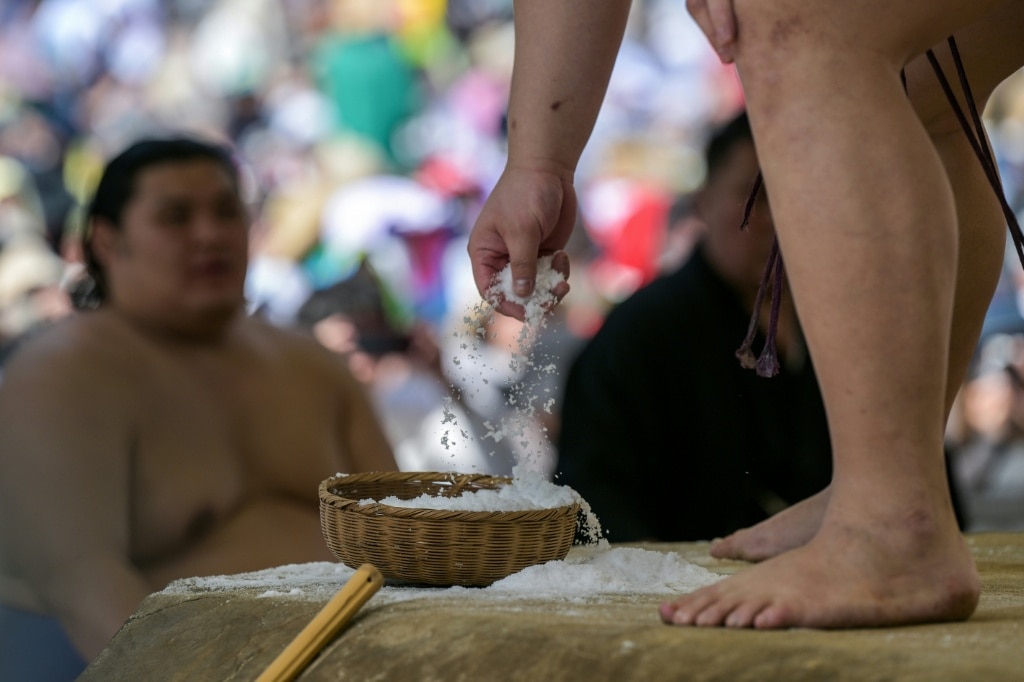
Next weekend, the streets of Paris will host a rare showcase of one of Japan’s most ancient and culturally significant martial traditions: professional sumo wrestling. While audiences will focus on the power and ritual of the competing rikishi (sumo wrestlers), an unexpected, unsung star of the two-day landmark event – the first major sumo tournament held in France since 1995 – is entirely homegrown: 200 kilograms of specially prepared Guerande salt harvested from France’s Atlantic coast.
For sumo, a sport deeply intertwined with sacred Shinto religious traditions, salt is far more than a random ceremonial accessory. It is a non-negotiable foundation of the sport, and no official tournament can proceed without it, according to David Rothschild, lead organizer of the Paris event.
Sumo competition is structured around a sequence of time-honored rituals rooted in Shinto spiritual beliefs. Each gesture carries deep symbolic meaning: when wrestlers clap their hands at the start of the pre-bout ceremony, they are calling on divine spirits to witness the match. The stamping of their feet is a deliberate act to drive malevolent demons from the ring. And the scattering of salt serves the critical purpose of purifying the dohyo – the 4.55-meter-diameter wrestling ring – clearing the space of any bad fortune that could bring injury, curses, or misfortune to the competitors.
Before every match, each rikishi throws a large handful of salt onto the dohyo in a practice that has become one of sumo’s most iconic and recognizable images. Throughout the tournament, the clay surface of the ring is kept dusted with a thin layer of salt, with yobidashi (ring announcers) regularly sweeping and replenishing the layer to maintain its purity. For the two-day Paris event, that adds up to a total need of 200 kilograms of salt for all the rituals and preparations.
When organizers reached out to Meredith and Gautier Ferard, third-generation salt producers based in the coastal French town of Le Croisic, the unusual large order caught them by surprise. “It’s definitely not the kind of request we get every day,” Meredith Ferard told reporters. “But I thought, why not take it on?”
The organizers provided extremely specific requirements for the custom salt to meet sumo’s unique needs. “They asked for a bright white salt, and above all, a very fine grain to avoid damaging the soft skin on the wrestlers’ feet,” Meredith explained. Natural sodium chloride crystals naturally form sharp, cubic shapes, and for wrestlers who carry massive body weights, walking across coarse, sharp grains could cause painful cuts and abrasions over the course of the tournament.
To meet these specs, the Ferards processed their 2024 summer-harvested fleur de sel through a months-long custom preparation process: after harvesting, the salt was stored, dried, dehumidified, sieved multiple times, and finally ground by hand to achieve the perfect fine texture.
While supplying salt for a sumo tournament is an unusual departure for their small business, Meredith notes that salt – often called “white gold” for its cultural and economic value across human history – carries sacred meaning in many global traditions, just as it does in Shinto.
“For us, this connection to sacredness is already part of our daily work,” she said. “My office looks out over the salt marshes that have been shaped by human hands for 2,000 years. Our product is entirely natural, entirely handmade. So it feels completely natural that our salt would take on this sacred role for the sumo tournament. I just hope it meets everyone’s expectations, that the wrestlers are happy with it, and that it fulfills its ceremonial purpose for their bouts.”