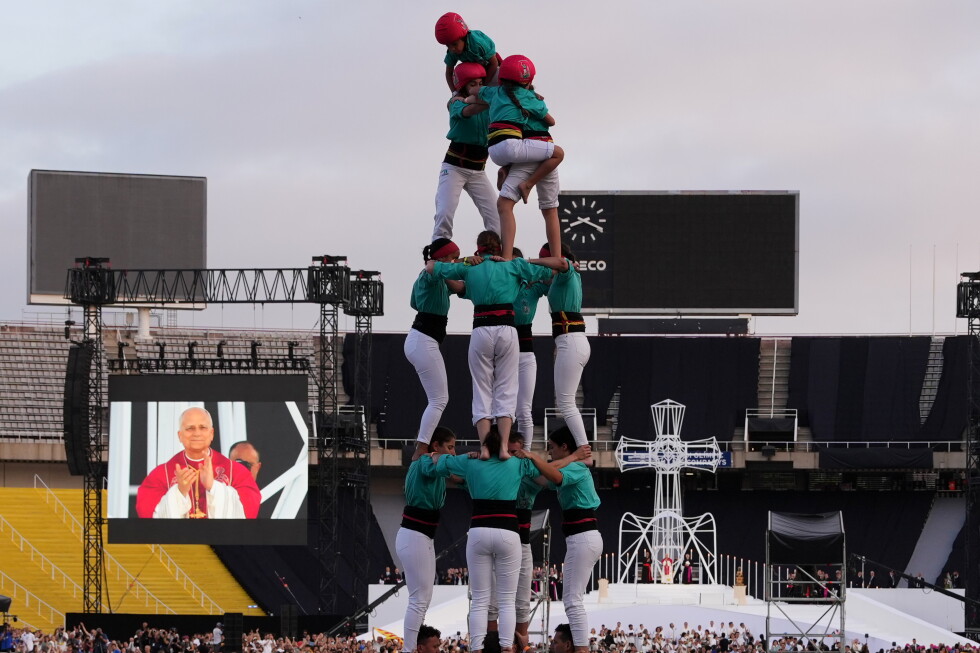
On June 9, 2026, as Pope Leo XIV kicked off a prayer vigil during his seven-day official visit to Spain at Barcelona’s Lluis Companys Olympic Stadium, a centuries-old cultural tradition delivered a one-of-a-kind Catalan welcome to the pontiff. At the peak of a nearly 33-foot human tower, or “castell” in the local Catalan language, stood 8-year-old Bruna Vall Galán, the youngest member of the famed Vilafranca del Penedes casteller collective selected to perform for the Pope.
Castells, recognized as a defining cultural treasure of northeastern Spain’s Catalonia region, are far more than a breathtaking display of physical balance, collective strength, and precise coordination. For Catalan communities, these towering human structures are a core pillar of regional cultural identity, binding generations together through shared practice and collective pride. The Associated Press was granted exclusive behind-the-scenes access to the Castellers de Vilafranca — one of the region’s most decorated castell groups — documenting the entire journey from the pre-performance bus ride to post-performance celebration.
More than 130 group members traveled 50 kilometers from their hometown of Vilafranca del Penedes, a small town nestled in Catalonia’s renowned Cava wine region, to Barcelona for the performance. Dressed in the collective’s iconic uniform: jade green shirts, white trousers, fitted black sashes, and red polka-dot bandanas, the team prepared for the high-stakes performance. The sashes and bandanas are not just decorative: they provide critical grip for climbers as they ascend and descend the structure built entirely of interconnected human bodies.
Ernest Gallart Pérez, president of the Castellers de Vilafranca, emphasized the inclusive ethos that lies at the heart of the castell tradition. “A fundamental richness of castells is that anybody can take part, independently of their age, their culture, their weight or height, their beliefs or ideologies. Every person has their place on the structure,” he explained.
For many members, castells are more than a cultural practice — they are a multigenerational family legacy. Bruna’s mother Maria Vall Camell joined the collective at 18, and later met her husband within the group’s tight-knit community. Aida Ibañez Sadurní, who performed alongside her father Xavier Ibañez Sanz, described the deep emotional bond the tradition fosters. “It’s union, family, strength,” she said. “When we get everybody down, we hug each other crying, and it’s the biggest emotion.”
Constructing a stable 10-meter castell requires months of dedicated training and coordination, though the full structure goes up in mere minutes. The process begins with a large, solid base: dozens of members stand pressed shoulder-to-shoulder in tight concentric circles, arms intertwined and heads rested against neighboring shoulders to distribute weight evenly. Successive smaller groups of climbers then ascend, forming stable standing rings layer by layer, until the “anxaneta” — the young child who serves as the tower’s symbolic peak — claims the top position. On Tuesday, that role fell to Bruna, who waved to the crowd of 40,000 from the summit before making the safe descent.
When the entire team reached the ground safely and the castell was disassembled without incident, Pope Leo XIV broke into a broad smile, and the stadium erupted in cheers as loud as a top-tier professional football match. Àngel Grau, the group’s head coach or “cap de colla”, spoke to reporters after the performance, still sweaty from the physical effort, beaming with pride. “It’s a relief, I’m very happy, very joyful,” he said, as the team made their way back to the buses for the return trip. “There were a lot of people watching us from around the world, and whether you believe a lot or believe less, it’s such an occasion for pride for us.”
Beyond high-profile events like the Pope’s visit, castells are woven into the fabric of everyday Catalan life, featured at patron saint festivals, regional competitions, and community gatherings that draw hundreds of participants annually. As Maria Vall Camell noted on the bus ride to Barcelona, the tradition captures the core of Catalan community values. “The human towers are like the skyline of Catalonia. They are an identity, very important for our culture, and they represent very well our society, that we work together as a team,” she said.
This coverage of religion and culture is part of an AP collaboration with The Conversation US, supported by funding from Lilly Endowment Inc. The Associated Press holds sole editorial responsibility for this content.