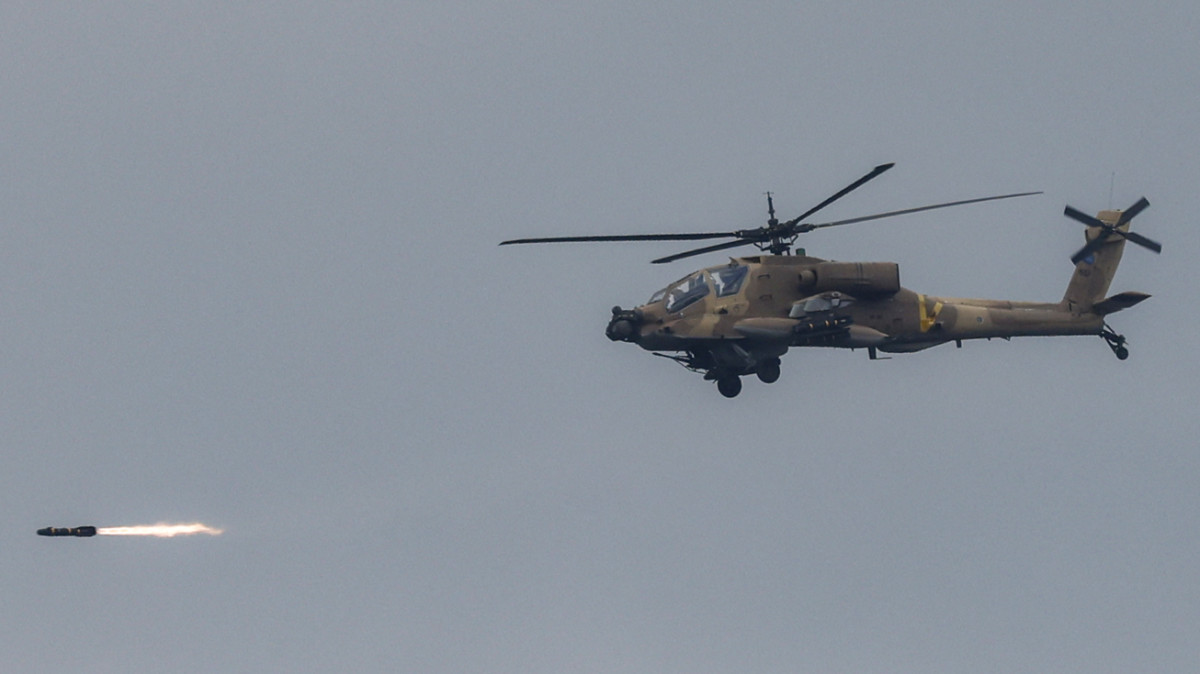
On Tuesday, U.S. President Donald Trump confirmed via social media that Iranian air defense forces shot down a cutting-edge U.S. Apache attack helicopter conducting patrol operations over the Strait of Hormuz, a revelation that directly undermines his earlier public statements declaring Iran’s air defense capabilities fully eliminated.
In his public post on the social platform, Trump noted that two pilots were aboard the downed aircraft, and both escaped the incident without injury. Despite no casualties being reported, the president stressed that the United States has no choice but to launch a response to the attack.
This incident comes at a moment of fragile détente between Washington and Tehran, just days after Trump intervened to de-escalate cross-border fighting between Israel and Iran. Just hours before he shared news of the helicopter downing on social media, Trump once again claimed that a comprehensive deal to end the ongoing regional conflict could be finalized within just two to three days — a repeated promise he has made dozens of times over recent months that has yet to produce any tangible progress.
The downing of the Apache is not an isolated event, and it is the latest in a string of military confrontations that have completely discredited Trump’s repeated assertions that Iran’s entire military infrastructure has been decimated. Back in April, Trump publicly claimed that the Islamic Republic’s navy and air force had both been completely destroyed, and that the vast majority of Iran’s missile stockpiles had either been expended or neutralized by coalition strikes. He went even further, stating that Iran no longer retained any functional anti-aircraft equipment, and that all of its radar systems had been 100 percent destroyed.
Recent Iranian military actions have directly contradicted these sweeping claims. Earlier this week, Tehran launched a wave of missile strikes targeting northern Israel, carried out as retaliation for Israeli airstrikes that hit Beirut, the capital of Lebanon. Just last week, Iran responded to U.S. military strikes by launching a coordinated attack of drones and missiles against targets in Kuwait and Bahrain, which host major U.S. military bases.
While it remains true that the United States holds overwhelming conventional military superiority over Iran, allowing U.S. forces to strike most targets in the region at will using a combination of air, sea, and ground-launched weapons systems, Iran has repeatedly demonstrated that it retains the capacity to disrupt U.S. military operations in its airspace. This latest helicopter downing adds to a growing list of successful Iranian strikes on U.S. military aircraft: in April, Iran downed a U.S. F-15E Strike Eagle fighter jet, forcing U.S. forces to launch a large-scale urgent search and rescue operation to prevent Iranian forces from capturing one of the downed airmen. To date, Iran has also shot down approximately 30 U.S. MQ-9 Reaper surveillance and combat drones.
This report is part of independent coverage from Middle East Eye, which provides unrivaled on-the-ground reporting and analysis of developments across the Middle East, North Africa, and surrounding regions.