BUNIA, Democratic Republic of Congo — Weddings in eastern Congo are traditionally vibrant, day-long affairs filled with warm embraces, crowded dance floors, and hundreds of joyful well-wishers gathering to celebrate a couple’s new chapter. But as the country grapples with a deadly Ebola outbreak that has already claimed 91 lives among more than 500 confirmed cases, the rituals of marriage have been fundamentally reshaped by life-saving public health restrictions. Even so, love finds a way to prevail.
The current outbreak, driven by the rare Bundibugyo Ebola virus, is centered entirely in Ituri, an eastern province of the DRC. Local and national health authorities have moved quickly to curb transmission, rolling out strict measures that include bans on large public gatherings and mandatory social distancing protocols. Unlike previous Ebola outbreaks, this strain has no approved vaccine or targeted treatment, and a weeks-long delay in confirming the outbreak means actual case counts are likely higher than official numbers, making response efforts all the more challenging.
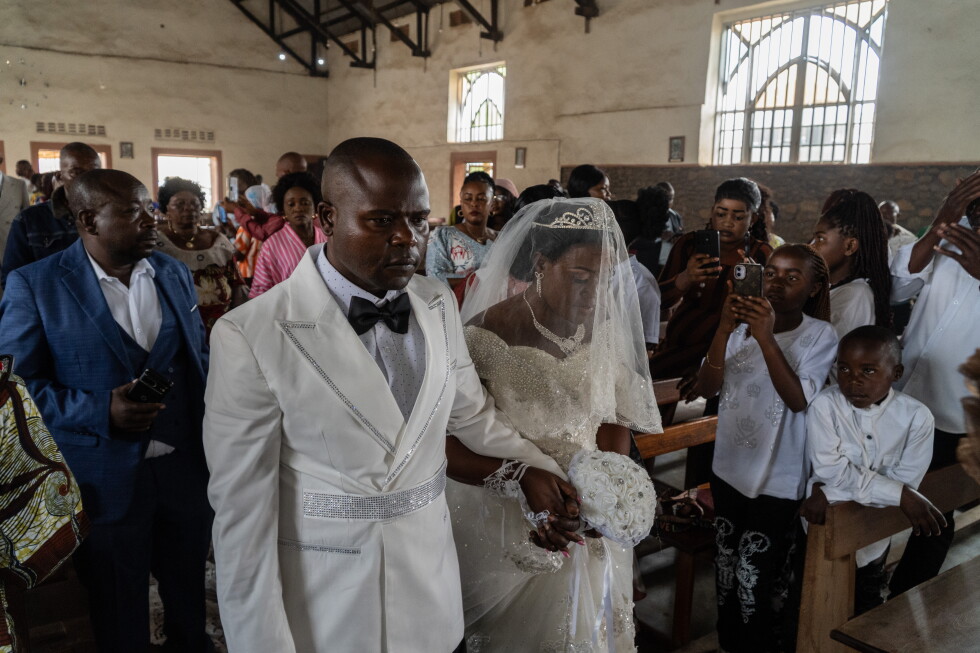
For Jean Claude Érable and his new wife Solange Hahati, who exchanged vows on a recent Saturday, these restrictions transformed one of life’s most celebrated milestones. The couple originally planned to welcome 300 guests to their big day, but local rules capped attendance at just 50, forcing many beloved family members and close friends to miss the ceremony. “It was really difficult because we wanted to celebrate with our friends,” Hahati shared in an interview with the Associated Press, reflecting on the disappointment of the scaled-back event.
At the main Catholic Church in Bunia, Ituri’s provincial capital, where Érable and Hahati’s wedding was held, multiple couples celebrated their marriages alongside the pair on the same day. Inside the sanctuary, the small group of attending guests stayed spaced apart in their pews, following social distancing guidelines as the choir sang and brides walked down the aisle. Cheering and photo-taking still filled the space, while a larger crowd of uninvited guests gathered outside the church walls to sing excitedly for the newlyweds.
Despite the scaled-back celebration, the groom emphasized that the couple has fully embraced the public health rules to protect their community. “We are adhering to the preventive measures and respecting social distancing,” Érable said. “I must say that there is no problem, no obstacle, because we are doing our best to respect all the measures dictated by the state.”
After the ceremony, as Érable placed the wedding ring on his bride’s finger, Hahati smiled through the moment. Following the mass, she happily showed off her new ring to waiting onlookers before the couple departed for their reception, which they moved outdoors to allow guests to spread out more comfortably and lower transmission risk.
Father Aimé Lokanabego, the priest who officiated the wedding, explained that adapting daily religious and community life has become a necessity amid the crisis. Many families have already chosen to postpone their upcoming weddings entirely rather than hold them under restrictions, he said, and the church has paused other high-risk religious gatherings, including large baptism ceremonies, to slow the spread of the virus. “This is, in a way, how we are dealing with this Ebola epidemic at our level. The situation is critical,” Lokanabego noted.
Across Ituri, these precautions, while inconsistently followed by all members of the public, have upended long-held social traditions that bind communities together. For couples like Érable and Hahati, that means a different wedding than they ever imagined — but still a celebration of love that persists even in a public health crisis.