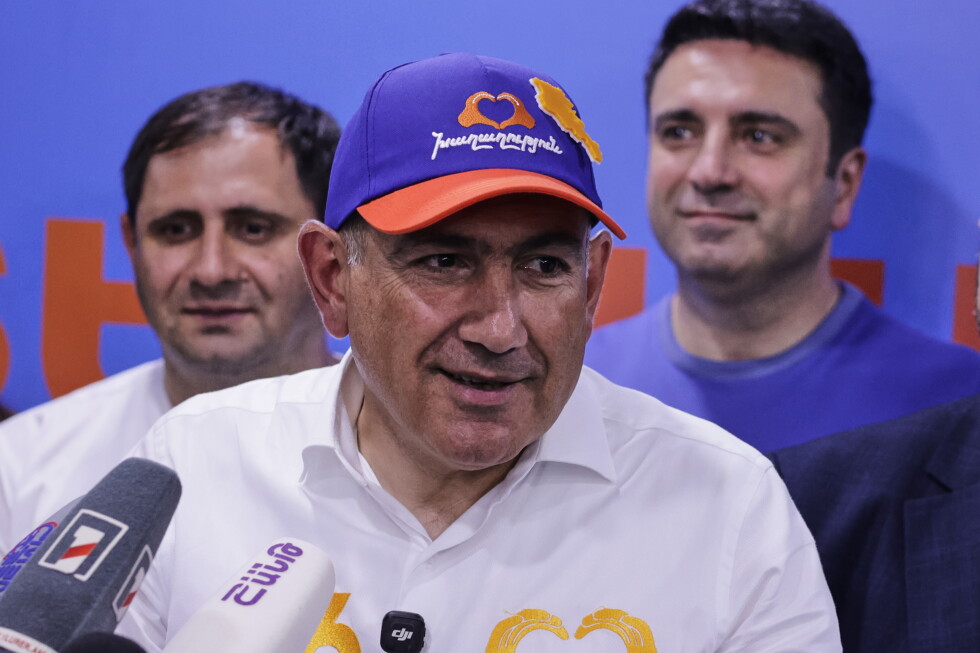
In the early hours of Monday, Armenian Prime Minister Nikol Pashinyan declared victory in the country’s snap general election, after official preliminary results confirmed his ruling Civil Contract Party secured a dominant first-place finish with 49.81% of the popular vote. The outcome of Sunday’s vote is widely viewed as a defining mandate for Pashinyan’s proposed new geopolitical trajectory for Armenia, a small South Caucasus former Soviet republic that has increasingly sought to distance itself from long-standing ally Moscow and advance its membership aspirations with the European Union.
Preliminary data from Armenia’s Central Election Commission shows that three opposition blocs crossed the 4% vote threshold required to secure seats in the new national parliament. The runner-up position went to the Strong Armenia bloc, led by imprisoned billionaire Samvel Karapetyan, who captured 23.29% of the vote. Karapetyan, who amassed his business fortune in Russia, is currently under house arrest on charges of plotting to overthrow the sitting government — allegations he has repeatedly dismissed as a politically motivated fabrication targeting his opposition. His bloc’s platform centers on rebuilding and expanding deep economic and political ties with Russia, and it has openly accused Pashinyan of reckless actions that risk triggering direct conflict with the Kremlin.
Two smaller parties also won parliamentary representation: the pro-Russia Armenia bloc took 9.94% of the vote, while Blossoming Armenia secured exactly the 4% threshold needed to enter the legislature. Final official data put overall voter turnout at 59.97%, a correction from an earlier erroneous report that incorrectly cited a 97% turnout figure.
Speaking to reporters at his campaign headquarters shortly before official results were confirmed, Pashinyan asserted his party had secured a historic landslide win and planned to form a single-party majority government without needing to enter a coalition with opposition groups.
The election outcome drew immediate congratulatory responses from top European Union leaders, who frame the contest as a critical litmus test for Russian influence across the post-Soviet space. European Commission President Ursula von der Leyen highlighted the enduring legacy of Pashinyan’s 2018 Velvet Revolution, the mass protest movement he led that ousted long-time pro-Russian leader Serzh Sargsyan. In a public social media statement Monday, von der Leyen said, “The spirit of the Velvet Revolution you led in 2018 is alive and well. We deeply value our partnership with a democratic Armenia that is drawing ever closer to Europe. Armenia can count on us.”
European Council President António Costa also extended his congratulations, emphasizing the EU’s growing strategic interest in the South Caucasus, a region that connects European energy markets to vast fossil fuel reserves in Central Asia. “Together, the EU and Armenia are building stronger links between people and creating new opportunities in energy, trade, and digitalization. Our strong partnership is an investment in a more peaceful and prosperous future for the region as a whole,” Costa wrote in a post on the social platform X.
The result comes amid mounting pressure from Moscow on Yerevan, with the Moscow-led Eurasian Economic Union previously threatening to suspend Armenia’s membership over its push to deepen ties with Brussels. The election confirms a clear popular mandate for Pashinyan’s pro-Western shift, setting the stage for new geopolitical realignment in the volatile South Caucasus region.