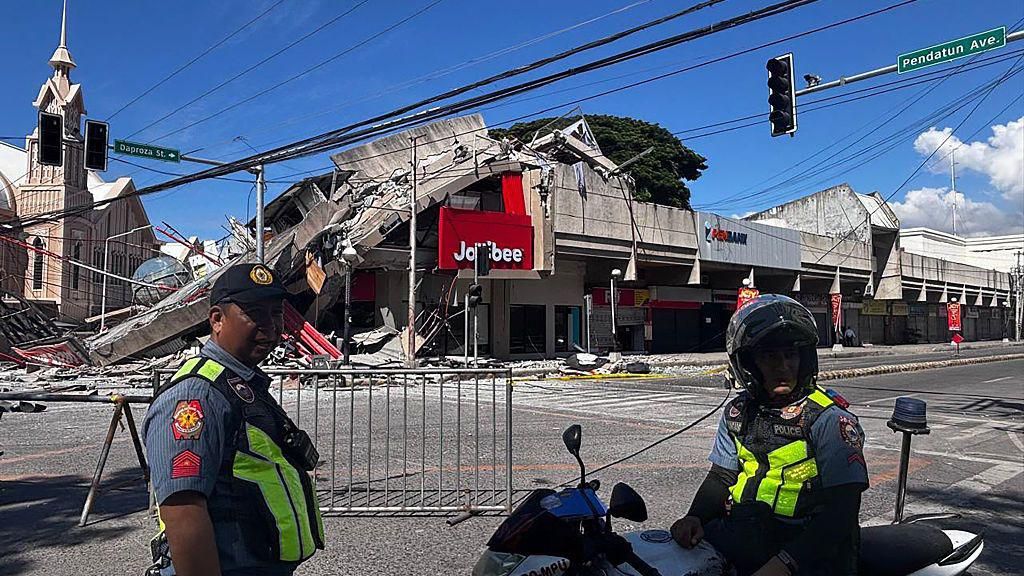
A powerful magnitude 7.8 earthquake that hit off the coast of Mindanao island in the southern Philippines has left at least 19 people dead and more than 130 injured, according to initial local official reports. The deadly seismic event struck at 7:37 a.m. local time on Monday, equal to 23:37 GMT on Sunday, sending shockwaves across the region and prompting emergency tsunami warnings across four nations: the Philippines, Indonesia, Japan, and Australia. Most of these alerts were lifted within hours of the initial quake.
Visual documentation circulating on social media and shared by local outlets captured the devastating force of the quake, showing multiple structures reduced to rubble. One widely circulated clip shows a local Jollibee fast-food outlet in a southern Philippine city completely crumbled, a striking image that has underscored the quake’s destructive power. Initial casualty counts, compiled by local authorities, list injuries across three hard-hit provinces — South Cotabato, Sultan Kudarat, and Sarangani — as well as General Santos city, the major urban center closest to the quake’s epicenter. These preliminary numbers are still undergoing formal verification by the National Disaster Risk Reduction and Management Council (NDRRMC), the national body that formalizes disaster casualty statistics by aggregating data from police, local governments, and relief organizations, a process that typically takes roughly 24 hours to complete.
In the immediate aftermath of the disaster, Philippine President Ferdinand Marcos Jr. issued a public statement confirming that national government agencies were coordinating a unified disaster response. “The national government is moving and we will not leave Mindanao behind,” Marcos assured the public. The quake coincided with the first day of the new Philippine school year, prompting Marcos to order an immediate suspension of classes across all affected regions. Footage from a primary school in Davao Occidental province captured the terrifying experience of students during the quake: dozens of children can be seen crouching on open ground as the earth shook beneath them, while a corrugated metal shelter collapsed behind the group. The school later confirmed that no students or staff were injured in the incident.
As of Tuesday morning, more than 130 aftershocks have been recorded across the region, with magnitudes ranging from a minor 1.3 up to a significant 6.7. In Sarangani, the coastal province closest to the epicenter, the initial quake knocked out power grids and mobile communication networks for several hours, though services have since been restored for most residents.
General Santos, the largest city near the quake’s origin, holds two major claims to fame: it is widely known as the tuna capital of the Philippines, and it is also the hometown of legendary world boxing champion turned politician Manny Pacquiao.
The Philippines lies along the Pacific Ring of Fire, a geologically active region where seismic activity is extremely common. While most seismic events in the country are minor and cause little to no damage, large deadly quakes are a recurring hazard. In September 2023, a magnitude 6.9 quake struck the central Visayas region, killing more than 70 people.
Immediately after the Monday quake, Japanese authorities issued an urgent warning for potential one-meter tsunami waves along the country’s coasts. By later Monday, only minor waves had been recorded: a small surge of a few centimeters hit southern Okinawa prefecture, and a 20-centimeter wave was measured in the distant Ogasawara Islands. Minor tsunami surges, ranging from a few centimeters to 1.4 meters, were also recorded along coastlines of Indonesia, Palau, and the Philippines.