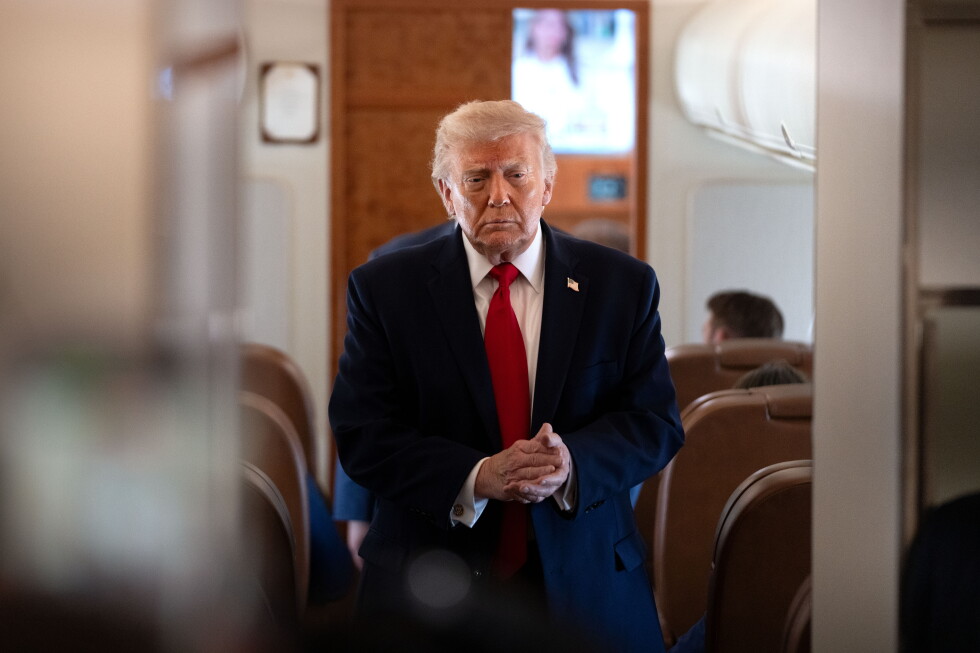
Aboard Air Force One, U.S. President Donald Trump confirmed Friday that a potential phone conversation with Taiwan’s President Lai Ching-te remains on the table, pushing back against explicit public pressure from Beijing to scrap any direct high-level engagement between the two leaders. China has long claimed the self-governing, democratic island of Taiwan as an inalienable part of its territory, and has repeatedly warned Washington against formal interactions with Taipei’s leadership.
The possibility of a call first emerged last month, shortly after Trump concluded his summit with Chinese President Xi Jinping in Beijing. At that time, Trump tied the potential dialogue to his ongoing deliberation over whether to approve a $14 billion arms sales package to Taiwan, which was greenlit by the U.S. Congress earlier in the year. When pressed by reporters Friday on whether he still planned to connect with Lai, Trump responded definitively: “I’ll always talk to him.”
A direct call between sitting U.S. and Taiwanese presidents would break a decades-long diplomatic precedent, making it a highly provocative step in the eyes of Beijing. This week, the Chinese Embassy in Washington issued a formal statement to the Associated Press warning that such a conversation would erode hard-won progress in fragile U.S.-China bilateral ties. The embassy urged the Trump administration to “handle the Taiwan question with utmost prudence” and avoid sending what it called “wrong signals” to Taipei.
This is not the first time Trump has drawn sharp condemnation from Beijing over cross-strait interactions. Immediately after his 2016 presidential election victory and before his inauguration, Trump accepted a congratulatory phone call from Taiwan’s then-President Tsai Ing-wen, a move that immediately upended decades of unspoken diplomatic protocol around cross-strait relations.
Today, Trump’s open discussion of a call with Lai comes amid lingering uncertainty over the fate of the pending arms deal. During his Beijing summit, Xi Jinping emphasized to Trump that the Taiwan question is the single most sensitive core issue in U.S.-China relations, warning that mismanagement of the dispute could lead to direct clashes and open conflict between the two global powers, per Chinese official readouts of the meeting. Trump has previously framed the approved arms sales as a “negotiating chip” in the administration’s broader Indo-Pacific policy strategy, leaving unclear whether he will ultimately greenlight the transfer.
Analysts note that Trump’s willingness to consult China on the Taiwan arms sale marks a departure from longstanding U.S. policy guidelines known as the Six Assurances, first established under the Reagan administration in 1982. The second of these nonbinding principles explicitly states that the U.S. would not agree to consult the People’s Republic of China on arms sales to Taiwan. While Secretary of State Marco Rubio reaffirmed during congressional hearings earlier this week that official U.S. policy toward Taiwan remains unchanged, experts say Trump’s public rhetoric has injected unprecedented uncertainty into cross-strait dynamics.
“Trump’s comments about framing Taiwan arms sales as a negotiating chip, combined with the uncertainty around a possible call with Lai, have created far more ambiguity than Taipei is comfortable with,” explained Craig Singleton, a China specialist at the Foundation for Defense of Democracies. “The real test will not be rhetoric — it will be whether the pending arms package moves forward, and on what timeline.”
For his part, Lai has made clear he is prepared to take the call if it happens. The Taiwanese leader has stated that he would use the conversation to stress that cross-strait peace and stability is a critical pillar of global security, and would argue that China’s increasingly aggressive military and diplomatic moves around the island are the primary threat to regional calm. Lai would also note that Taiwan’s growing defense budget and planned purchase of U.S. arms are defensive measures designed to deter aggression and maintain cross-strait stability, he has said.
Diplomatic context for the current standoff dates back to 1979, when the U.S. switched formal diplomatic recognition from Taipei to Beijing under the One China policy, which acknowledges Beijing’s position that Taiwan is part of Chinese territory. The U.S. maintains informal non-diplomatic relations with Taiwan, and has committed through the Taiwan Relations Act to provide Taipei with the defensive arms needed to maintain its security, while deliberately keeping ambiguous the question of whether it would intervene militarily if China launched an invasion of the island. Past high-level U.S. engagements with Taiwanese leaders have drawn fierce pushback from Beijing: after then-House Speaker Nancy Pelosi led a congressional delegation to Taipei in 2022, China responded with large-scale military exercises that included launching short-range ballistic missiles over the island.
After Trump’s Friday comments, the Taipei Economic and Cultural Representative Office — Taiwan’s de facto embassy in Washington — reaffirmed its commitment to maintaining close ongoing coordination with the U.S. on arms sales and other key issues. “We will leave it up to the U.S. to announce if there’s any arrangements for President Trump to speak with President Lai,” the office said in a formal statement.
Edgard Kagan, a former senior State Department East Asia policy official and U.S. ambassador to Malaysia who now holds the China Studies chair at the Center for Strategic and International Studies, noted that Beijing views a potential Trump-Lai call as even more provocative than moving forward with the proposed arms sale. Kagan added that it is notable Trump continues to publicly float the possibility of a call even after receiving explicit warnings from Chinese leaders.
Kagan laid out a potential strategic path forward for the administration: if Trump chooses to forgo the call, it could create diplomatic space to approve the arms sales while minimizing backlash from Beijing. “This could give him the room to announce an arms sale, defuse criticism that the U.S. is turning its back on Taiwan, and do it in a way that leaves the Chinese feeling there was some respect for their views,” Kagan explained.
Reporter Madhani contributed reporting from Washington.