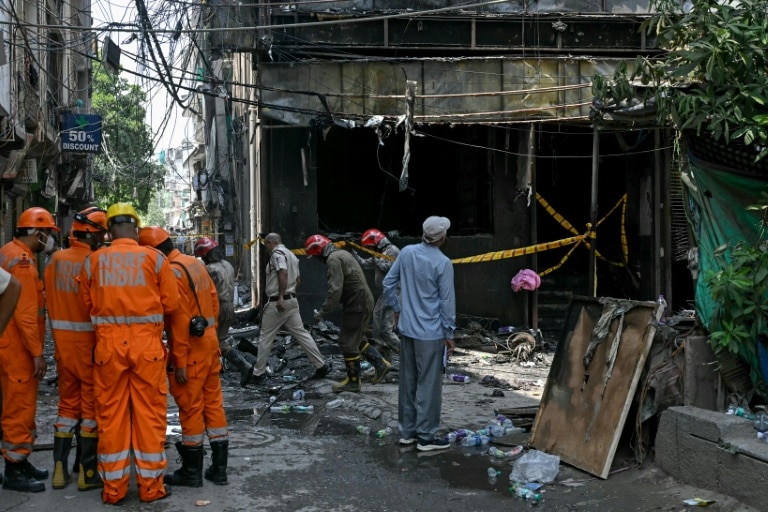
On a Wednesday morning in a crowded residential neighborhood of South New Delhi, a devastating fire tore through the Flourish Stay bed-and-breakfast, leaving at least 21 people dead and dozens more injured, in one of the deadliest urban blazes to strike the Indian capital in recent years. Local law enforcement and news outlets confirmed that a large share of the fatalities were foreign nationals, most hailing from Central Asian and African nations, many of whom had traveled to New Delhi to access affordable medical care in the city’s world-renowned healthcare hubs.
Footage broadcast on major Indian television networks captured the scale of the emergency: bright orange flames bursting from the multi-story building, thick plumes of acrid black smoke billowing into the sky, and trapped guests on upper levels leaping onto hastily placed mattresses that local residents dragged from a nearby bedding store to cushion their falls. Eyewitness Mohammad Anees, one of the first locals to respond to the crisis, told Agence France-Presse that five women successfully jumped to safety on the improvised landing pads before first responders fully arrived on scene.
By the time the blaze was fully contained eight fire engines that responded to the emergency, more than 40 injured guests had been transported to local hospitals for emergency care. A spokesperson for a nearby medical facility confirmed that eight of those patients remain in critical condition as of initial updates. Officials confirmed that 47 guests were registered at the hotel when the fire broke out.
In the wake of the tragedy, senior Indian officials have offered condolences and launched a full investigation into the incident. Prime Minister Narendra Modi’s office released a statement calling the loss of life “tragic”, extending formal condolences to all families who lost loved ones in the blaze. India’s Ministry of External Affairs has confirmed it is in constant contact with the embassies of the affected foreign nations, and is providing all necessary consular assistance to affected parties. Junior Foreign Minister Kirti Vardhan Singh shared the update via the social platform X, noting that the government remains committed to supporting all those impacted.
Preliminary investigations are still ongoing, and the exact origin of the fire has not been confirmed as of yet. However, local lawmaker Satish Upadhyay told reporters that initial site assessments found the hotel only had a single entry and exit point, and lacked adequate fire safety infrastructure and ventilation. Upadhyay added that a formal public inquiry will be launched, and any individual found to have violated safety regulations or be culpable for the tragedy will face immediate arrest.
This latest deadly fire has once again drawn attention to India’s persistent gap in public fire safety regulation. Fatal building fires are a recurring crisis across the country, driven by chronic underinvestment in firefighting infrastructure, lax enforcement of basic safety codes, and widespread non-compliance among small commercial properties. Electrical short circuits, caused by poorly maintained and outdated wiring, are the leading cause of fire-related deaths in India, and officials have not ruled out that this mechanism triggered the New Delhi blaze.
The incident is the latest in a string of deadly fire tragedies to strike India in recent years. In March of this year, a fire at a state-run hospital in eastern India killed 10 critically ill patients who were trapped in the facility. The deadliest previous blaze in New Delhi dates back to 2019, when a fire at an unregulated factory building in Old Delhi killed 43 workers who were sleeping on the premises overnight.