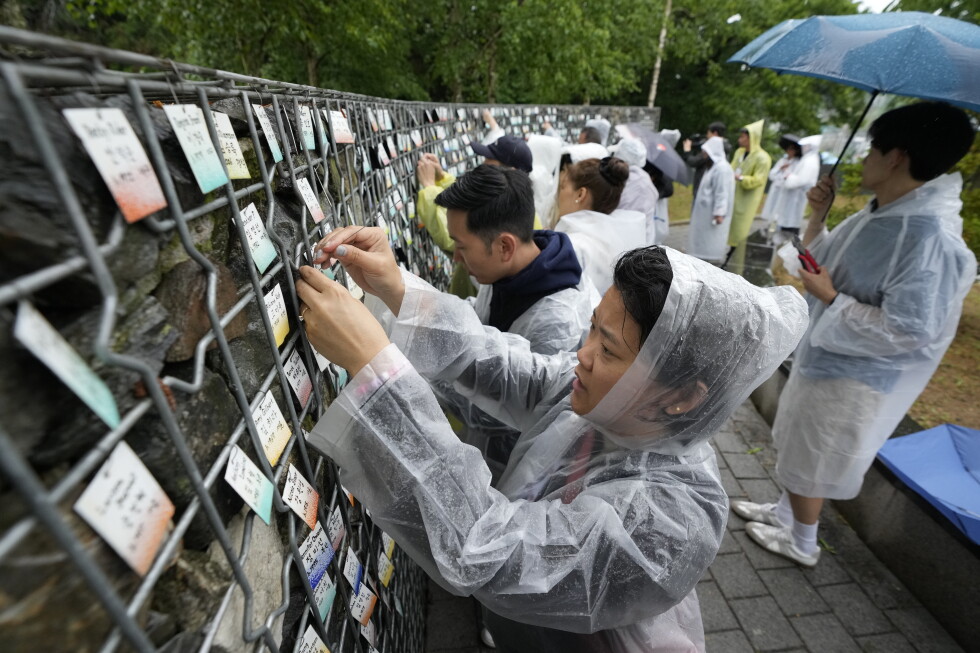
Against a misty, rain-dampened backdrop in Paju, a South Korean city just miles from the North Korean border, dozens of Korean adoptees who grew up across North America and Europe recently gathered at a former U.S. military base to add their names to a quiet, powerful memorial. Their goal: after decades apart, to leave a trace that a birth mother still searching for them might find.
The site, Omma Poom Park — its name translates to “mother’s embrace” in Korean — is home to a growing cobblestone monument covered in mesh, where adoptees hang handcrafted ceramic name tags that carry their details. As of the recent gathering, more than 900 tags hang like unmailed, waiting letters, a quiet testament to the mass separation of children from their parents that created what experts call the world’s largest adoptee diaspora.
Each hand-painted tag includes the adoptee’s full name, year of birth, and place of birth in Korea. Color coding marks the decade an adoption was finalized: most tags are red or sky blue, matching the peak decades of foreign adoption from South Korea in the 1970s and 1980s. White tags are reserved for adoptees who died without ever being reunited with their biological families. Among the dozens of tags, one laminated handwritten note flutters, left by anonymous birth parents searching for a daughter they named Bora: “You are not alone. You have a mother and a father. I’m so sorry and I love you.”
The history of foreign adoption from South Korea stretches back to the end of the 1950-1953 Korean War, when the first wave of children sent abroad were mixed-race kids born to Korean women and U.S. soldiers, who were widely stigmatized as outcasts in Korean society at the time. Adoption numbers surged in the 1970s, when the country’s former military dictatorship pushed for large-scale foreign placement of full-Korean children, most often born to unwed mothers or families living in extreme poverty. From the 1970s through the mid-2000s, thousands of Korean children were sent to Western homes every year, with adoption numbers peaking at more than 6,600 placements annually in the 1980s, as the authoritarian government sought to reduce domestic population pressure.
After a yearslong advocacy campaign led by Paju-based photographer Lee Yong-nam and adoptee support nonprofit Me & Korea, Omma Poom Park opened to the public in June 2025. Lee, now 72, first became invested in adoption justice after spending decades searching for a Black-Korean childhood friend who was adopted to the United States as a child. “Adoptions continued unchecked and now the pain is surfacing,” he explained of the adoptees who travel to the park to add their names to the wall, most of whom are younger than the war generation that first saw widespread adoption.
On a neighboring hill overlooking the park, a converted former U.S. Army building operates as a dedicated museum that holds nearly 1,000 adoptee profiles, each featuring a photo, birth details, and a personal message to the adoptee’s birth mother.
One of those profiles belongs to Angela Lee-Pack, who was adopted by a family in Ontario, Canada, in 1971 when she was just 2 years old. Growing up, Lee-Pack endured severe abuse at the hands of her adoptive mother, including being locked in a closet without food, and later experienced further abuse in a second foster home before leaving at 15 and struggling for years to build a stable adult life. “I think about you every day and only wish the best for you,” she wrote to her biological mother. “I hope one day I will be able to know who I am.”
Lee-Pack has traveled to South Korea twice to search for her birth mother, posting flyers across Seoul and the southern city of Jeonju. During her first trip in 2019, a man contacted her believing she was the daughter of his late uncle. The lead gave her hope, but it slowly and painfully unraveled: eventually, the man tracked down a woman in her 70s whose background matched Lee-Pack’s adoption records, but she denied ever giving up a child and refused to meet. Lee-Pack collapsed in her hotel room and cried for hours. “Every time I look in the mirror I wonder who she is and what she looks like,” she said. “The thoughts never end.”
For Nicole Rieth, who was adopted to a family in Michigan at 4 months old in 1989, becoming a mother of two sons pushed her to launch her own search for her birth mother. Her adoption records note that she was the third child of a Seoul couple who surrendered her shortly after birth in 1988, citing extreme financial hardship at a time when the government was aggressively pressuring families to limit their number of children. Rieth first began her search in 2024, but letters sent by her adoption agency to her birth mother’s last known address went unanswered. She is now continuing her search through South Korea’s National Center for the Rights of the Child, a government agency, in the hopes that her sons will one day know the cultural heritage she never got to grow up with.
“I kind of don’t allow myself to hope because the whole journey has been a roller coaster of hoping, finding something out, and diving down into hopelessness, getting a glimmer of a maybe,” Rieth said. “And yet I want to exhaust every effort … so that there are no regrets.” For her, the act of putting her name on the wall at Omma Poom is not about forcing a relationship with her birth mother. “I’ve just always wanted to know who I looked like, because I’ve never had that before,” she explained.
Decades of unregulated adoption have left deep, lasting scars on both adoptees and their biological families. At the peak of foreign adoption, South Korean authorities largely turned a blind eye to rampant systemic fraud, including illegal procurement of children from hospitals and orphanages and deliberate falsification of children’s origins to speed up international placements. Tens of thousands of children were falsely labeled as abandoned orphans to make them eligible for adoption, leaving generations of adoptees with no clear information about their identity, family history, or the circumstances of their separation. On the other side, birth mothers were often pressured to surrender children born out of wedlock, some were separated from their children without their full consent, and many spent decades searching only to learn their children were sent overseas with falsified paperwork.
The recent gathering at Omma Poom came just weeks after a group of birth mothers formally asked South Korea’s Truth and Reconciliation Commission to open an investigation into the illegal adoptions of their children, joining hundreds of existing fraud and abuse claims filed by adoptees across the globe.
Jalyn Smith, who was adopted to Michigan in 1993, had her adoption agency locate her birth mother in 2021. According to adoption records, the woman had surrendered Smith after separating from Smith’s biological father — but she declined to meet or have any contact. Five years later, Smith is continuing her search, and chose to add her name to the memorial wall. “Hanging it up, I felt proud,” Smith said. “I feel proud to be part of this community, though it comes with a lot of conflicting feelings of sadness and anger and grief.”