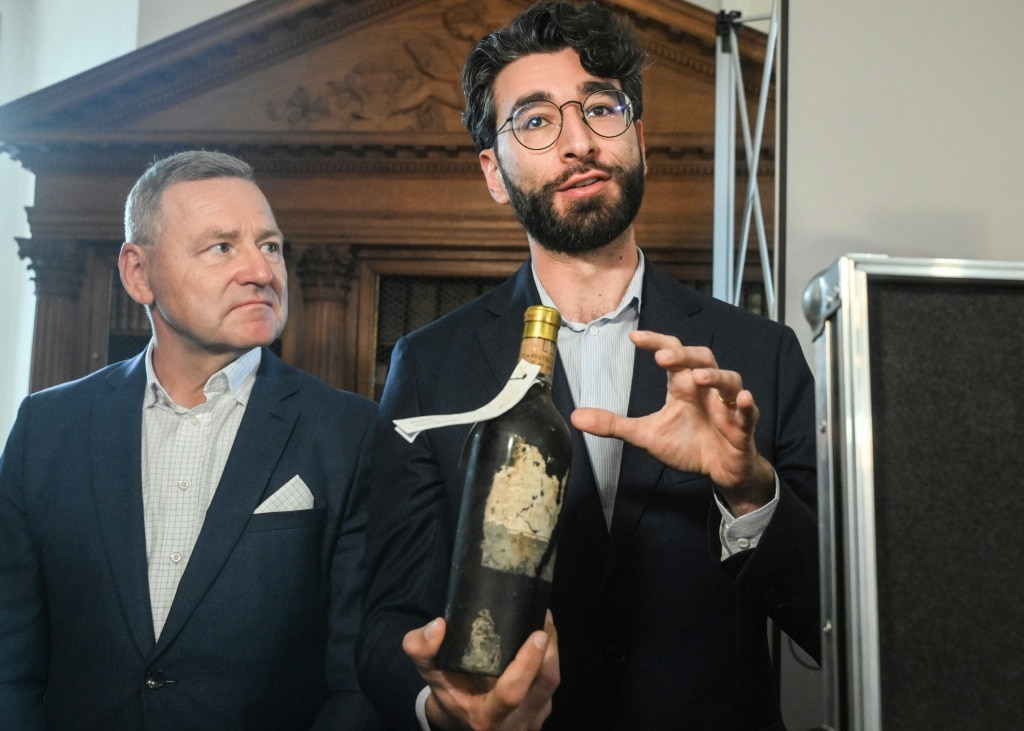
A remarkable piece of viticultural history has been brought back to life after more than a century of hiding: eight bottles of legendary 130-year-old Chateau d’Yquem Sauternes wine, which survived both World War II and decades of communist rule tucked beneath the floorboards of a Czech castle, have been carefully restored by the very Bordeaux winery that originally produced them.
The bottles form part of a larger 136-bottle rare spirit collection unearthed in the 1980s at Becov nad Teplou Castle in western Czechia, and all the recovered bottles are set to go on public display once preparations are complete. The collection originally belonged to the noble Beaufort-Spontin family, who were forced to flee Czechoslovakia abruptly at the close of World War II over allegations of collaboration with Nazi occupying forces. In their haste to leave, they hid their valuable wine assortment beneath the floorboards of the castle’s chapel, right next to the revered Shrine of St Maurus, where it lay undisturbed for four decades.
In 1985, communist secret police stumbled upon the hidden collection during a search. While the Shrine of St Maurus was immediately transported to Prague for extensive restoration work before returning to Becov for public display in 2002, the forgotten wine was left undisturbed in its original hiding spot. It was not until a routine inventory audit a decade later that the cache was rediscovered, prompting a meticulous, years-long rescue and restoration project led by Chateau d’Yquem, the iconic producer of some of the world’s most expensive and sought-after sweet white wine from Bordeaux’s Sauternes region.
The eight bottles restored by the winery were produced in two vintages: 1892 and 1896. Working to verify and preserve the rare liquid, the winery’s team conducted careful sensory testing to confirm the wine’s authenticity. “We tasted a very small quantity to be sure that, aromatically and in terms of balance on the palate and overall perception, the wine corresponded to a Chateau d’Yquem of that age,” explained Toni El Khawand, cellar master at Chateau d’Yquem. Follow-up laboratory analysis confirmed the wine’s provenance, allowing the team to move forward with conservation work: original degraded corks were replaced, fresh protective capsules were fitted to the original glass, and in some bottles where significant oxidation had occurred, the wine was transferred to new containers. As a result of this necessary conservation, only five fully intact original bottles will return to Becov for display.
El Khawand described tasting the well-preserved wine, which survived the decades-long burial thanks to its naturally high sugar content that acts as a preservative, as an extraordinary experience. “What we’re really doing when we open it is unveiling a time capsule. We pull out this cork that has sealed the liquid off from its surroundings and, in a way, from the passage of time,” he told reporters at the official presentation of the restored bottles.
Against all expectations, the 130-year-old wine retained remarkable brightness and complexity. “The wine impressed us with its freshness on the palate. It is very, very fresh, with an almost acidic freshness,” El Khawand noted. He went on to detail the wine’s layered bouquet, highlighting notes of cedar, dried fruit, saffron, cinnamon and nutmeg, alongside age-characteristic Chateau d’Yquem notes of chocolate, coffee, mocha and oud.
While recent vintages of Chateau d’Yquem already retail for hundreds of dollars per bottle, the Czech National Heritage Institute estimates the entire 136-bottle recovered collection would fetch roughly $5 million if put up for auction. El Khawand, however, emphasized that the wine’s value extends far beyond its market price. “First and foremost, it has moral and historical value,” he said. “It is a memory, ultimately — a liquid memory, to be sure — but it is a memory of all those who came before us, of the work that was done.”
There are currently no plans to auction the collection. Instead, Becov Castle is preparing a public exhibition that will showcase all recovered bottles of wine and cognac, including other rare vintages such as an 1899 Pedro Ximenez sherry and an 1892 port. To fund the exhibition space and further restoration work, the castle has launched a public fundraising campaign. If enough funds are raised, collections manager Katerina Nyvltova says the team plans to conduct more in-depth analysis of the remaining wines and complete restoration of all salvageable bottles in the collection. “If we raise the money, we will definitely want to do a more thorough analysis of the wines. And if we can recondition the rest, we’ll definitely go for it,” she told AFP.