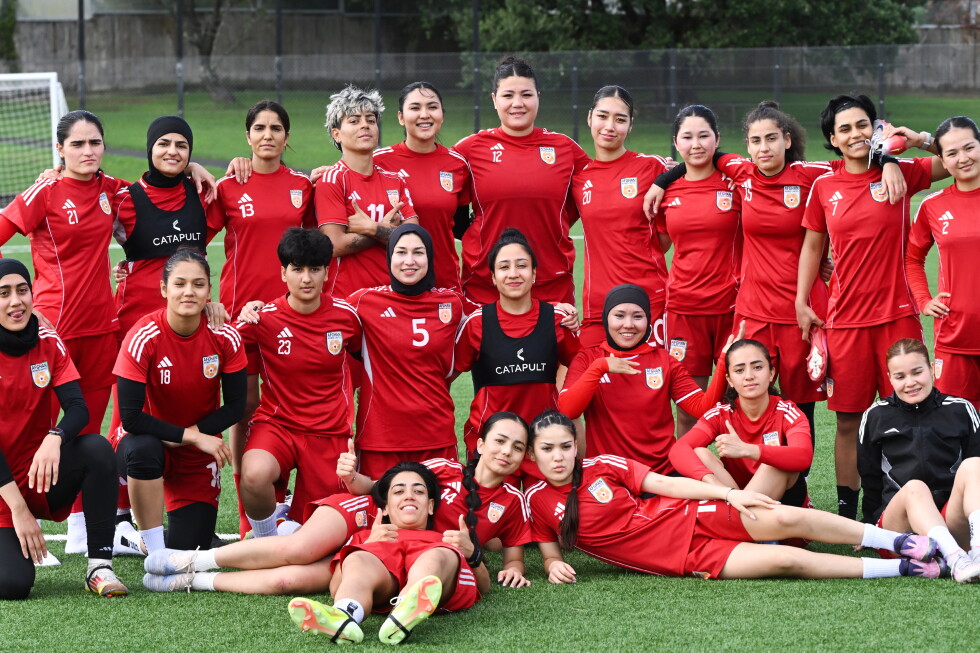
AUCKLAND, New Zealand – For thousands of displaced Afghan women soccer players, the dream of representing their homeland on the international pitch seemed dead after the Taliban’s 2021 return to power, which immediately banned all women’s sports across the country and forced the entire national women’s squad into hiding. Today, that impossible dream is one step closer to reality, after FIFA granted the exiled team official eligibility to compete in global competitions – a milestone years in the making for a group of athletes who have refused to let displacement and oppression erase their passion.
The journey began in 2021, when a urgent evacuation effort relocated 13 core members of the former Afghan national women’s team to Australia, where they spent the next five years rebuilding their lives, training relentlessly, and holding out hope that they would one day earn the right to wear their nation’s crest again. Today, the team’s roster has grown to 23 players through the Afghan Women United program, with members scattered across Australia, Europe, and the United States, all brought together for training camps and matches by head coach Pauline Hamill. This week, the full squad has gathered in Auckland, New Zealand for a intensive training camp ahead of an upcoming friendly match against a representative side from the Cook Islands.
For the players, FIFA’s April recognition marks the end of a years-long fight that began long before the 2021 Taliban takeover. Even when the former Afghan government was in power, female players faced steep cultural barriers, constant threats of violence, and widespread pushback from conservative segments of society. Goalkeeper Fatima Yousufi, who now lives and studies in Melbourne, escaped Afghanistan with nothing but a single backpack, fleeing the threat of violence against women who dared to play sports. She recalled the crushing disappointment when the team was initially denied official status after their evacuation.
“When we first arrived here, we had already lost everything: our families, our childhood homes, our connection to the country we loved,” Yousufi told reporters. “The only thing we had left was our identity as soccer players, as the Afghan national team. When we couldn’t play officially, it felt like we had lost the game before we even stepped onto the pitch. When we got the news from FIFA, it was the greatest thing that could have happened to us. We actually have a national team again.”
Midfielder Mona Amini, another core team member who also resettled in Australia, called FIFA’s decision a vindication of the years of hard work and sacrifice the squad put in after their displacement. She pointed to a 2023 friendly tournament where the team defeated Libya, marking the first time the squad had played an official international match since the Taliban takeover – and the first time in three years the team heard the Afghan national anthem played before a game.
“That moment was something I will never forget,” Amini said in a recent Zoom interview. “This recognition we have now is the result of four or five years of nonstop work, every single day. We never gave up.”
For the team, the fight goes far beyond the soccer pitch. Back in Afghanistan, women and girls remain banned from all secondary education, public recreation, and most organized sports, with the Taliban barring women from leaving the country without a male guardian and restricting nearly all aspects of public life. The exiled players see themselves as representatives and voices for the millions of women and girls still trapped under Taliban rule, working to prove that Afghan women deserve equal access to education, sport, and public life.
“We are here not just to play soccer,” Amini said. “We are here to be a voice for all the girls back home who cannot chase their dreams. We want to build a new generation of Afghan women soccer players, and show the whole world what we can do. The Taliban took our freedom, but they can never take our ambition or our right to do what we love.”
Yousufi added that the team hopes to change global perceptions of Afghan women, and push for greater rights for those still living in the country. “Our team might be the one to change the way people think, and change the situation for girls and women in Afghanistan,” she said. “We all work every day to show that women and girls belong in every part of society – in education, in sport, everywhere. We have the same rights as anyone else to follow our dreams.”