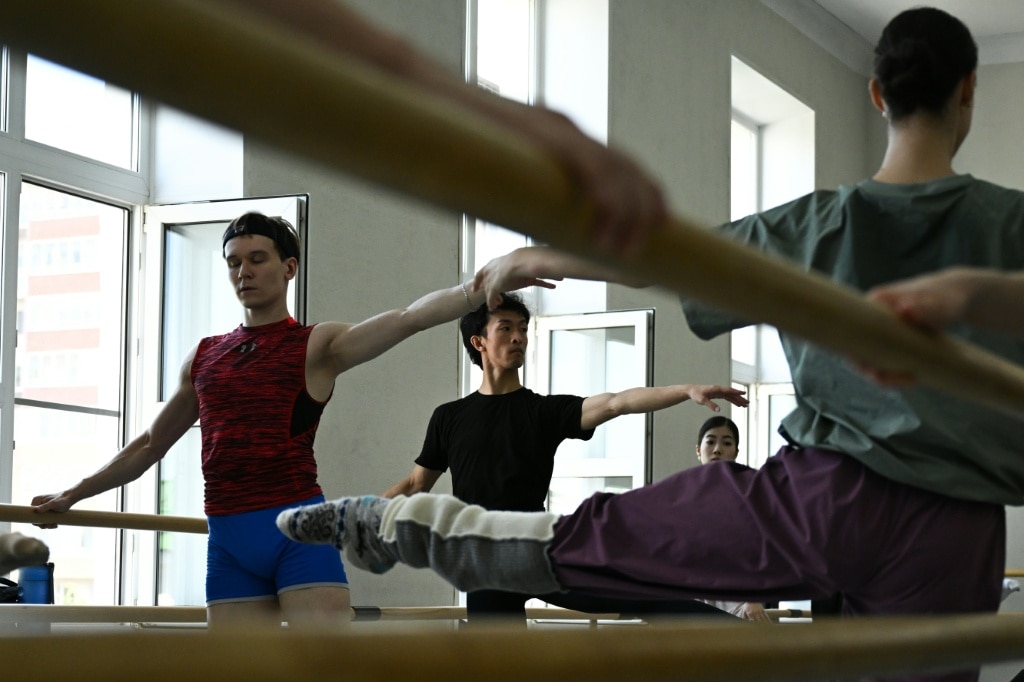
Deep in Russia’s historic Volga region city of Nizhny Novgorod, two Japanese ballet artists have built their entire lives around the rigorous, demanding craft they traveled halfway across the world to master – even as geopolitical upheaval and the ongoing war in Ukraine have created unexpected disruptions to their daily routines.
Thirty-two-year-old Jotaro Kanazasi first made the decision to move to Russia 14 years ago, drawn to the country’s unrivaled legacy in classical ballet, home to world-renowned institutions like Moscow’s Bolshoi Theatre and St. Petersburg’s Mariinsky Theatre. Speaking in measured Russian, Kanazasi explains his choice was rooted in a desire to grow and reach his full potential as a professional dancer. Today, he holds the position of principal dancer at the Nizhny Novgorod Opera and Ballet Theatre, located roughly 400 kilometers east of Moscow, where he seamlessly transitions from iconic role to iconic role: the scheming sorcerer Rothbart in Swan Lake, the tragic noble Albrecht in Giselle, and more. When many foreign artists made the choice to leave Russia immediately following the start of the 2022 full-scale military campaign in Ukraine, Kanazasi made the deliberate decision to stay.
For 20-year-old Haruka Takemi, who has now lived in Russia for six years, the draw of Russian ballet was similarly life-altering. “I love Russian ballet and I have always dreamed of being a professional dancer, but Japan does not have a national-level ballet school that offers the training I needed,” she explains. “That is why I chose to move here.”
Both dancers say they prioritize their craft above all else, and only follow breaking news about the war in Ukraine very loosely. Takemi notes that it is her family back in Japan that monitors current events closely, constantly sharing news articles and updates to make sure she stays informed. That dynamic reflects the broader geopolitical context of their lives: Japan has stood firmly with Ukraine since the start of the Russian offensive, joining Western nations in imposing sweeping economic sanctions on Moscow, while Russia has introduced strict new censorship laws over the course of its military campaign, unmatched since the Soviet era.
“I am either at the theatre rehearsing or performing, or at home resting – it is a constant cycle. I work all the time, and I only focus on ballet,” Takemi says, adding that her family back home is the one who carries the worry for her safety.
Nizhny Novgorod, despite sitting more than 800 kilometers from the Ukrainian border, has not escaped the ripple effects of the conflict. In recent weeks, a major Lukoil oil refinery located in the nearby city of Kstovo was hit in a Ukrainian cross-border strike, part of Kyiv’s regular targeting of Russian military and energy infrastructure designed to weaken Moscow’s ability to sustain its offensive. The digital space has also seen significant changes: Russia has imposed sweeping new digital restrictions over recent months, particularly limiting open access to mobile internet, and many popular foreign apps are now blocked.
“There are difficulties with internet access, so we have to use a VPN to connect,” Takemi says. “But it is important for me to stay in touch with my family, so they know I am safe.”
Valeri Konkov, director of the Nizhny Novgorod ballet company, notes that Japanese dancers are far from an anomaly in Russia’s professional ballet scene. Many are graduates of the country’s most elite ballet academies, including the Moscow State Academy of Choreography, St. Petersburg’s legendary Vaganova Academy, and the Perm State Ballet School. For Japanese artists, building a sustainable career in classical ballet in their home country remains incredibly challenging, even now. Despite all the disruptions and uncertainties that have come with the conflict, Kanazasi says his resolve to stay has never wavered.
“As long as I am still able to dance, I will stay here,” he says.