Global financial markets faced fresh downward pressure on Tuesday, driven by the resurgence of armed conflict between the United States and Iran that has undermined a recently brokered ceasefire and stoked new fears over energy supply disruptions.
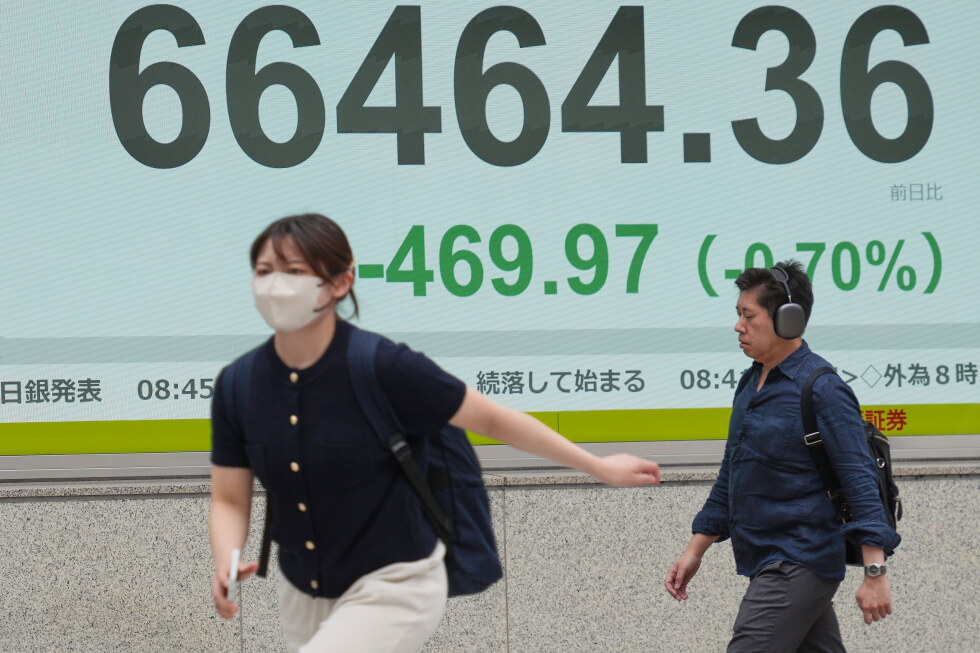
Most major Asian equity benchmarks ended the trading day in negative territory as investors pulled back from risk assets amid escalating geopolitical tension. Japan’s benchmark Nikkei 225 index fell 1.6% to close at 65,833.49, while South Korea’s Kospi dropped 1.7% to settle at 8,642.82. Australia’s S&P/ASX 200 also shed 0.4% to reach 8,692.20, and China’s Shanghai Composite posted a minor dip of less than 0.1% to close at 4,056.56. In a rare bright spot for the region, Hong Kong’s Hang Seng Index bucked the downward trend to gain 1.2%, finishing at 25,698.75. U.S. futures also moved lower in early Asian trading, extending the risk-off sentiment across global markets.
The downturn in Asia comes on the heels of a record-setting session on Wall Street Monday, when U.S. equities notched new all-time closing highs. The broad S&P 500 added 0.3% to close at 7,599.96, the Dow Jones Industrial Average gained 0.1% to finish at 51,078.88, and the tech-heavy Nasdaq composite climbed 0.4% to end the day at 27,086.81. Chipmaking giant Nvidia led market gains, jumping 6.2% after CEO Jensen Huang unveiled a slate of new product updates at an industry conference. As the world’s largest publicly traded company by market capitalization, Nvidia’s performance exerts an outsize influence on overall U.S. market movements. In the U.S. bond market, the 10-year Treasury yield ticked up to 4.46% by the end of trading Monday, up slightly from 4.45% late Friday, after briefly touching a high of 4.52% during the session.
Geopolitical volatility has sent energy prices swinging in recent sessions, with crude oil remaining far elevated from pre-war levels. After rising in overnight trading Monday, benchmark U.S. crude lost 39 cents to trade at $91.77 per barrel in early Asian trading Tuesday. Brent crude, the global pricing benchmark for oil, fell 28 cents to $94.70 per barrel. Even with this minor pullback, both benchmarks remain well above the roughly $70 per barrel price seen before the outbreak of the current conflict. Higher oil prices have already hit U.S. companies with high fuel costs: United Airlines shares fell 2.6% Monday, while Alaska Air Group dropped 3.3%.
Analysts warn that the current energy market squeeze is spreading beyond crude oil inventories to the refined fuels that power everyday economic activity. “Crude shortages have already forced refiners across Asia and Europe to aggressively reduce runs,” said market analyst Stephen Innes. “The result is that the squeeze is no longer confined to crude inventories. It is spreading into the fuels that actually power economies: gasoline, diesel, jet fuel, LPG, and naphtha.”
Much of the future trajectory of global energy prices and inflation hinges on whether the U.S. and Iran can reach a lasting agreement to reopen the Strait of Hormuz, a critical chokepoint through which a large share of global oil supplies pass from the Persian Gulf. A reopening would resume normal oil deliveries and ease upward inflationary pressure on global markets. Japan, which imports nearly all of its oil needs, has so far avoided extreme price spikes for gas and other energy products by releasing national petroleum reserves, but the long-term impact of sustained high prices remains uncertain.
The latest escalation in tensions comes after a series of tit-for-tat strikes over the weekend. On Monday, the U.S. announced it had bombed Iranian radar and drone sites after Tehran shot down an American drone. Iran also claimed it launched missile strikes targeting U.S. soldiers stationed in Kuwait, a strike U.S. officials said they successfully intercepted. While U.S. President Donald Trump announced that Israel and Hezbollah had agreed to de-escalate hostilities following his conversations with Israeli Prime Minister Benjamin Netanyahu and mediated communications with the Lebanese militant group, the renewed fighting between the U.S. and Iran has erased early hopes of a broad regional ceasefire.
In currency markets, the U.S. dollar posted a minor gain against the Japanese yen, rising to 159.70 yen from 159.66 yen. The euro held steady, remaining unchanged at $1.1631.