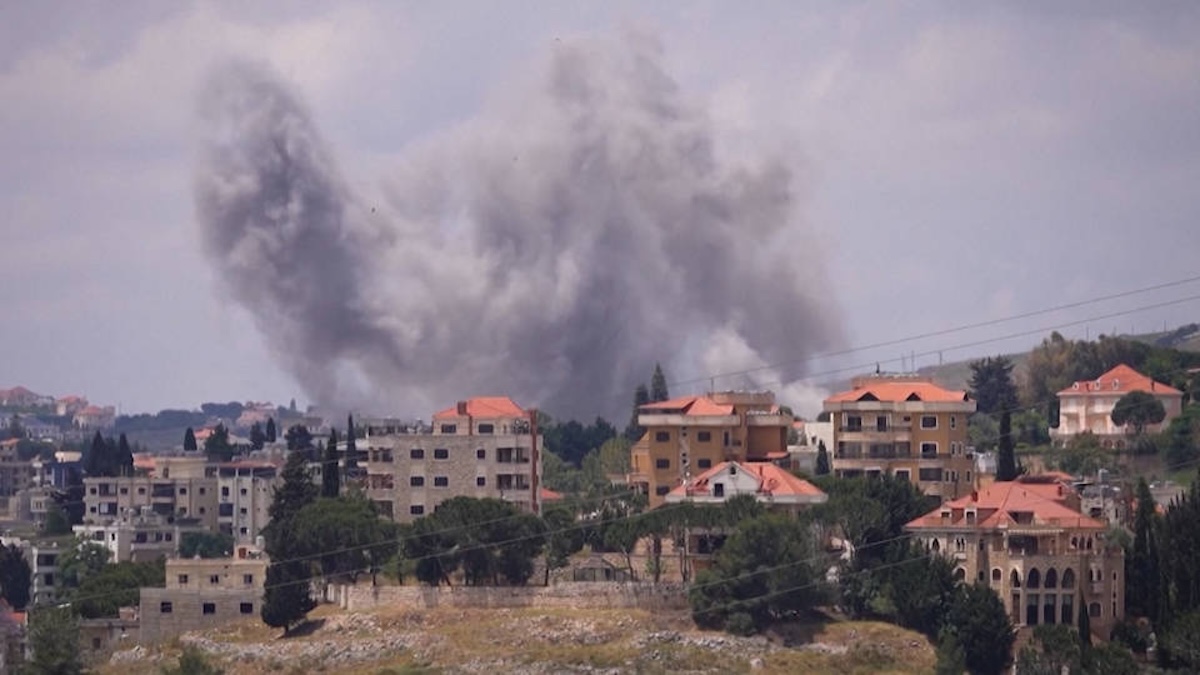
On Monday, a fresh wave of diplomatic and military upheaval roiled the Middle East, as Iran paused indirect negotiations with the United States in response to Israel’s intensifying military campaign in Lebanon – just hours before former President Donald Trump announced unexpected claims of a de-escalation between Israeli forces and the Lebanese militant group Hezbollah.
The escalation traces back to joint military strikes launched by Trump and Israeli Prime Minister Benjamin Netanyahu against Iran in late February. Since that offensive began, Iranian officials and independent global analysts have repeatedly charged that Israeli leadership is intentionally working to sabotage any diplomatic path toward a lasting regional ceasefire.
Iran’s state-owned Tasnim News Agency, which has close ties to the country’s Islamic Revolutionary Guard Corps (IRGC), confirmed the suspension of mediated talks on Monday. In its official announcement, the outlet noted that a full ceasefire across all fronts, including Lebanon, had been a core precondition for continuing negotiations. With Israeli attacks ongoing across Lebanese territory, that precondition had been fully violated, prompting Tehran’s negotiating team to pause all talks and draft exchanges through third-party intermediaries.
In an official statement published by the IRGC-affiliated outlet, the corps warned that any crossing of Iran’s red lines in Lebanon and Gaza constitutes a direct act of war that threatens Iranian national security and the broader Islamic Resistance movement. In response to ongoing violations, the statement confirmed Iran would carry out defensive operations via unconventional tactics, open new military fronts, and maintain its current leverage over the Strait of Hormuz, one of the world’s most critical global chokepoints for energy trade.
Tehran has already leveraged this leverage in response to the US-Israeli offensive, restricting commercial vessel traffic through the strait – a key transit route for global fossil fuel and fertilizer shipments. As international oil prices have spiked sharply in response to the supply chain disruption, Trump imposed a US naval blockade of Iran, a measure he has continued to uphold even after a tentative April ceasefire agreement that Israel initially argued did not apply to military operations in Lebanon.
Shortly after news of Iran’s negotiation suspension broke, Trump spoke to NBC News, saying he had not received official notification of Tehran’s decision, but downplayed the development, saying “I think it’s fine if they’re done talking.” He added that “they’re better negotiators than they are fighters, but they haven’t informed us of that,” and stressed that the US would not immediately launch a new round of widespread bombing.
Trump’s comments came just days after his administration launched new targeted strikes against Iranian assets over the weekend, which were followed by Iranian retaliatory attacks on US military installations across the Middle East. The president reaffirmed that the US naval blockade would remain in place, adding: “If they don’t want to talk, that’s OK with me. I think it’s fine. I don’t particularly want to talk either. We talk too much.”
Less than a day after those remarks, however, Trump posted a correction and new announcement on his Truth Social platform, stating he had held what he called a “very productive call” with Netanyahu. In the post, he claimed “there will be no Troops going to Beirut, and any Troops that are on their way, have already been turned back.” He added that he had also held indirect talks with Hezbollah representatives through a third party, and that the group had agreed to a full ceasefire: “That Israel will not attack them, and they will not attack Israel.” Within 15 minutes of that post, Trump added a follow-up note confirming that talks with the Islamic Republic of Iran were “continuing, at a rapid pace.”
While Iran’s top leadership had not formally confirmed the suspension of talks as of Monday evening, Iranian Foreign Minister Abbas Araghchi issued a clear warning on social media, stating that the existing ceasefire between Iran and the US unequivocally applies to all fronts, including Lebanon. “Its violation on one front is a violation of the ceasefire on all fronts,” he wrote, adding that the US and Israel bear full responsibility for any consequences that stem from the breach.
Mohammad Bagher Ghalibaf, Iran’s chief nuclear negotiator and Parliament Speaker, echoed that stance, arguing that the ongoing US naval blockade and the escalation of what he called “war crimes” in Lebanon by the “genocidal Zionist regime” are clear proof the US has failed to uphold its ceasefire commitments. “Every choice has a price, and the bill comes due. It will all fall into place,” he said.
Independent regional analysts have framed Iran’s actions as a clear response to Israel’s escalating campaign, with a consistent red line linking Lebanese security to the future of broader diplomacy. “The Iranian message is increasingly clear: no Lebanon ceasefire, no broader framework, and potentially no talks at all,” explained Sina Toossi, senior nonresident fellow at the Washington-based Center for International Policy. Toossi noted that negotiations have fallen into a damaging cycle: “progress, escalation, backtracking.” Many Iranian leadership suspect Trump is intentionally seeking to push down global oil prices ahead of potential further military expansion, while Israel is working to completely derail diplomacy by turning southern Lebanon into a second Gaza, he added.
The tactics Israel is deploying in Lebanon mirror the “Gaza playbook,” Toossi argued, including widespread scorched-earth operations, mass forced displacement of civilian populations, and what he characterized as ethnic cleansing of the small neighboring country.
Other analysts have echoed this comparison, pointing to the ongoing humanitarian catastrophe in Gaza, where Israel faces widespread global accusations of perpetrating genocide against the besieged Palestinian population. Assal Rad, a fellow at the Arab Center Washington DC, criticized mainstream media coverage of Israel’s Lebanon escalation, noting that just as the phrase “targeting Hamas” is used to justify widespread destruction in Gaza, labeling areas “Hezbollah-controlled” is used to justify flattening entire civilian neighborhoods in Lebanon. “This isn’t journalism, it’s stenography,” she said, sharing publicly available satellite imagery that shows widespread destruction of residential infrastructure across southern Lebanon. “This is what Israel’s total destruction of southern Lebanon looks like, deliberately destroying people’s homes so they have nothing to return to.”
Mohamad Safa, who resigned earlier this year as a United Nations representative for the nongovernmental organization Patriotic Vision Association, issued a blunt accusation Monday: “Israel is committing another genocide in real time in Lebanon with complete impunity.”
Former US Department of Defense advisor Jasmine El-Gamal, who now leads global consulting firm Averos Strategies, noted that the current crisis in Lebanon highlights a long-building conflict of interest between the US and Israel. “Early in the Iran war, I warned that US and Israeli interests would inevitably diverge and that President Trump would have to make a choice: to actually put America first, or to continue to allow Netanyahu to threaten our interests,” El-Gamal said early Monday. “Lebanon is the epitome of this choice.”