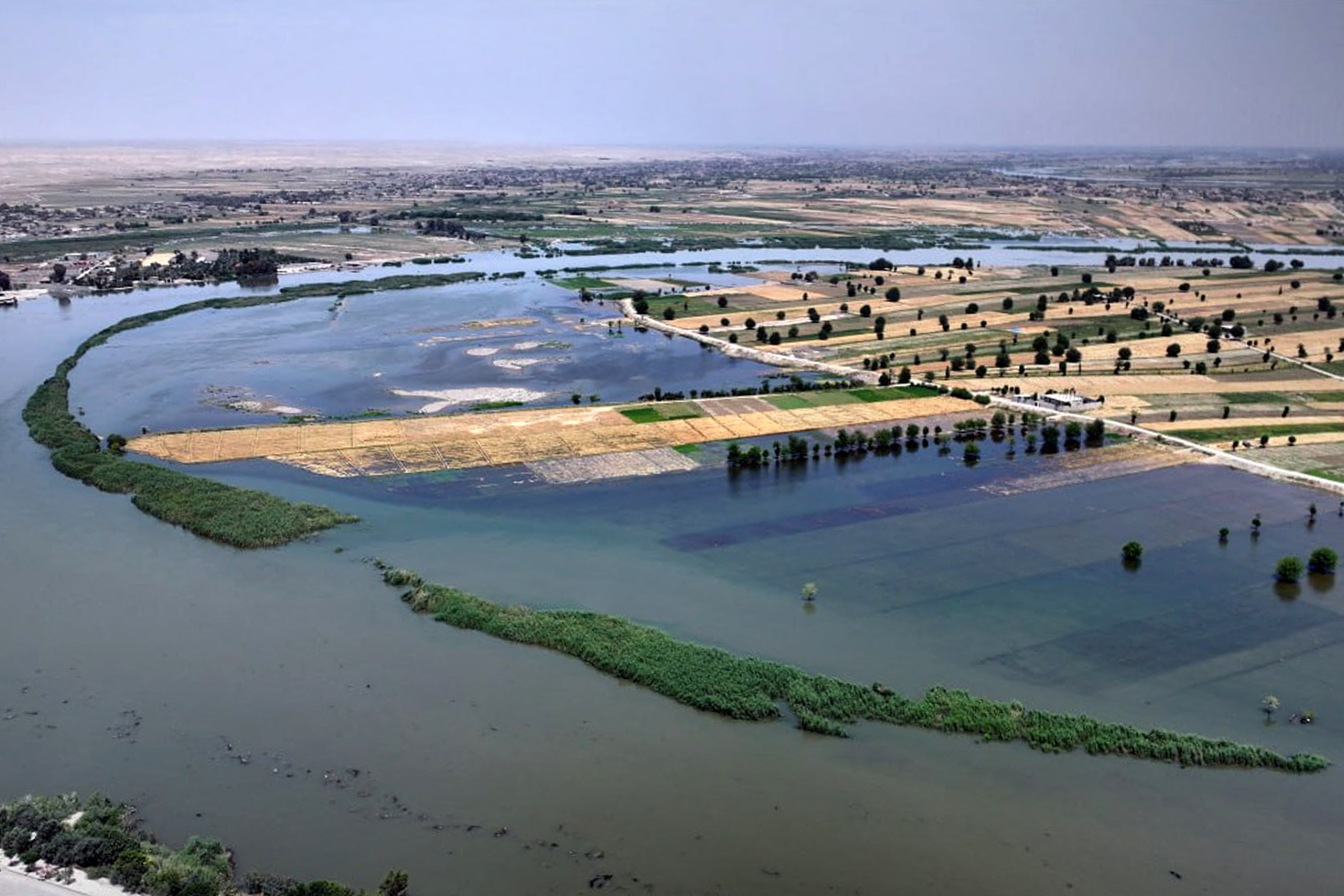
A devastating flood event triggered by sharply rising water levels along the Euphrates River has left more than 2,400 families across Syria’s eastern Deir Ezzor province grappling with widespread disruption, submerging entire rural villages, destroying critical farmland, and cutting off access to basic life-sustaining services across the hard-hit region.
The flood crisis, which has been most severe in Deir Ezzor and neighboring Raqqa governorate since the unexpected water surge began on May 26, has been officially attributed by Syria’s Ministry of Energy to two key factors: unusually heavy rainfall across the river basin this season, and the opening of floodgates on upstream dams located in Turkish territory along the Euphrates.
Labeling the sudden increase in cross-border water flows as “unprecedented”, the Ministry of Energy confirmed that it took the emergency step of opening three spillway gates at Syria’s own Euphrates Dam — a measure not required for more than three decades — to reduce dangerous structural pressure on the key infrastructure.
By the end of the first week of the crisis, Syrian authorities announced that diplomatic and technical coordination between the Syrian government and their Turkish counterparts had yielded progress, with Turkey beginning to reduce the volume of water released into Syrian territory via the river.
In a public video statement posted to the social platform X, Syrian Energy Minister Mohammad al-Bashir confirmed that water levels along the entire stretch of the Euphrates running through Syria are gradually stabilizing after the emergency structural measures implemented at the country’s main Euphrates Dam. He added that government monitoring teams will remain deployed around the clock to track water conditions until levels return to their normal, safe range.
Tragedy struck in the early hours of the flood emergency, when three children lost their lives after entering the swollen Euphrates to swim, despite repeated public warnings issued by Syria’s Emergency and Disaster Management Minister Raed al-Saleh to avoid all contact with the dangerous rising waters.
Beyond the fatal incident, the swelling floodwaters forced dozens of households to flee their inundated residences, and left multiple small villages partially cut off from the outside world after key access roads and river crossing structures were damaged or swept away by the current.
In response to the crisis, Syrian emergency response teams have been deployed across the affected region to carry out urgent work: reinforcing vulnerable riverbanks to prevent further breach, coordinating the evacuation of residents from high-risk low-lying areas, and conducting systematic assessments of damage to public and private infrastructure.
On Friday, al-Saleh issued an official update confirming that water levels across the affected stretch of the Euphrates have returned to normal baseline, and no new instances of uncontrolled flooding have been recorded across the region.
To wrap up the first week of the emergency response, Syrian President Ahmed al-Sharaa traveled to Deir Ezzor province on Friday alongside a full senior ministerial delegation, to conduct an on-site assessment of the flood damage and meet with affected communities to review their immediate humanitarian needs.
This reporting was originally published by Middle East Eye, an outlet that provides independent, in-depth coverage of events across the Middle East, North Africa, and surrounding regions.