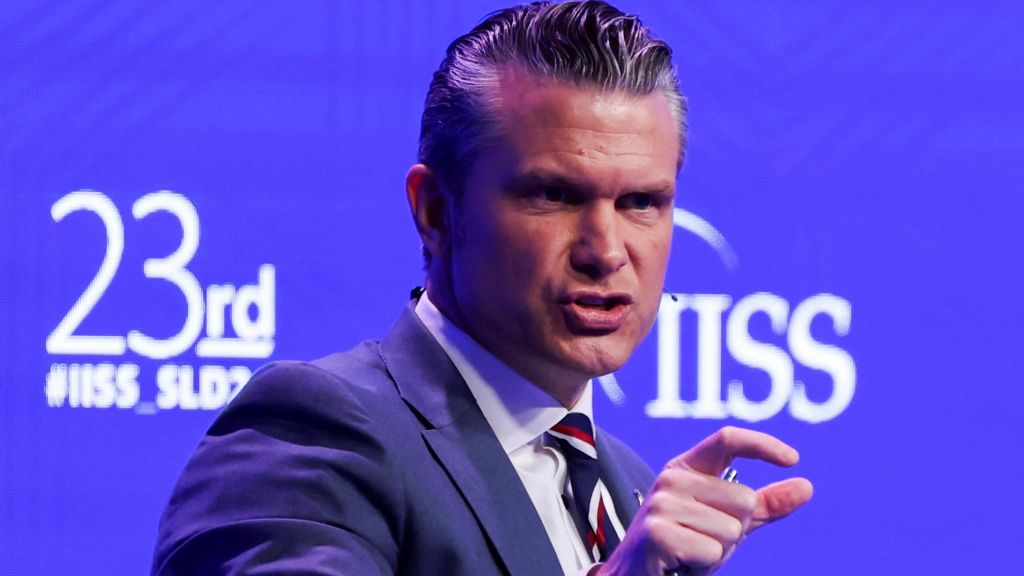
At the 2026 Shangri-La Dialogue hosted in Singapore, U.S. Defense Secretary Pete Hegseth moved to dispel growing regional concerns that Washington is turning away from the Asia-Pacific amid its expanding military commitments tied to the conflict in Iran.
Weeks after U.S. President Donald Trump held high-level positive talks with Chinese President Xi Jinping in Beijing, Hegseth sought to strike a calibrated balance: acknowledging widespread anxiety over China’s rapid military expansion in the region while stressing that Washington has no interest in provoking unnecessary confrontation.
Responding directly to questions raised by Japanese Defense Minister Shinjiro Koizumi, who warned that bad-faith actors could attempt to undermine trust by sowing doubt about U.S. commitment to the region and driving wedges between Washington and its allies, Hegseth pushed back on claims that global obligations pull focus from the Indo-Pacific. “People conflate our global duties with turning our backs on this region, but we are fully capable of advancing multiple priorities at once,” he said. Hegseth emphasized that integrated power projection across the Pacific and close collaboration with regional allies remain core pillars of U.S. national defense strategy, noting that Washington continues its quiet, resolute engagement with partners while working to prevent Iran from acquiring nuclear weapons.
One of the most pressing questions from dialogue participants centered on Washington’s decision to pause a $14 billion arms sales package to Taiwan in order to redirect munitions to the Iran conflict, a move that sparked questions about U.S. ability to meet its security commitments to regional partners. Hegseth sought to decouple the two issues, reassuring attendees that the U.S. maintains a robust overall munitions stockpile and has sufficient industrial capacity to ramp up production if additional supplies are required.
In his keynote address ahead of Hegseth’s remarks, Vietnamese President To Lam called for expanded diplomatic dialogue to de-escalate simmering regional tensions. Striking a more hardline tone on security policy, Hegseth pushed back against traditional diplomatic framing, arguing that the region needs more tangible military capability rather than empty diplomatic rhetoric. “Rules are meaningless if you cannot back them up with hard power,” he said. “We do not need more conference dialogues – we need more combat power, more ships, more submarines.” Hegseth also positioned this approach as a departure from what he described as hollow “globalist rhetoric” around the rules-based international order.
Consistent with his messaging from the 2025 Shangri-La Dialogue, Hegseth pressed regional allies to increase their defense spending, setting a formal target of 3.5% of gross domestic product for all regional partners. He openly praised partners that have boosted military outlays and deepened security cooperation with Washington in recent months, specifically naming Japan, South Korea, Australia and the Philippines. In contrast, he called out countries he labeled defense “freeloaders,” singling out New Zealand in his comments, and added that NATO and European allies face critical upcoming decisions on their own defense commitments.
Notably, Hegseth adopted a far softer tone on cross-strait and China policy this year compared to his 2025 address, where he accused Beijing of posing an imminent threat to Taiwan. He only referenced the suspended Taiwan arms package in response to a direct question, weeks after President Xi warned Trump during their Beijing summit that Taiwan remains the most sensitive core issue in bilateral relations.
“While there is rightful concern over China’s unprecedented military buildup, we recognize that our regional allies do not seek constant escalation,” Hegseth said. The U.S. goal, he added, is to maintain a balanced regional power structure where no nation – including China – can impose hegemony over others, working toward “a genuinely stable equilibrium that preserves the conditions for long-standing peace and prosperity across the region. We approach this challenge with measured, deliberate strength, not unnecessary confrontation.”
The Shangri-La Dialogue, organized by the London-based International Institute for Strategic Studies, is one of the most high-profile annual defense forums in the Indo-Pacific, long serving as a key platform for regional states to hold direct security talks with the United States and China. This year marks the second consecutive year that China has declined to send its sitting defense minister, instead delegating a lower-ranking delegation. Analysts and attendees remain divided on the move: some interpret the decision as a deliberate snub to the forum, while others frame it as a choice to avoid direct public confrontation with the U.S. amid ongoing great power competition for influence across the region.