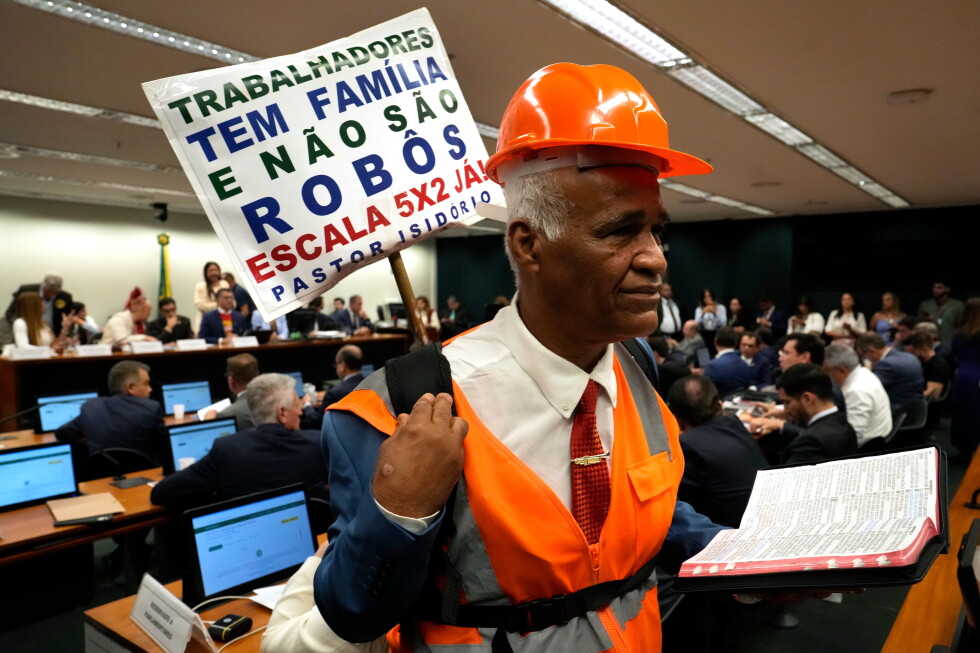
SAO PAULO — A major shift in labor policy is moving forward in Brazil, where the country’s lower chamber of Congress has greenlit a constitutional amendment that would establish a standard 40-hour, five-day workweek, aligning the nation with a growing trend of workweek reduction sweeping across Latin America.
The initiative, which holds broad public support ahead of Brazil’s October presidential election, was championed by sitting President Luiz Inácio Lula da Silva, who has repeatedly pushed the proposal as a key win for working-class Brazilians. While the regional push for shorter working hours has earned widespread praise from labor rights advocates, it has faced sharp pushback from business groups across the continent, and Brazil’s debate has been no exception.
Currently, Brazilian workers log a 44-hour weekly schedule: five full eight-hour days plus a four-hour shift on a sixth working day. If the amendment is finalized, it will phase out the six-day workweek while guaranteeing no pay cuts for at least 37 million employed people, capping weekly working time at 40 hours. The reform also enshrines the right to two consecutive 24-hour rest periods each week, with a preference for the Saturday-Sunday weekend that is standard in much of the world.
During floor debate ahead of the vote, government whip in the lower house Paulo Pimenta framed the reform as a long-overdue step toward justice for low-wage workers. “People who have this workweek from Monday to Saturday are the ones that have to work the hardest and are paid the least,” Pimenta told fellow lawmakers. “We need to be brave and do justice.”
While many opposition lawmakers ultimately backed the amendment after months of constituent pressure, some critics remained vocal in their opposition. Lawmaker Kim Kataguiri argued that the rushed timeline ahead of an election puts both small businesses and workers at risk. “I don’t care this is an election year. I think we need to be responsible. This will be a problem for many companies,” Kataguiri said. “We are doing this in a rush and workers should know they might end up worse than they are now if business leaders stop hiring.”
To address business concerns, negotiators included a 14-month adaptation window for companies to adjust their operations to the new schedule — a compromise that fell far short of the 10-year phase-in period many business leaders and conservative lawmakers had demanded. Leo Prates, the lower house lawmaker who drafted the amendment, pushed back against claims of irresponsibility, noting the reform was crafted to balance the needs of workers, families and employers. “This was built with a lot of responsibility, thinking about workers and families in Brazil,” Prates said. “We need to accomplish this for the Brazilian people.”
Wednesday’s late-night vote advances the amendment to Brazil’s Senate, where no vote date has been scheduled. Upper chamber lawmakers could introduce modifications to the text before a final version is sent to Lula for approval to formalize the constitutional change.
Flávio Bolsonaro, Lula’s main opponent in the upcoming presidential race and a sitting senator, has put forward a competing vision for Brazilian labor policy: he proposes replacing the fixed weekly system with a more flexible hourly pay model, a plan that has so far only garnered support from a subset of business leaders.
Brazil’s push for a shorter workweek comes as labor policy shifts diverge across Latin America. In February, Mexican lawmakers approved a proposal from President Claudia Sheinbaum to cut the country’s existing 48-hour workweek, with a gradual phase-in that will bring the nation to a 40-hour standard by 2030. In 2023, Chile passed its own “40-Hour Law,” which implemented a 40-hour workweek for all workers covered by the country’s labor code starting last year, with no corresponding reduction in pay.
Argentina stands as a notable outlier to this regional trend. Under libertarian President Javier Milei, the country is moving to expand working hours, with a labor overhaul passed earlier this year that extends the maximum daily work limit from eight to 12 hours and eliminates mandatory overtime pay. Argentine labor unions have condemned the package, arguing it prioritizes corporate interests over the rights of working people.
AP journalists Megan Janetsky, Isabel DeBre and Nayara Batschke contributed reporting from Mexico City, Buenos Aires, and Santiago, Chile.