For 49-year-old Indian vegetable vendor Tofan Jena, the moment he slipped on a new pair of $2 corrective glasses changed his entire world. After a lifetime of blurry vision that he had accepted as unchangeable, Jena could suddenly make out even the smallest text on his phone screen and see the details of the world around him for the first time. “I can read, I can write, and I can see very well at a distance,” Jena said, still marveling at his new perspective. “I’ll be able to do everything with these glasses.”
Jena is one of an estimated 1 billion people globally living with uncorrected vision impairment, according to the World Health Organization, a population locked out of educational, economic and daily opportunities simply because they lack access to affordable eye care. In India alone, the International Agency for the Prevention of Blindness calculates that unaddressed, preventable vision conditions cost the country $30 billion annually in lost economic productivity. Data from the non-profit GoodVision, the organization that provided Jena’s exam and glasses, estimates that 550 million people across India require corrective lenses, and 250 million have no access to this basic care.
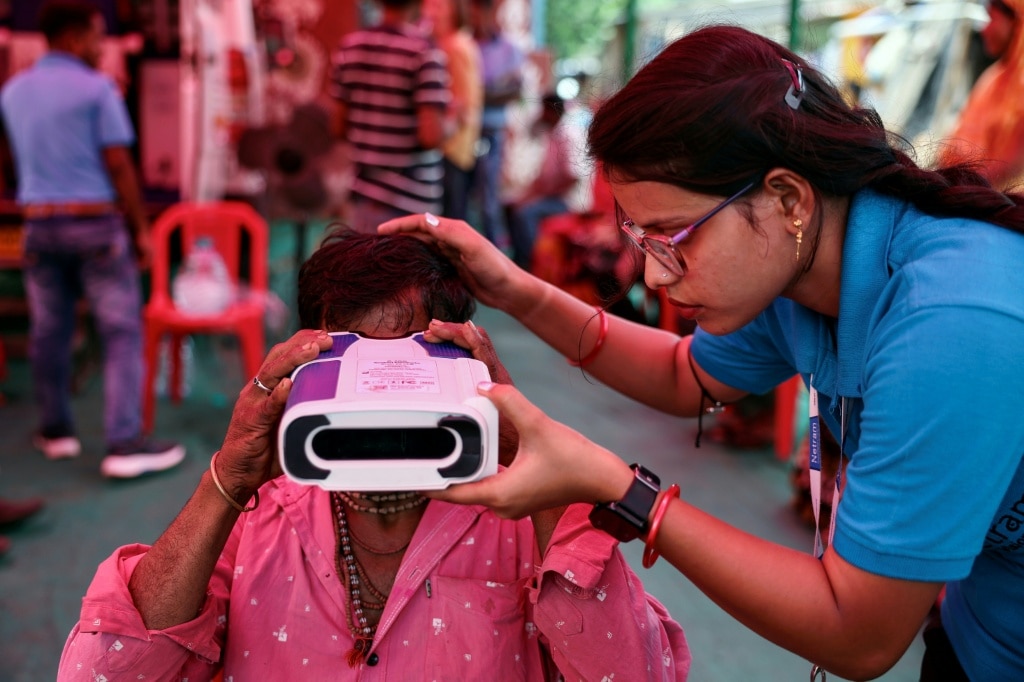
GoodVision is a global charity focused on closing the vast global gap in accessible eye care, operating across 12 low- and middle-income countries to bring services directly to underserved communities. In Odisha, the eastern Indian state where Jena lives, the organization runs mobile community screening camps that set up temporary clinics in poor urban neighborhoods and remote rural villages – areas largely overlooked by India’s public health system. At these pop-up sites, local technicians provide free eye screenings, custom-fit glasses for less than $2, and referrals for advanced procedures like cataract surgery for low-income patients. The charity sources low-cost lenses from China and assembles lightweight frames from locally produced Indian metal wire, with a full pair of glasses ready for a patient in just 10 minutes.
Dozens of residents in Salia Sahi, a low-income district on the outskirts of Bhubaneswar, Odisha’s capital, experienced the same life-changing clarity Jena did during a recent camp. After receiving their glasses, many patients blinked in wonder at a level of visual detail they had never experienced before, or had forgotten over years of uncorrected vision. For 43-year-old shopkeeper Minati Rout, the new glasses let her complete small daily tasks that had become impossible: sorting rice pebbles, threading needles, reading small print. “I will tell my neighbours to get their eyes checked here too,” she said.
Local optometrist Gopinath Das, who works with GoodVision’s camps, explained that these mobile outreach efforts fill a critical gap for rural communities. “These community camps are extremely important for villagers, because they have no access to eye care,” Das said. “Sometimes they don’t have money, sometimes they don’t even know they have eye problems.” The organization visits more than 400 underserved neighborhoods and villages across India every month, bringing care directly to people who could never travel to urban eye clinics or afford private treatment. For 23-year-old technician Debasmita Behera, the work is both personally and professionally fulfilling: “We are able to provide help to people, and we feel good about it. And I’m also earning.”
Beyond basic corrective lenses, GoodVision also facilitates low-cost cataract surgery for patients with advanced vision impairment, referring cases to partner hospitals like Bhubaneswar’s Vision Care Hospital. Hospital director Srimant Kumar Mishra says the biggest barrier to care is not cost, but widespread cultural misconceptions. “There is a lot of social stigma, they are afraid… They have a feeling that even if you get old, it is natural that they are not able to see.” GoodVision’s India director Piush Khetan agrees that public education is a core part of the organization’s mission. “In India, we only take things seriously if it’s a matter of life or death,” Khetan said. “So we focus on providing information, we try to convince people of the importance of taking care of their eyes.”
Maryline Ehlermann, GoodVision’s representative in France, emphasizes that expanding affordable eye care is not just a public health good – it is a high-return global economic investment. Citing global research, Ehlermann notes that treating the 1 billion people living with curable vision impairment would generate an additional $447 billion in annual global economic output. For India, the world’s most populous nation with stark economic inequality, the scale of the challenge remains enormous. But for thousands of low-income Indians like Tofan Jena and Minati Rout, low-cost glasses and accessible community care have already opened the door to a clearer, more hopeful future.