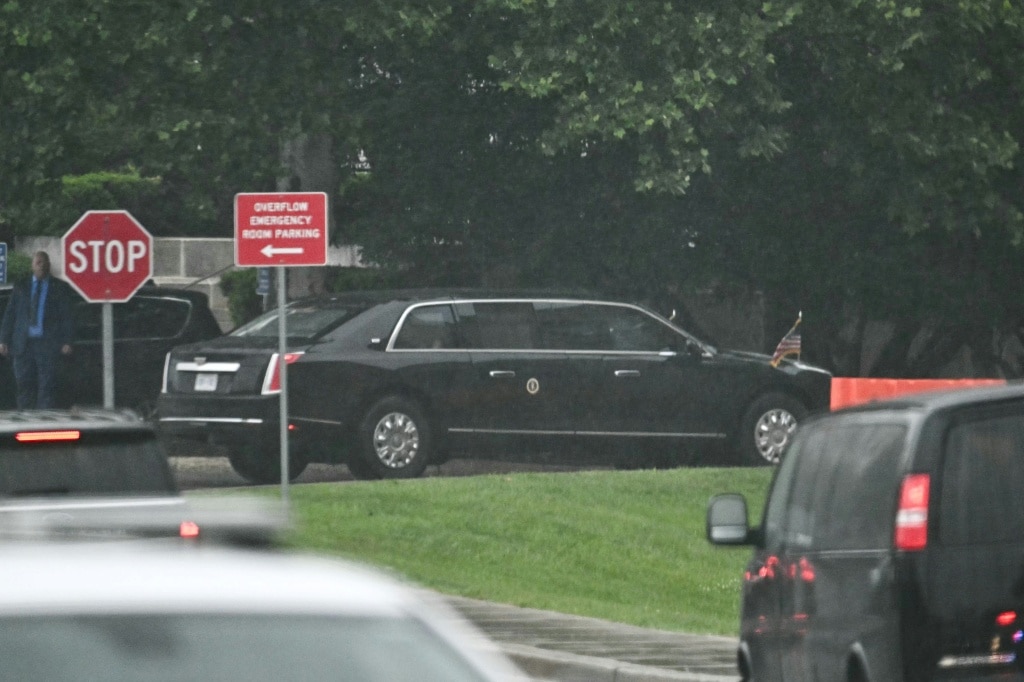
Just five days before he marks his 80th birthday, sitting U.S. President Donald Trump underwent his scheduled annual medical examination on Tuesday at Walter Reed Military Medical Center, reigniting long-running public and political discussion about the state of the commander-in-chief’s physical and mental health.
As the oldest person ever inaugurated to the U.S. presidency, Trump has repeatedly positioned his own perceived vitality as a point of contrast against his Democratic predecessor Joe Biden, frequently claiming superior physical and mental fitness on the campaign trail and in public appearances. However, this latest check-up comes amid renewed public speculation over Trump’s well-being, sparked by recent visible bruising on his right hand and multiple observations of apparent drowsiness during high-stakes official meetings.
This exam marks Trump’s third formal physical assessment since he returned to the White House for his second term in January 2025. He completed a scheduled annual check in April 2025, followed by an unannounced after-hours visit to Walter Reed that October, which the White House later classified as a second “annual” physical – a move that drew criticism and fresh questions from political observers and transparency advocates about the consistency of the administration’s health disclosures.
Criticism over the lack of full transparency around Trump’s personal health has followed him throughout his political career, and that pattern has held during his second term. While the White House has confirmed it plans to release limited details about Tuesday’s exam later in the day, the administration retains full discretion over how much clinical information it makes public.
An Agence France-Presse reporter embedded with the presidential motorcade confirmed Trump arrived at the Bethesda, Maryland, medical facility, located roughly 10 miles outside Washington D.C., at approximately 8:50 a.m. local time (12:50 GMT). Per the president’s publicly released daily schedule, he is set to return to the White House for a 1:30 p.m. (17:30 GMT) policy briefing where the ongoing conflict in Iran will be the top agenda item.
Trump’s 80th birthday, scheduled for June 14, will coincide with a high-profile Ultimate Fighting Championship (UFC) bouts hosted on the White House South Lawn, an event expected to draw thousands of invited spectators. The president has long leaned into public boasts about his personal health, repeatedly claiming he is far more physically fit than prior Oval Office occupants despite his well-documented preference for fast food and publicly disclosed higher-than-average body weight.
“I feel the same as I did 50 years ago,” Trump told attendees at an Oval Office event earlier this month, adding with characteristic dry humor, “Maybe junk food is good.” The president is widely known for his public fondness for beef burgers, well-done steaks, and Diet Coke, a diet that has long been noted by health commentators as inconsistent with standard cardiovascular wellness guidance.
Public discussion of Trump’s health first ramped up last summer, when the White House officially confirmed that Trump had been diagnosed with chronic venous insufficiency after observations of persistent swelling in his lower legs. The common vascular condition, caused by faulty valves in leg veins that allow blood to pool in lower extremities, causes symptoms including swelling, muscle cramping, and visible skin discoloration.
More recently, Trump has repeatedly appeared in public with unexplained bruising on his right hand, which makeup artists have regularly attempted to cover during televised appearances. He also developed a visible neck rash during one widely watched Oval Office address last year. Administration officials have attributed the hand bruising to daily low-dose aspirin Trump takes as part of a standard preventive cardiovascular care regimen.
Following his unannounced October 2025 visit to Walter Reed, Trump told reporters that an MRI conducted during the appointment confirmed his cardiovascular health was “excellent.” His personal physician, U.S. Navy Captain Sean Barbabella, released a public letter after that visit claiming Trump’s “cardiac age” was calculated to be roughly 14 years younger than his actual chronological age at the time.
The subject of presidential age and fitness has dominated U.S. political discourse for the better part of a decade, and gained renewed attention during the 2024 general election cycle. Then-incumbent Joe Biden, who was 81 years old at the time, was forced to suspend his re-election campaign following a widely panned debate performance against Trump that stoked widespread public concern over his cognitive fitness. Biden previously held the title of oldest inaugurated U.S. president, a record he lost when Trump was sworn in for his second term at age 78. Trump still holds the record as the third oldest person to be inaugurated as president, a mark he set when he first took office at age 70 in 2017.