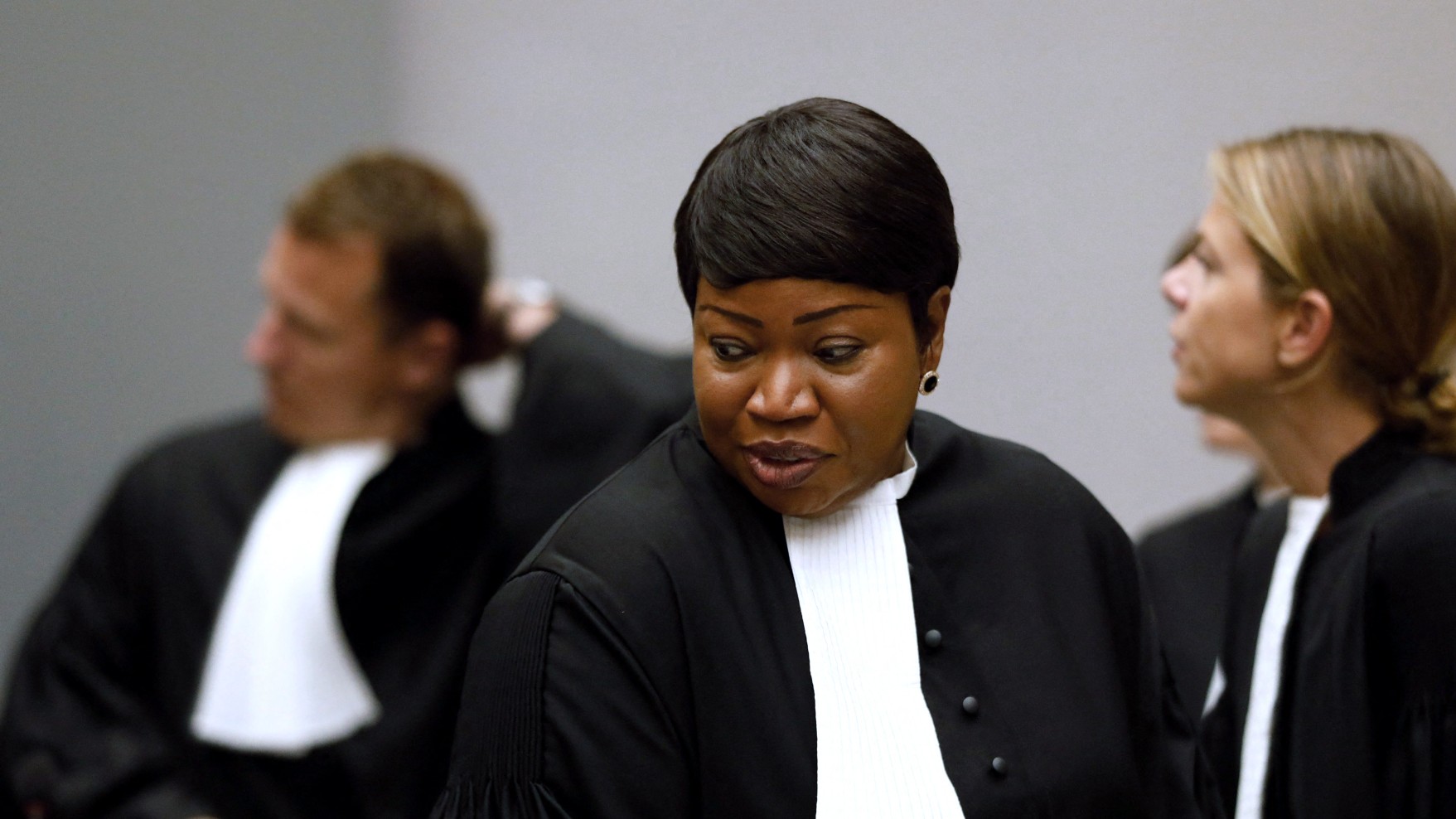
In a bombshell new interview with Al Jazeera published Sunday, former International Criminal Court chief prosecutor Fatou Bensouda has lifted the veil on coordinated political pressure, intimidation tactics and punitive sanctions designed to force her to abandon a landmark investigation into alleged war crimes committed in occupied Palestine. Bensouda, who led the ICC’s prosecution division from 2012 until 2021, laid out a years-long campaign of harassment that began just months after she opened a preliminary examination into the Palestinian situation in 2015.
The first incident came when two unidentified men showed up unannounced at Bensouda’s private residence in The Hague, where the ICC is headquartered. The men left her an envelope holding $500, claiming the cash was a thank-you gift from a party she had previously assisted. But Bensouda told the outlet she quickly recognized the encounter for what it was: a deliberate threat designed to prove that her opponents could track her down to her home. She immediately reported the break-in visit to ICC security and Dutch law enforcement, which later traced phone numbers linked to the two men back to Israel. No further action was ever taken in the case, according to Bensouda, leaving her feeling abandoned and unprotected by the institutions she served.
Beyond the surprise home visit, Bensouda detailed repeated, high-level pressure meetings with Yossi Cohen, who led Israel’s Mossad intelligence agency during her tenure. One of the most notable encounters took place in a New York City hotel during the annual United Nations General Assembly, where Cohen made his organization’s position explicitly clear. According to Bensouda, the meetings opened with superficial friendly overtures and attempts to coerce her through persuasion, before quickly shifting to direct, uncompromising demands that she end the Palestine investigation. When asked to confirm a prior Guardian report that Cohen explicitly warned her proceeding with the probe would put her personal safety and her family’s security at risk, and that Israel could “take care” of her if she complied, Bensouda answered plainly: “He did. He did.” The former prosecutor said she had no doubt that the messages amounted to direct threats against her and her loved ones, all aimed at killing the investigation.
Bensouda went on to link these Israeli intimidation efforts to the sweeping sanctions imposed against her by the first Donald Trump administration in September 2020. The punitive measures were implemented after the ICC moved forward with investigations into alleged war crimes by both U.S. forces in Afghanistan and Israeli troops in occupied Palestine. The sanctions froze her global assets and imposed broad travel restrictions, upending both her professional and personal life in ways the public rarely sees, she explained.
Beyond barring her from entering the United States, the sanctions triggered cascading financial disruptions that affected nearly every part of her daily life. Her long-held account with the UN Federal Credit Union, opened decades earlier during her work at the International Criminal Tribunal for Rwanda, was shut down immediately. Basic routine transactions from booking hotel rooms to sending money to ICC member states became impossible. Even Dutch banks, which fall under the scope of U.S. financial regulations, were forced to cut ties: the bank that held her mortgage closed her account entirely. It took coordinated intervention from the ICC registrar and Dutch authorities to arrange for her salary to be deposited at a bank that already worked with the court, and eventually for a second Dutch bank to take over her basic transactions, even with strict limits on her activity. Even after that workaround, transfers to family members regularly failed when intermediary correspondent banks refused to process the payments out of fear of U.S. penalties. Her own son, a resident of The Gambia, had his personal bank account blocked as a result of the sanctions.
Bensouda also confirmed that her husband was targeted for surveillance in the lead-up to the 2020 sanctions designation, with efforts to collect intelligence through photographs and audio recordings. The U.S. only lifted the punitive sanctions against Bensouda in early 2021, shortly after Joe Biden took office. Since that time, the politicization of the ICC has only escalated. After returning to the U.S. presidency, Donald Trump reimposed broad sanctions targeting ICC personnel in an executive order signed in February 2024. The order authorizes economic and travel restrictions for any individual working on ICC investigations into U.S. citizens or U.S. allies including Israel. To date, current ICC chief prosecutor Karim Khan, who succeeded Bensouda in 2021, both of his deputy prosecutors, and eight sitting ICC judges have been added to the sanctions list. Khan has since narrowed the scope of the Afghanistan investigation to focus exclusively on atrocities committed by the Taliban and the Islamic State, effectively dropping the probe into alleged U.S. war crimes.
In addition to detailing the pressure campaign, Bensouda pushed back against longstanding criticisms that the ICC disproportionately targets African nations for investigation. She noted that the vast majority of the court’s African investigations were launched at the formal request of African governments themselves, rather than being imposed by the court unilaterally. “People always forget that ICC did not go to Africa to start investigating. It was Africa that came to the ICC,” she said.
Despite the growing bipartisan and international political attacks on the court’s authority, Bensouda reaffirmed her unwavering support for the ICC’s core mandate of advancing international justice. “There will be attempts to make the court disintegrate and fade away. But I know that there are still people, institutions and countries that want justice,” she said.
Bensouda spoke out publicly ahead of her keynote address at last week’s Hague Rights Forum, where she urged the European Union to take concrete action to shield the ICC and its personnel from extraterritorial sanctions imposed by outside powers. She called on the EU to activate its blocking statute, a regulation designed to protect European companies and individuals from the extrajurisdictional impact of third-country sanctions, and to share technological resources from the bloc’s autonomy initiatives with the court to strengthen its resilience.