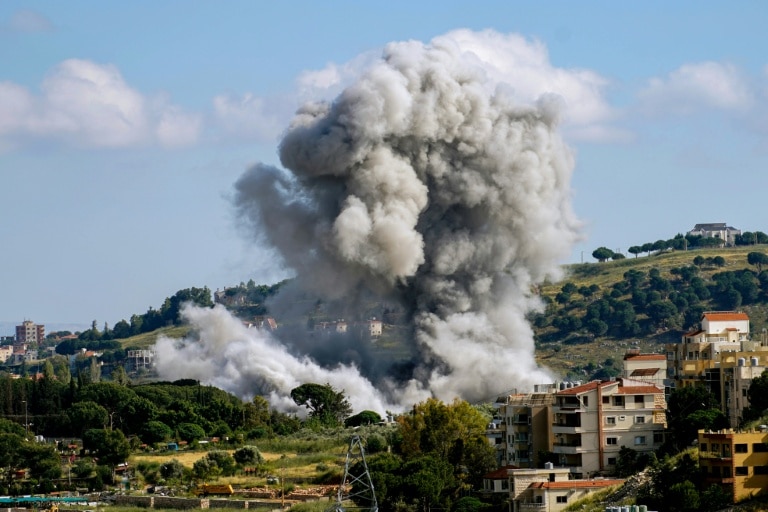
On Monday, the Israeli military ramped up its air and ground strikes across Lebanon, acting on Prime Minister Benjamin Netanyahu’s direct order to escalate operations with the stated goal of crushing Iran-backed Hezbollah. This escalation comes even as international diplomacy moves forward to end broader regional conflict, including a potential deal that would de-escalate the Lebanon front where clashes have persisted since early March.
Though a formal ceasefire was implemented on April 17, cross-border fire between Israeli forces and Hezbollah has remained a near-daily occurrence. In a pre-recorded video statement published to his Telegram channel, Netanyahu confirmed his administration’s push for expanded military action. “I have ordered an even greater acceleration of our operations,” he said. “It is true that they are attacking us with drones, including fibre-optic drones, but we have teams working on countermeasures and we will solve this issue… We will intensify our blows, increase our firepower, and we will crush them.”
Witnesses with Agence France-Presse reported streams of civilian residents fleeing the southern suburbs of Beirut, a longstanding Hezbollah stronghold, shortly after Netanyahu’s announcement. Lebanon’s official National News Agency (NNA) confirmed that the Israeli Air Force carried out multiple successive strikes in the eastern Bekaa Valley by Monday evening. Earlier in the day, dozens of airstrikes targeted a string of towns and villages across southern Lebanon, killing three people in separate strikes on two passenger vehicles and a motorcycle. Additional strikes later hit communities near the ancient coastal city of Tyre, following evacuation orders issued by Israel for 10 southern Lebanese villages.
Israeli military officials justified the escalation by pointing to repeated ceasefire violations by Hezbollah. “In light of Hezbollah’s violation of the ceasefire agreement, the Israel Defense Forces are compelled to operate against it with force,” Avichay Adraee, the IDF’s Arabic-language spokesperson, wrote in a social media post that listed the targeted villages. Hezbollah has continued to launch drone strikes targeting Israeli positions along the border and inside Israeli-occupied Lebanese territory, including multiple attacks on Monday. Late Monday, the group issued a statement confirming it had targeted three military barracks and one outpost in northern Israel, framing the strike as retaliation for Israeli violations of the truce.
Data from Lebanese public authorities shows that Israeli strikes have killed more than 3,100 people in Lebanon since hostilities resumed in early March. On the Israeli side, the military announced Monday that one additional soldier had been killed in combat in southern Lebanon the previous day, bringing the total death toll for Israeli service members to 23 since clashes with Hezbollah began. One civilian defense contractor has also been killed in the fighting.
The push for escalation has been amplified by two of Netanyahu’s far-right coalition partners, who are calling for a dramatic expansion of the offensive deep into Lebanese territory. Finance Minister Bezalel Smotrich, a resident of an illegal settlement in the occupied West Bank, wrote on Telegram that “there is an urgent need to put an end to the threat posed by Hezbollah’s explosive drones.” He added, “For every explosive drone strike, 10 buildings must fall in Beirut.” National Security Minister Itamar Ben Gvir echoed the call, demanding a “return to intensive warfare” and an Israeli takeover of the Zahrani River, a waterway located far north of the Litani River, which the IDF has currently named as the southern boundary of its Hezbollah-clearing operation. Israeli forces currently control a roughly 10-kilometer deep strip of territory inside southern Lebanon.
Meanwhile, diplomatic efforts to broker a long-term settlement remain underway. Lebanese President Joseph Aoun reaffirmed his stance Monday that Lebanon will proceed with talks with Israel, and added that his demand for a full Israeli withdrawal from all southern Lebanese territory is “non-negotiable.” Lebanon and Israel, which have never maintained formal diplomatic relations, are set to hold a new round of negotiations in Washington on June 2 and 3, preceded by a meeting of top military officials from both sides at the Pentagon on May 29. On Sunday evening, Hezbollah’s deputy leader Naim Qassem reiterated the movement’s firm opposition to direct negotiations between Lebanon and Israel, and repeated its refusal to disarm, sticking to longstanding positions that have complicated diplomatic progress. The unfolding escalation has also raised new uncertainty for ongoing talks between the U.S. and Iran, which are currently working to finalize a broader agreement to end all hostilities across the Middle East, including on the Lebanese frontier.