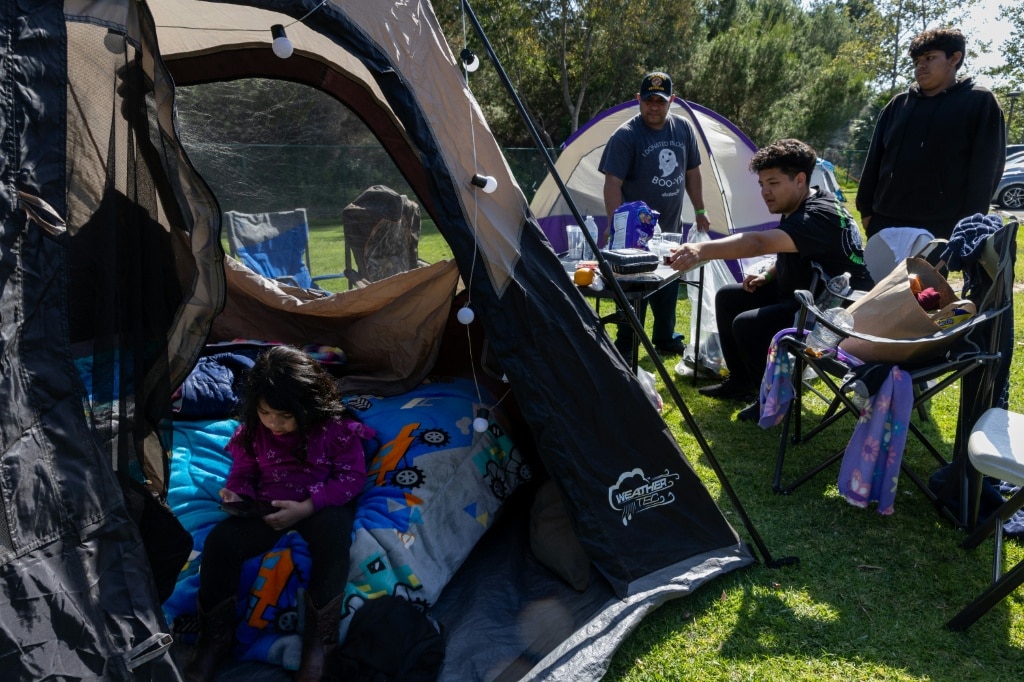
A days-long public safety crisis in Orange County, California, has reached a critical turning point, with fire officials confirming Monday that the imminent threat of a catastrophic explosion from a leaking chemical storage tank has been fully neutralized. Even with the major risk removed, tens of thousands of displaced local residents are still required to remain outside their designated evacuation zones as emergency teams continue to monitor lingering safety hazards, official announcements confirm.
Interim Fire Chief TJ McGovern of the Orange County Fire Authority announced the update in a video posted to social platform X Monday morning, stating, “We are happy to report that the threat… has been eliminated.” Despite the positive development, McGovern emphasized that evacuation orders remain in full effect, urging residents to “abide by those evacuation zones.” In a separate post on X, the authority added that “there is still an ongoing threat to public safety” that requires continued precautions.
The emergency was triggered late last week, when crews first detected a leak, and later a structural crack, in a 7,000-gallon storage tank holding methyl methacrylate — a volatile, flammable liquid chemical used in plastic manufacturing. Located in Garden Grove, roughly five miles from the world-famous Disneyland Resort and in a heavily populated region southeast of Los Angeles, the tank’s compromised condition sparked urgent fears that a buildup of heat and pressure could trigger an explosion, prompting authorities to order evacuations for roughly 50,000 local residents starting Friday.
By Sunday evening, emergency responders confirmed there was no longer an active leak, and continuous atmospheric monitoring detected no unauthorized chemical release into the surrounding air. On Monday, Incident Commander Craig Covey reported that pressure inside the damaged tank had continued to drop, and internal temperature had fallen to 93 degrees Fahrenheit (34 degrees Celsius), down from a hazardous high of 100 degrees Fahrenheit (38 degrees Celsius). “The crack is there. We have verified that it’s there, and the tank has released its pressure,” Covey said. “That is incredibly positive news as we turn the corner on this incident.”
Federal regulators stepped in rapidly to support the response, with a team of experts from the U.S. Environmental Protection Agency (EPA) dispatched to advise on response strategies. EPA Administrator Lee Zeldin told CNN Sunday that the “most catastrophic scenario” would have involved a chain reaction where one tank explosion triggered blasts at adjacent storage units, but the agency assessed from the start that the “most likely scenario” was a controlled low-volume release that would allow crews to contain and neutralize the risk — an outcome that aligns with the latest on-the-ground updates.
The damaged tank is owned by GKN Aerospace, a global aerospace technology manufacturer headquartered in Birmingham, UK, that operates 32 production facilities across 12 countries. In a statement released Sunday, the company confirmed it was “working around the clock to mitigate the risk of a leak.” Nearby Disneyland Resort officials also released a statement early in the crisis noting that the popular tourist destination “remains open to guests,” and that resort leadership was keeping close track of developments.
Public health experts warn that methyl methacrylate, the chemical stored in the tank, causes irritation to human skin, eyes, and mucous membranes. Acute or extended exposure can also trigger serious respiratory and neurological adverse reactions, making continued monitoring critical to protect both response crews and returning residents.