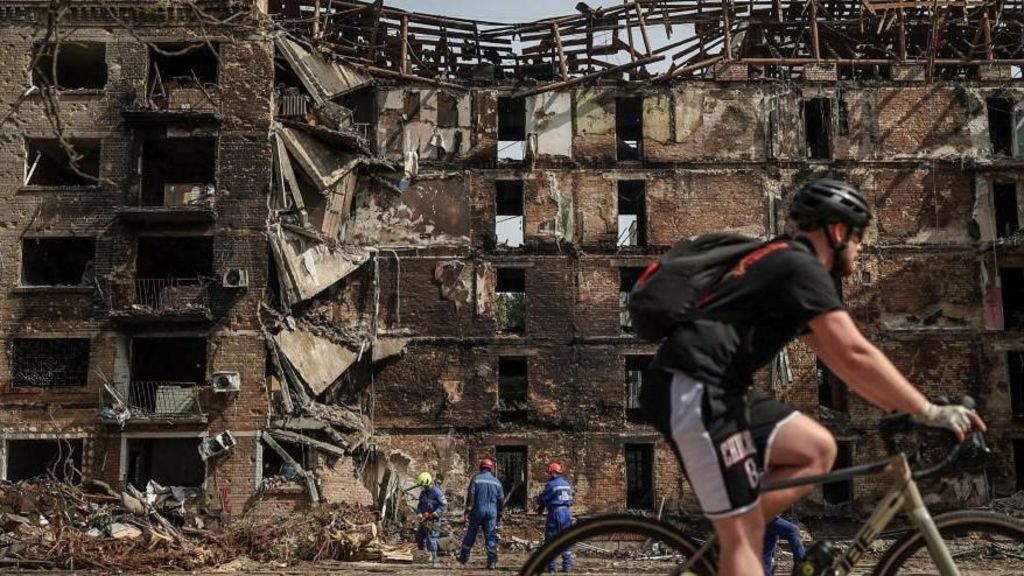
Just days after one of the largest aerial assaults on Ukraine’s capital since the full-scale invasion began, Russia has issued a explicit threat of a new wave of coordinated, systematic attacks targeting Kyiv. In an official statement released by the Russian foreign ministry, Moscow confirmed that upcoming strikes will focus on what it labels “decision-making centres and command posts” in the capital, alongside facilities Ukraine uses to manufacture unmanned aerial vehicles. The statement also urged all foreign nationals and diplomatic staff to evacuate Kyiv “as soon as possible”, and warned local Ukrainian residents to avoid moving near administrative and military infrastructure across the city.
The large-scale barrage carried out by Russian forces on Saturday night left four people dead and approximately 100 others injured across Kyiv and surrounding regions, Ukrainian President Volodymyr Zelensky confirmed. Moscow has framed both this weekend’s attack and the coming new strikes as retaliation for what it claims was a deliberate Ukrainian strike on a student dormitory in the Russian-occupied eastern Ukrainian town of Starobilsk last Friday. Russian officials allege that 21 people were killed in that incident. Ukraine’s military has pushed back against this narrative, confirming it targeted an elite Russian military drone unit operating in the area and maintains no civilian facilities were intentionally targeted in the strike.
This latest round of violence comes after a series of escalating attacks on Kyiv that began earlier this May, when a temporary ceasefire timed to coincide with Moscow’s annual Victory Day military parade expired. Within days of the ceasefire ending, Russian strikes on a Kyiv residential apartment block killed 24 people, including three children. The assault carried out overnight Saturday marked one of the most intense large-scale aerial attacks on the capital since the start of the full-scale invasion.
Footage shared by Kyiv residents on social media platforms captured sustained explosions lighting up the night sky across the capital, with multiple blasts reported that shook buildings across wide areas of the city. Dozens of ballistic and cruise missiles, alongside hundreds of attack drones, were launched against Kyiv in the assault. Russian forces also fired a nuclear-capable Oreshnik hypersonic missile targeting the area of Bila Tserkva, a city located roughly 90 kilometers south of the Ukrainian capital.
The attack left a trail of destruction across both cultural and civilian sites in Kyiv. The Chernobyl Museum, located in the city’s historic central district, and the National Art Museum of Ukraine both suffered significant damage. Multiple residential buildings, a public market and a large commercial shopping centre in Kyiv’s Lukanivka neighborhood were completely destroyed.
Analysts and political observers broadly view Russia’s public call for foreign nationals to evacuate Kyiv as a deliberate tactic of psychological warfare designed to sow panic and instability among the capital’s population. Large-scale strikes on Kyiv have been a consistent feature of Russian military strategy since Moscow launched its full-scale invasion of Ukraine in February 2022.
After four and a half years of continuous full-scale war, Ukraine has built out a sophisticated, multi-layered air defense network that now intercepts the vast majority of Russian drones and missiles. However, Russia often launches attacks with such large volumes of projectiles that Ukrainian defenses are periodically overwhelmed, allowing a significant number of weapons to reach their targets. Ukraine’s air defense capabilities also remain heavily reliant on military support from Western allies, a vulnerability that Ukrainian leadership has repeatedly highlighted. Back in March, Zelensky warned that Ukraine faced a critical deficit of air defense weapons due to shifting defense resource priorities driven by conflicts involving the U.S. and Israel.