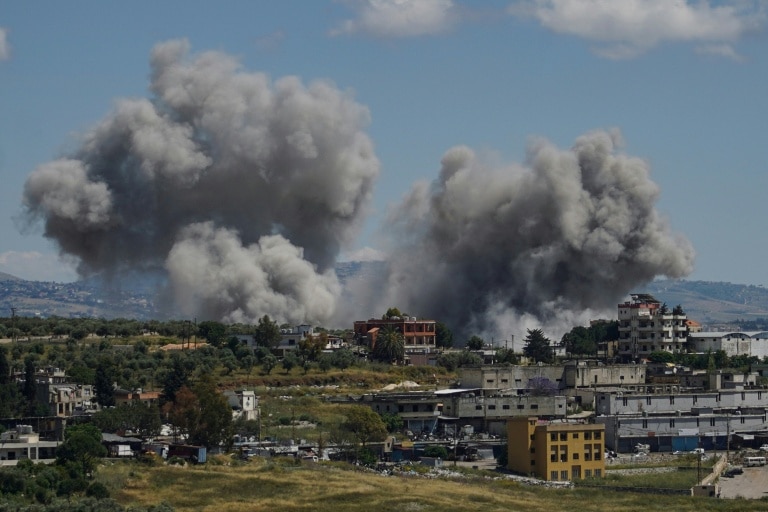
Fresh waves of deadly Israeli airstrikes have hammered swathes of southern and eastern Lebanon on Sunday, shattering the relative calm of a weeks-old ceasefire and pushing already soaring casualty numbers higher even as Hezbollah’s leader voiced cautious optimism that a forthcoming US-Iran agreement could end the broader regional conflict engulfing the country.
Lebanon’s Ministry of Public Health announced Sunday that the cumulative death toll from hostilities in the country since March 2 has climbed to 3,123. According to official updates, two people – including a paramedic with the Hezbollah-affiliated Islamic Health Committee – lost their lives in Sunday’s raids. The ministry also confirmed that a single Israeli strike on the southern Lebanese village of Sir al-Gharbiyeh a day earlier killed 11 people, among them six women and one young child, an incident officials have decried as a deliberate massacre.
The ongoing military operations mark a clear continuation of Israeli hostilities despite a ceasefire that first took effect across Lebanon on April 17 and was recently extended for an additional several weeks. Israeli military officials maintain that all strikes target legitimate Hezbollah positions aligned against the country. The Iran-backed armed group, for its part, has not ceased its own cross-border and frontline attacks: it claimed more than 20 separate assaults against invading Israeli troops in southern Lebanon and other targets inside Israeli territory on Sunday alone, ranging from rocket barrages and drone attacks to artillery shelling.
While Tehran has signaled that any framework for a de-escalation understanding with Washington to end the broader regional war would explicitly include Lebanon, Israeli Prime Minister Benjamin Netanyahu said Sunday that US President Donald Trump had reaffirmed unwavering support for Israel’s inherent right “to defend itself against threats on all fronts, including in Lebanon.” In an official statement, Israeli military Chief of Staff Lieutenant General Eyal Zamir emphasized that “we continue to strike Hezbollah across all dimensions… the security of civilians and the safety of our forces remain paramount.”
Lebanon’s official National News Agency documented Israeli airstrikes hitting more than 30 separate locations across southern and eastern Lebanon on Sunday, with multiple strikes resulting in casualties. Agence France-Presse correspondents on the ground reported large plumes of black smoke rising from impacted areas across the region. The Israeli military has issued mandatory evacuation orders for more than a dozen villages in southern Lebanon and the eastern Bekaa Valley, a move that has displaced hundreds of additional civilian residents.
Lebanon’s civil defense agency confirmed that its regional headquarters in the key southern city of Nabatieh was completely destroyed in an overnight Israeli strike. An AFP photographer witnessed civil defense teams sifting through rubble to recover usable equipment, and as of Sunday afternoon, the Israeli military had not responded to repeated requests for comment from AFP’s Jerusalem bureau on the attack on the facility.
Speaking amid the renewed violence, Hezbollah Secretary General Naim Qassem expressed hope that a prospective agreement between the United States and Iran would be finalized “God willing” and that Lebanon and Hezbollah would be included in any full cessation of hostilities. However, Qassem doubled down on the group’s longstanding rejection of direct bilateral negotiations between the Lebanese government and Israel, a landmark process that launched recently under US mediation. The talks are scheduled to hold their fourth round in early June, with a preparatory meeting between military delegations set to take place at the Pentagon on May 29.
“Abandon the direct negotiations… Don’t be with them and stab us in the back,” Qassem warned Lebanese authorities. He also ruled out any discussion of Hezbollah disarmament, stating bluntly that “disarmament is annihilation and we cannot accept it.” Adding that “we and our people face an existential threat,” Qassem stressed that “we will not bow, even if the whole world turns against us.”
In response to Qassem’s remarks, US Secretary of State Marco Rubio accused Hezbollah of actively seeking to drag Lebanon “back into chaos.” The current cycle of regional violence was triggered in early March, when Hezbollah opened fire on Israel with a massive rocket barrage in retaliation for the US-Israeli airstrike that killed Iran’s supreme leader.
Under the terms of the ceasefire published by the White House, Israel retains the right to carry out military operations against what it defines as “planned, imminent or ongoing attacks” originating from Lebanese territory. Israeli forces that have invaded southern Lebanon also continue to operate within an Israeli-declared “yellow line” that extends roughly 10 kilometers, or six miles, deep into Lebanese territory along the border.