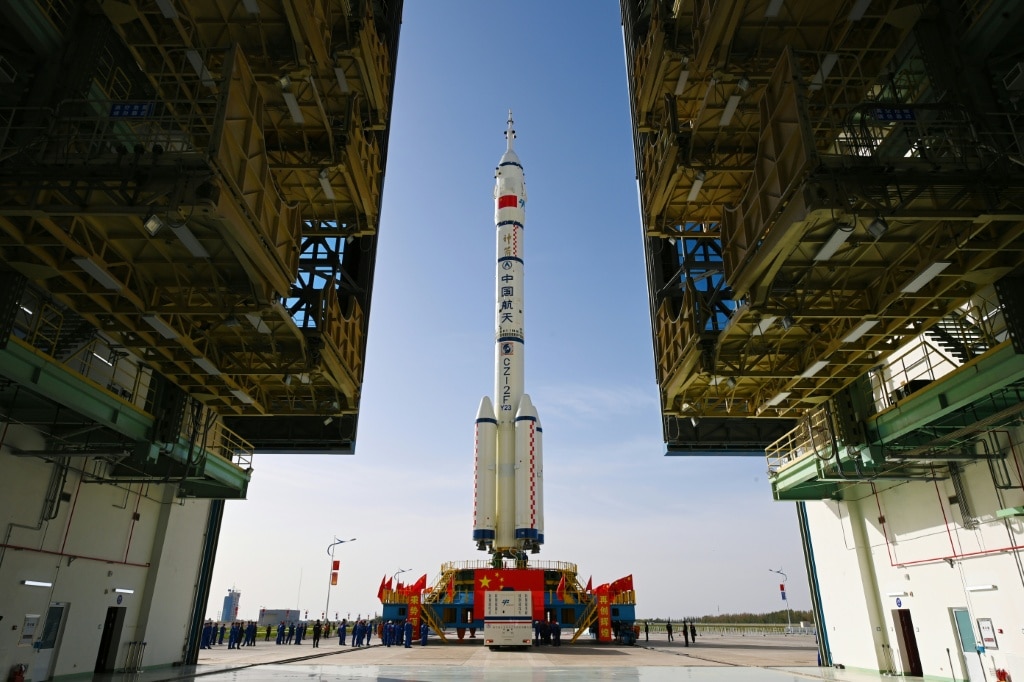
China has successfully launched the Shenzhou-23 crewed spacecraft, marking another major milestone in its ambitious plan to land humans on the lunar surface by 2030, with the craft completing a smooth docking with the country’s Tiangong Space Station just hours after liftoff, according to official Chinese state media. This mission carries historic significance, as it includes the first ever astronaut from Hong Kong to travel to space, opening a new chapter in the region’s participation in China’s growing space exploration program.
The Long March 2-F carrier rocket lifted off on schedule at 11:08 pm Beijing Time Sunday (1508 GMT) from the Jiuquan Satellite Launch Center located in China’s arid northwestern Gobi Desert. Footage broadcast by China’s state-run CCTV captured the powerful launch, with the rocket ascending through the night sky, engulfed in bright orange flames and thick plumes of smoke. Roughly 10 minutes after liftoff, the Shenzhou-23 spacecraft successfully separated from the rocket and entered its planned orbit, the China Manned Space Agency (CMSA) confirmed in a social media statement shortly after launch. “All three astronauts are in good physical condition, and the launch mission has been declared a complete success,” the agency added.
Approximately 3.5 hours after entering orbit, the spacecraft completed an automated docking with the Tiangong Space Station, China’s permanent outpost in low-Earth orbit, state news agency Xinhua reported, citing CMSA updates. The three-member crew is led by 43-year-old Li Jiaying, a former Hong Kong police officer who makes history as the first Hong Kong-born astronaut to reach space. She is joined by two other crewmates: 39-year-old space engineer Zhu Yangzhu, and 39-year-old Zhang Zhiyuan, a former Chinese Air Force pilot who is making his first trip to space.
In pre-launch ceremonies held at the launch center, crowds of attendees waved national flags and cheered as the three crew members saluted from the stage, accompanied by a ceremonial performance from a military band. Once settled aboard Tiangong, the crew will conduct a wide range of scientific experiments across multiple disciplines, including life sciences, materials science, fluid physics, and biomedical research.
The centerpiece of the mission is a groundbreaking 12-month orbital stay for one crew member, a first for China’s manned space program that will generate critical data to support the country’s 2030 lunar landing goal. This long-duration mission is designed to study the physiological and psychological impacts of extended exposure to microgravity, a key area of research for any crewed deep space exploration effort, including future missions to Mars. CMSA has stated that the specific crew member selected for the full-year stay will be announced at a later date, based on the progress of the mission in its early phases.
Richard de Grijs, an astrophysicist and professor at Australia’s Macquarie University, outlined the unique challenges that this mission will address. Extended stays in space carry well-documented health risks for humans, including bone density loss, muscle atrophy, increased radiation exposure, sleep disruption, and cumulative mental and physical fatigue, he explained. Beyond human health, the mission will also test the reliability of critical life support systems, including closed-loop water and air recycling technologies, as well as protocols for managing potential medical emergencies thousands of kilometers from Earth.
De Grijs noted that the year-long mission represents a steady, deliberate step forward for China’s space program, building operational experience for long-term sustained occupation of the Tiangong Space Station and laying critical groundwork for future lunar and deep space exploration. “A 12-month orbital stay pushes both the program’s hardware and the astronauts themselves into a new operational domain, compared to the shorter six-month missions that have been standard for Shenzhou in earlier phases of the program,” he told Agence France-Presse. Prior to this mission, all crews rotating through Tiangong have served six-month tours of duty before being relieved by replacement crews.
Shenzhou-23 is a core part of China’s timeline to put astronauts on the Moon before 2030, a goal that puts Beijing in a friendly global space race with the United States, which is pursuing its own return to the Moon through the NASA-led Artemis program. China is already moving forward with testing the next-generation hardware needed for lunar missions, with an uncrewed orbital test flight of the new Mengzhou spacecraft planned for 2026. The Mengzhou craft will replace the current Shenzhou fleet, and is designed specifically to carry Chinese astronauts to the Moon. Beijing also aims to complete the first phase of its International Lunar Research Station, a permanent manned outpost on the lunar surface, by 2035.
Looking beyond its national program, China has plans to expand international collaboration in low-Earth orbit, with the first foreign astronaut – a Pakistani crew member – set to visit Tiangong by the end of 2024.
Over the past three decades, China has rapidly expanded its space exploration program, investing tens of billions of dollars into the sector to close the gap with long-established space powers including the United States, Russia, and Europe. The country has already notched multiple historic space firsts: in 2019, it became the first nation in the world to land a robotic probe, Chang’e-4, on the far side of the Moon, a feat no other space program had achieved. In 2021, China successfully landed a robotic rover on the surface of Mars, cementing its status as a major player in deep space exploration.
China’s development of an independent space station grew out of a political restriction: since 2011, the country has been excluded from participating in the U.S.-led International Space Station, after U.S. legislation banned NASA from any formal collaboration with Beijing. That restriction pushed China to pursue an entirely domestic space station program, which it completed with the construction of Tiangong in 2022.