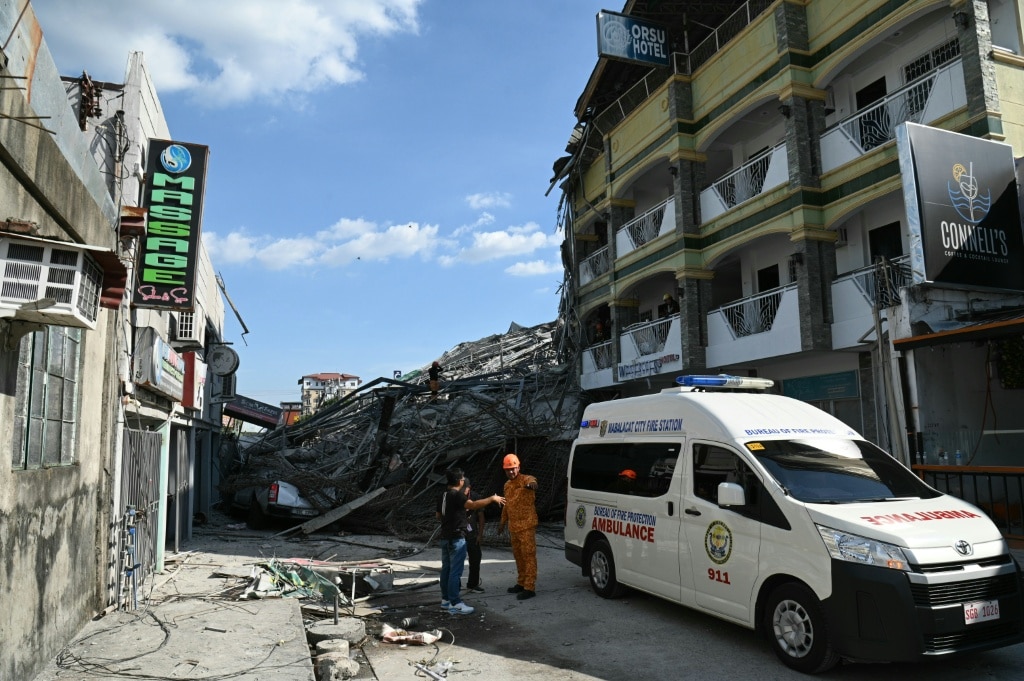
In the early hours of Sunday, a catastrophic nine-story building still under construction collapsed in Angeles City, located roughly 80 kilometers north of the Philippine capital Manila, leaving one person dead, 20 unaccounted for, and triggering a urgent large-scale rescue operation that stretched into the night.
Initial official updates confirm that 26 people trapped in the wreckage have been pulled out alive, but two construction workers remain pinned deep beneath the rubble, still conscious as rescuers work frantically to reach them. The only confirmed fatality is 65-year-old Mohd Rezal bin Abdullah, a Malaysian tourist staying at a nearby hotel that suffered collateral damage in the collapse. Acting Philippine fire chief Rico Kwan Tiu told reporters that Abdullah managed to contact rescuers by phone shortly after the structure fell at 3:00 a.m. local time (19:00 GMT Saturday), but his body was recovered without signs of life hours later.
Angeles City Mayor Carmelo Lazatin noted that the timing of the disaster amplified its human toll: almost everyone inside the under-construction building was asleep when the collapse occurred, catching many off guard. Footage posted to the regional fire service’s Facebook page captures the intensity of ongoing rescue efforts: one clip shows a firefighter using a power cutting tool to reach a moaning worker in a blue shirt, trapped under a tangled mass of steel scaffolding and plywood, with the rescuer calmly urging the victim to stay calm. Other footage shows teams of rescuers in orange safety gear squeezing through narrow gaps in the debris to search for signs of other trapped people.
Eyewitness accounts paint a chaotic picture of the moments after the collapse. Thirty-year-old delivery rider James Bernardo told AFP he had just finished dropping off a food order on the same street when disaster struck. “A few seconds later, there was suddenly a loud noise in the area, and when I looked, I realised that (the building) had already collapsed,” Bernardo recalled, adding that at first witnesses assumed the shaking and noise was an earthquake. A video he captured, verified by AFP, shows the entire street blocked by a massive pile of twisted steel, fractured concrete slabs and downed power infrastructure, as bystanders documented the scene on their mobile phones.
City information officer Jay Pelayo explained the unique challenges rescuers are facing: the building’s outer walls and supporting scaffolding buckled inward during the collapse, piling massive concrete chunks on top of anyone trapped. “There are big chunks of concrete and we need heavy equipment to lift them up. That is what’s challenging for the rescue right now,” Pelayo said. AFP journalists on site also confirmed that rescue teams lack powerful floodlights to illuminate the rubble field as operations continue overnight, forcing crews to rely on small handheld lights to search for signs of life.
In response to the crisis, the Metropolitan Manila Development Authority has dispatched additional support to the site, including heavy rescue equipment, police search dogs, life detection monitors, listening devices, and hydraulic spreaders to cut and lift heavy debris. Investigations into the root cause of the collapse are still in their early stages, and no official conclusions have been released about what triggered the structural failure.