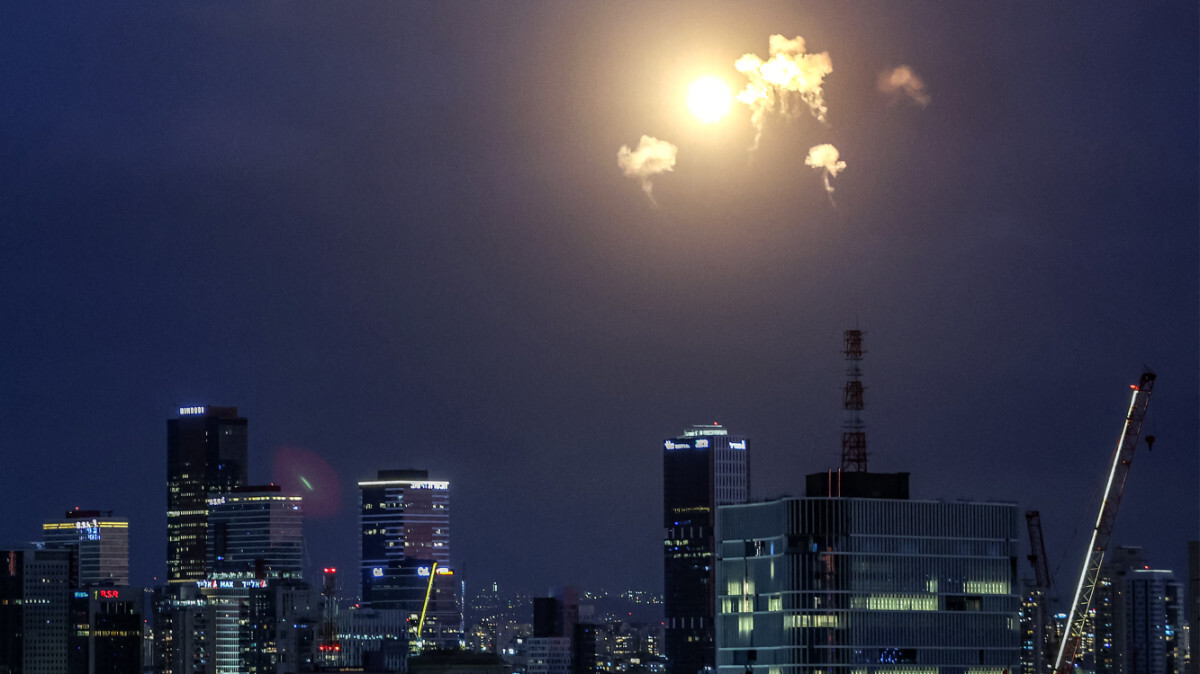
New data published by The Washington Post in a Thursday report has laid bare the starkly uneven burden of missile defense operations against Iran, showing the United States has expended far more advanced interceptor assets shielding Israel than Israel itself has deployed to protect its own territory.
According to the report, the unprecedented scale of US interceptor usage is the root cause of the critical stock shortages previously documented by Middle East Eye and other regional news outlets. The gap in available munitions has already had ripple effects across the region: during the peak of active conflict, Gulf US allies saw their requests for emergency interceptor resupplies rejected, despite Israel stepping in to deploy Iron Dome batteries and personnel to defend the United Arab Emirates, a key regional partner.
Breaking down the volume of deployments, The Washington Post confirmed the US launched more than 200 Terminal High Altitude Area Defence (THAAD) interceptors to counter Iranian attacks — a figure equal to roughly 50 percent of the Pentagon’s entire global stock of the advanced defense system. In addition to the THAAD deployments, US Navy vessels operating in the Eastern Mediterranean fired more than 100 Standard Missile-3 and Standard Missile-6 interceptors to down incoming threats.
By comparison, Israel’s own interceptor usage was far lower. Israeli defense forces launched fewer than 100 Arrow interceptors and approximately 90 David’s Sling interceptors. Notably, the David’s Sling systems were also diverted to counter projectiles launched by Yemen’s Houthi movement and Lebanon’s Hezbollah, groups whose missile and drone arsenal is far less sophisticated than that of Iran.
These numbers paint a clear picture of a “lopsided dynamic” at the heart of the US-Israel military alliance, the Post concluded. The revelation has sparked pushback from foreign policy analysts, with Trita Parsi, executive vice president of the Quincy Institute, describing the data as “stunning” in a post on the social platform X. “Very understandable that many view the Iran war as ‘Israel first’ when you see these statistics,” Parsi added. “The US depleted far more of its advanced missile defense interceptors inventory to defend Israel than Israel itself did.”
The disclosure comes as Washington and Tehran hold indirect talks to finalize a proposal to end the conflict, with a fragile ceasefire currently holding across active front lines. Former US President Donald Trump has publicly threatened to resume full-scale attacks on Iran if the country does not accept his administration’s terms for a permanent ceasefire.
But the depleted interceptor stockpiles leave the US in a strategically vulnerable position. Even before the conflict escalated, defense officials had publicly acknowledged that US interceptor inventories were already stretched thin, and the massive deployment for Israel leaves just 200 THAAD interceptors remaining in US stockpiles globally.
The military dynamic of the conflict has centered on a race between two sides: the US and Israel have sought to destroy as many of Iran’s ballistic missiles and mobile launchers as possible inside Iranian territory, while Iran has aimed to exhaust the stockpiles of defense munitions held by the US, Israel, and their regional Gulf partners. A recent New York Times report corroborated that Iran has retained roughly 70 percent of its pre-war mobile missile launchers and 70 percent of its total ballistic missile stockpile, leaving it with substantial remaining strike capacity if conflict resumes.
Compounding the strategic vulnerability, The Washington Post notes that if hostilities restart, the US will almost certainly be forced to take on an even larger share of missile defense duties for Israel. This additional burden stems from a recent decision by the Israeli military to take several of its own domestic missile defense batteries offline to conduct scheduled maintenance. One unnamed senior US official told the outlet that “the imbalance will likely be exacerbated if fighting restarts.”