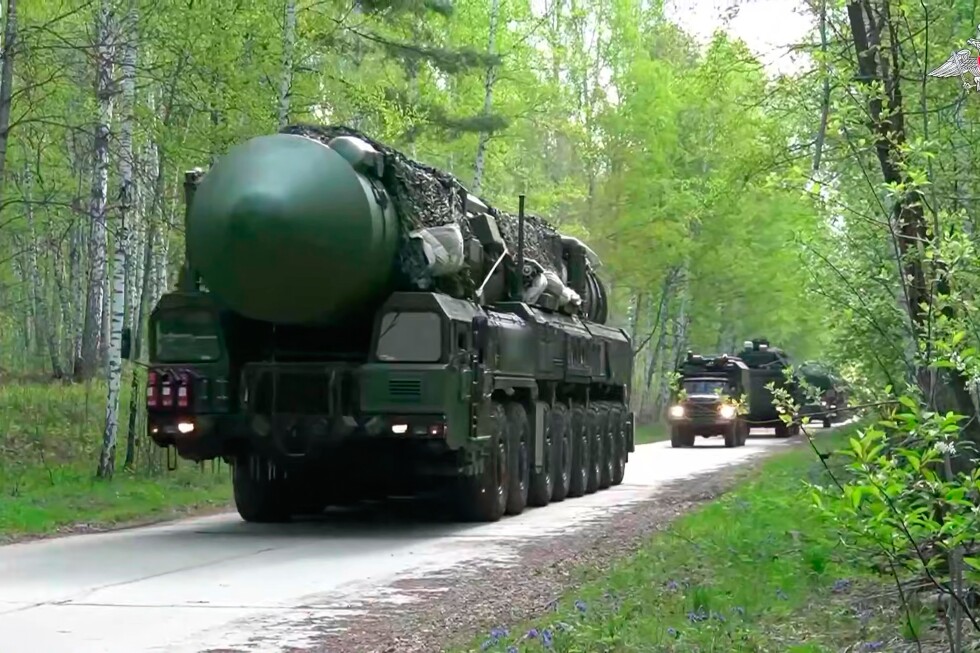
In the final stretch of a high-stakes joint military exercise focused on nuclear capabilities, heavy military convoys transporting intercontinental ballistic missiles (ICBMs) rolled through forested training grounds Thursday, as nuclear-powered submarines departed their Arctic and Pacific basins and combat aircrews scrambled to their alert positions across Russia and its western ally Belarus.
The three-day drill, which launched Tuesday, unfolds against a sharply escalated backdrop of long-range Ukrainian drone attacks deep into Russian territory. Recent strikes targeting Moscow’s outer suburbs have left three civilians dead and damaged multiple residential and industrial structures, eroding the Kremlin’s long-held narrative that the ongoing conflict in Ukraine — now stretching into its third year — remains a distant threat that does not disrupt ordinary Russian life.
During a visit to a Belarusian military unit participating in the exercise, Belarusian President Alexander Lukashenko personally inspected Russian-made Iskander short-range ballistic missiles, which are modified to carry nuclear warheads. “I dreamed about this machine a long time ago,” Lukashenko told reporters during the inspection.
Russian defense officials released detailed figures on the scale of the exercise: more than 64,000 military personnel, over 200 missile launch systems, more than 140 fixed-wing and rotary aircraft, 73 surface combat vessels, and 13 submarines, eight of which are outfitted with nuclear-armed ICBMs. According to the ministry, the core training objective of the drills is to practice “preparation and use of nuclear forces under the threat of aggression,” while also strengthening combined operational coordination between Russian and Belarusian military units. Belarus has served as a key Russian ally since the 2022 full-scale invasion of Ukraine, and currently hosts Russian nuclear weapons on its territory, including the advanced, nuclear-capable intermediate-range Oreshnik missile system.
This exercise marks the latest iteration of the Russian government’s public demonstration of its nuclear deterrent capabilities, a strategy that Russian President Vladimir Putin has leaned on repeatedly since ordering the full-scale invasion of Ukraine in February 2022. The core goal of this posture is to dissuade Western nations from expanding military support to Kyiv, particularly by restricting Ukraine’s access to longer-range strike weapons that can hit targets deep inside Russia.
Earlier this year, Putin signed off on a revised Russian nuclear doctrine that introduced a key new provision: any conventional attack on Russia backed by a nuclear-armed power will be treated as a combined attack on the Russian state. Analysts widely view this revision as a deliberate lowering of the threshold for potential Russian nuclear use, explicitly designed to deter Western nations from approving Ukrainian long-range strikes against Russian territory. The updated doctrine also extends the Russian nuclear umbrella to cover Belarus, with Putin confirming that while Moscow will maintain ultimate control over nuclear weapons deployed in the ally’s territory, Belarus would be allowed to participate in target selection in the event of armed conflict.