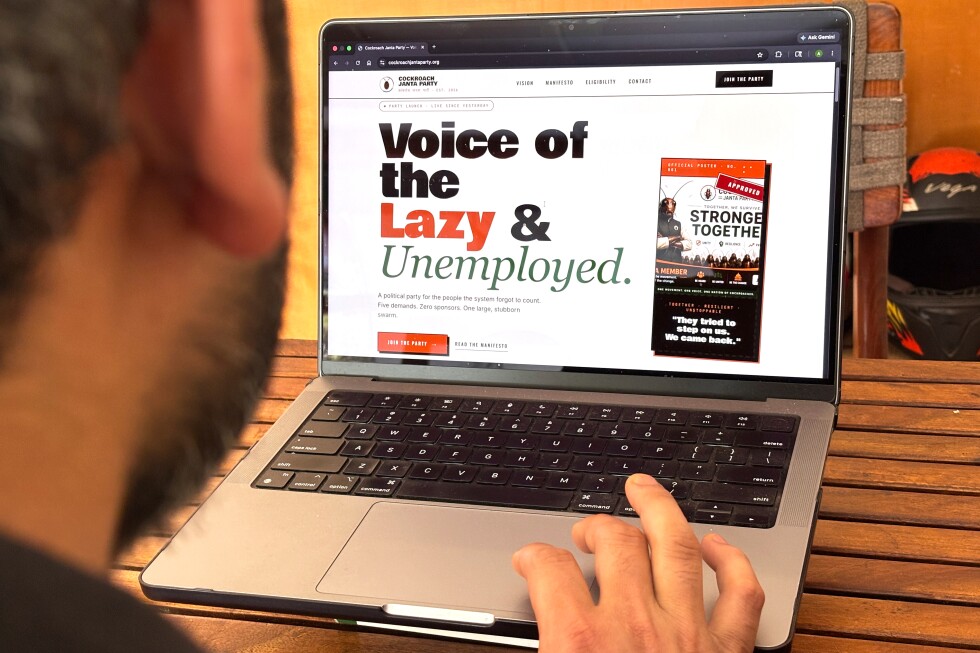
In the digital age, grassroots political discontent often emerges in the most unexpected of forms. What started as an offhand, throwaway comment from one of India’s top judicial officials has evolved into a viral satirical protest movement that is capturing the attention of millions of young Indians and upending the country’s online political landscape.
The story of the Cockroach Janta Party (CJP) — Janta translates to “people” in Hindi — began last month, when Supreme Court Chief Justice Surya Kant made inflammatory remarks during a public hearing. Addressing widespread anger over widespread unemployment, leaked government exam papers that have derailed job recruitment drives, and skyrocketing living costs, Kant compared unemployed young activists and job seekers to cockroaches, claiming they operated as “parasites” attacking India’s democratic institutions. “There are youngsters like cockroaches, who don’t get any employment or have any place in the profession,” Kant said, adding that many turned to social media activism to “start attacking everyone.”
The comments spread like wildfire across Indian social media, with many young users decrying them as a dehumanizing dismissal of widespread youth hardship. While Kant later issued a clarification, saying his remarks targeted only people obtaining fraudulent academic degrees and that he never intended to insult India’s younger generation, the damage was already done. The controversy set the stage for what would become one of the fastest growing online movements in India’s recent history.
Abhijeet Dipke, a political communications strategist and Boston University student with past experience working with the opposition Aam Aadmi Party, launched the CJP’s website and social media accounts just one week after Kant’s comments. What Dipke calls an accidental, unplanned satirical project quickly exploded in popularity: within five days of its launch, the CJP’s Instagram page had amassed more than 15 million followers, a figure that already outpaces the 8.8 million followers Prime Minister Narendra Modi’s ruling Bharatiya Janata Party (BJP) holds on the platform.
Adopting the cockroach as its official party symbol — a nod to the insect’s legendary ability to survive even the harshest conditions, and a playful reclamation of the insult lobbed at unemployed youth — the CJP has turned absurdist humor into a powerful vehicle for protest. Its feed is flooded with viral memes, short skits, and satirical commentary mocking systemic political corruption, persistent joblessness, and the widespread dysfunction of India’s traditional political establishment. The movement leans heavily into self-parody: its tongue-in-cheek membership requirements include being unemployed, chronically active online, professionally skilled at political rants, and “lazy.” Its satirical manifesto nonetheless tackles serious, divisive issues in Indian politics, from allegations of voter manipulation to the cozy ties between corporate media and the Modi administration to the controversial practice of appointing retired judges to key government posts.
Within days of launching, the CJP drew more than tens of thousands of online volunteers who signed up via a public Google Form, and earned public endorsements from several opposition politicians. Dipke says the movement’s explosive growth reflects a long-simmering wave of discontent that has been building among India’s young population for years. “It is the younger people who were actually very frustrated. They didn’t have any outlet. They were really angry at the government,” Dipke told the Associated Press in an interview.
India’s youth make up more than 27% of the country’s 1.4 billion population, and decades of rapid population growth have left millions of young people facing scarce job opportunities and double-digit youth unemployment, a crisis that successive governments have failed to address. Beyond economic hardship, many young Indians have grown increasingly critical of Modi’s ruling Hindu nationalist BJP, citing rising religious polarization, widening economic inequality, and growing authoritarianism as core sources of anger.
Dipke emphasizes that the CJP is not formally affiliated with any existing political party, but its rapid rise fits into a broader regional trend across South Asia, where youth-led movements have toppled sitting governments in recent years, from the 2022 uprising that ousted Sri Lanka’s Rajapaksa regime to mass student-led protests in Bangladesh and Nepal. “Five years ago nobody was ready to speak up against Modi or the government. The times are changing,” Dipke said.
Not everyone has welcomed the satirical movement. Supporters of Modi and the BJP have dismissed the CJP as nothing more than an opposition-aligned online gimmick, arguing that its viral popularity will fade as quickly as it emerged, noting that it remains a digital-first movement with no established grassroots infrastructure. Critics have also pointed to Dipke’s past work with the Aam Aadmi Party to claim the movement is not the spontaneous outpouring of youth anger its founders claim.
But Dipke pushes back against those claims, arguing that what started as an online project will not remain confined to social media, and that it will permanently reshape India’s political discourse. “This is the movement that has arrived in India … it will change the political discourse,” he said. “It will continue online, and if required it will also come on the ground.”
Already, the movement has begun to spill over into offline space, with young volunteers appearing at public protests dressed in full cockroach costumes. And as the movement grows, it has already faced its first wave of official pushback. Last week, Dipke announced on X (formerly Twitter) that the CJP’s original X account, which had amassed roughly 200,000 followers, had been blocked within India’s borders for reasons that have not been publicly disclosed. Within minutes, Dipke launched a replacement account and shared a defiant poster reading: “Cockroach is back. You thought you can get rid of us? Lol.”