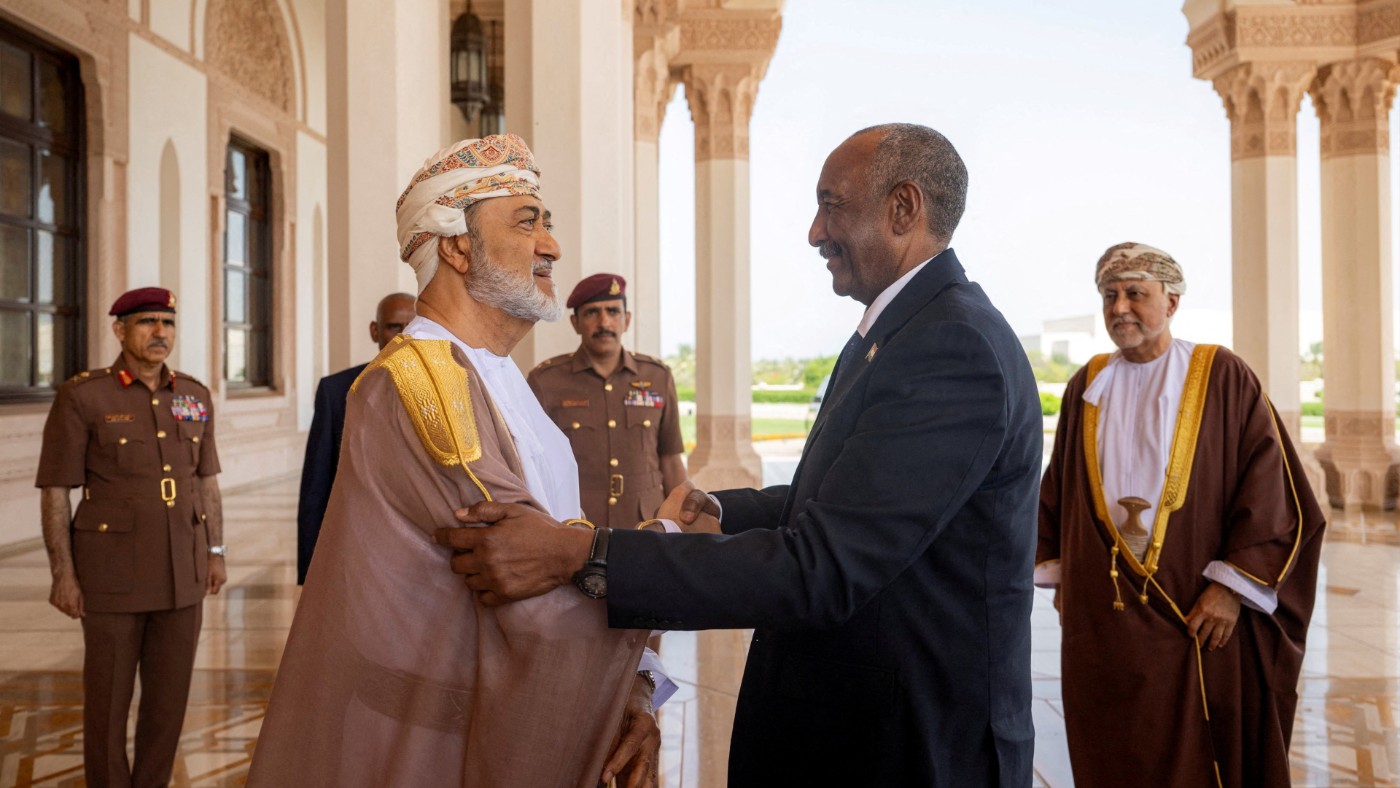
More than two years into Sudan’s devastating civil conflict between the Sudanese Armed Forces (SAF) led by General Abdel Fattah al-Burhan and the paramilitary Rapid Support Forces (RSF), diplomatic overtures are stirring tentative movement between the SAF-aligned transitional government and the United Arab Emirates, a major backer of the RSF. In an exclusive interview with Middle East Eye, Burhan laid out clear preconditions for any formal dialogue with Abu Dhabi: the UAE must immediately end its military and logistical backing for the RSF, honor Sudan’s territorial sovereignty, and conduct all negotiations on terms set by Khartoum’s recognized military leadership.
MEE can exclusively confirm that Burhan’s high-profile visit to Bahrain last week was not a routine diplomatic stop: it formed the core of a deliberate mediation push by Manama, which leverages its long-standing close political ties to Abu Dhabi to act as a trusted intermediary between the Sudanese government and Emirati officials. Multiple sources, including a senior Sudanese intelligence official and four European diplomatic figures with direct knowledge of the talks, confirm that while efforts to open a sustained communication channel remain ongoing, they have yet to yield any tangible breakthrough.
Burhan’s recent Gulf tour, which also included stops in Oman and Saudi Arabia, comes amid growing cautious optimism among SAF leadership based in Port Sudan that the UAE could eventually be pressured to curb or end its support for the RSF, a force that has faced widespread international accusations of perpetrating genocide in the Darfur region. This tentative optimism has been fueled in large part by a wave of high-profile defections from the RSF in recent months, with every departing senior commander publicly corroborating claims of ongoing Emirati military and financial support for the paramilitary group.
Even as new mediation efforts get underway, however, veteran regional diplomats warn that there is little sign Abu Dhabi is prepared to alter its core stance in the near term. This comes after Burhan launched a rare public rebuke of both the UAE and Ethiopia in recent weeks over their ongoing backing of the RSF. MEE previously confirmed that the RSF operates from an Ethiopian army base, plunging already fraught relations between Khartoum and Addis Ababa to a new low, with the UAE also implicated in channeling weapons to the RSF through Ethiopian territory.
Abu Dhabi has repeatedly rejected all accusations of support for the RSF, dismissing claims from the Sudanese government as “unfounded accusations and deliberate propaganda.” In an official statement to MEE, the Emirati foreign ministry claimed the allegations were a deliberate deflection tactic by the SAF, designed to shift blame for the continuation of the war away from military leadership and obstruct genuine peace efforts.
This is not the first attempt to open direct dialogue between Burhan’s leadership and the UAE. Over the past three years, multiple initiatives have been launched to bridge the divide, with only rare limited successes. The most recent successful contact came in July 2024, when Ethiopian Prime Minister Abiy Ahmed mediated a direct phone call between Burhan and UAE President Mohammed bin Zayed Al Nahyan. A separate effort was launched during indirect Quad mechanism talks between the SAF and RSF in Washington last year: the Quad, which includes the United States, Saudi Arabia, the UAE, and Egypt, arranged a closed-door face-to-face meeting between Sudanese military delegates and senior Emirati officials to de-escalate tensions. But the talks collapsed within minutes, far ahead of the scheduled one-hour timeline.
According to three sources briefed on the collapsed meeting, the SAF delegation arrived with documented evidence of Emirati military and logistical support for the RSF, a set of accusations Abu Dhabi continues to publicly deny. Led by UAE Minister of State for Foreign Affairs Shakhboot bin Nahyan Al Nahyan, the Emirati delegation cut the discussion short after the Sudanese side focused exclusively on the support allegations. “The atmosphere became tense very quickly,” one participating diplomat recalled. “The Sudanese side focused almost entirely on accusations regarding Emirati support for the RSF, and the Emiratis saw no basis for continuing the discussion.”
Senior regional figures say the collapse of that meeting reflects a deeper, persistent rift: Abu Dhabi remains deeply distrustful of Burhan’s leadership, clinging to the perception that the SAF is heavily influenced by Islamist political networks and has grown increasingly aligned with Iran, a regional rival of the UAE. Burhan’s recent Gulf tour was in part designed to counter this narrative, with multiple stops in key Gulf Cooperation Council states intended to signal that his administration does not side with Tehran in regional tensions.
One senior regional diplomat explained that broader geopolitical alignments are the primary driver of the UAE’s intransigence, noting that meaningful change will only come if external powers pressure Abu Dhabi to alter its course. “Without a major change in the approach taken by Washington and Tel Aviv towards the region, there is unlikely to be enough pressure on Abu Dhabi to reconsider its current strategy in Sudan,” the source said. Both the U.S. and Israel maintain close strategic alliances with the UAE, even after a recent public disagreement when Israeli Prime Minister Benjamin Netanyahu’s office unilaterally revealed a “secret meeting” between Netanyahu and Mohammed bin Zayed weeks after Israel launched its war on Iran.
Sudan’s April 2023 outbreak of conflict has long since evolved from an internal power struggle into a proxy battleground, with competing regional powers including Gulf states, Egypt, Ethiopia, Iran, and Turkey backing rival factions to advance their own strategic interests. Despite repeated public denials from Abu Dhabi, a growing body of open-source evidence – including testimony from defected RSF commanders, satellite imagery, flight tracking data, weapons serial numbers, and on-the-battlefield evidence – confirms ongoing Emirati support for the RSF. Emirati academic Abdulkhaleq Abdulla, who has close ties to Abu Dhabi’s leadership, has pushed back on international criticism, arguing that the RSF receives support from multiple regional states including Uganda, Ethiopia, and Chad, and that the UAE is being unfairly singled out.
The four diplomatic sources interviewed by MEE uniformly agree that there is currently no unified consensus among international and regional actors on a path to end the war, with deep divisions emerging within the Quad mediation framework that have left each member pursuing its own separate interests inside Sudan. “The problem is that everyone officially wants peace, but they all imagine a different Sudan after the war,” one European diplomat explained. “That makes coordinated pressure almost impossible.”
Another senior diplomatic source assessed the current fragmented diplomatic landscape as unlikely to produce any major breakthrough before the final quarter of 2025, an assessment that aligns with recent comments from U.S. Special Envoy for Africa and Arab countries Massad Boulos, who openly acknowledged the severe challenges of bringing Sudan’s warring factions to the negotiating table.
Parallel to Bahrain’s mediation efforts, Saudi Arabia has recently ramped up its own diplomatic engagement in Sudan, seeking to counter growing Emirati influence over both civilian and military actors in the country. According to a senior regional diplomat and a Sudanese political figure with direct knowledge of Riyadh’s recent outreach, Saudi officials have quietly expanded contacts with Sudanese civilian political groups over the past several months, hosting a series of closed-door meetings since Ramadan that included members of the Sumoud civilian coalition led by former Prime Minister Abdalla Hamdok (currently based in the UAE) and delegates from the Democratic Bloc.
These meetings are part of a broader Saudi strategy to build political leverage inside Sudan comparable to the extensive influence the UAE has cultivated across sections of Sudan’s civilian political sphere since the war began. Riyadh is also working to build a broad civilian political coalition aligned with Burhan’s SAF-aligned administration. One Sudanese political figure familiar with the discussions said Saudi officials have privately expressed regret over their approach to Sudan following the 2019 popular uprising that toppled long-time ruler Omar Hassan al-Bashir, acknowledging that Riyadh and other Gulf states overrelied on Emirati guidance when backing the country’s post-revolution transitional military leadership.
“The Saudis increasingly believe that their previous approach helped deepen instability rather than contain it,” the source said. Today, Saudi officials are prioritizing the formation of a civilian-led governing structure, a position that came to the fore during recent debates over Burhan’s appointment of a new civilian prime minister. Multiple sources confirm that Riyadh pushed Burhan aggressively to appoint a civilian premier before he ultimately named Kamil Idris to the role. That push created public tensions with Cairo, which favors a slower, more deliberate transition process and is cautious about rapid restructuring of Sudan’s wartime government. “The Egyptians opposed the idea,” one diplomat confirmed. “But the Saudis pushed hard for Burhan to move ahead with appointing a civilian prime minister.”
The competing approaches taken by Saudi Arabia, the UAE, and Egypt underscore the growing zero-sum competition among regional powers for influence over Sudan’s war and its uncertain post-conflict future. While all Gulf states continue to publicly voice support for diplomatic initiatives to end the conflict, diplomats privately acknowledge that competing strategic interests are the primary driver of their engagement with Sudan’s military and civilian factions.
For the immediate future, diplomats broadly agree that Bahrain’s indirect mediation is unlikely to produce a quick breakthrough between the SAF and the UAE. Even so, the resumption of backchannel contacts signals that despite high-profile public hostility between the two sides, lines of communication remain open behind closed doors, as regional powers continue to jockey for position in a conflict that has killed hundreds of thousands of people and displaced millions more across Sudan.