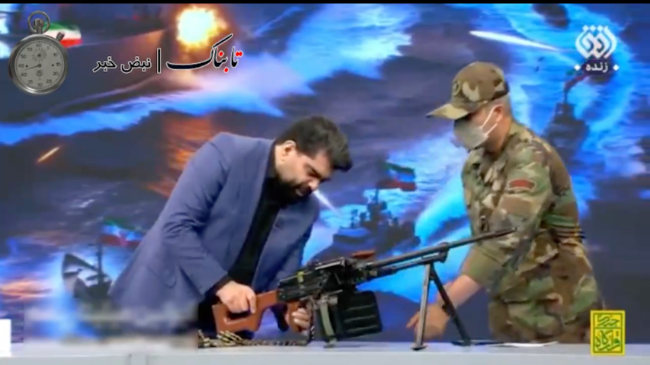
Against a backdrop of escalating regional tensions tied to the U.S.-Israeli conflict, Iran’s state-controlled public broadcaster has introduced a dramatic shift in programming, rolling out weapons training segments that mark a new escalation of militarized messaging on national airwaves. The Islamic Republic of Iran Broadcasting (IRIB), the country’s sole television network, remains firmly under the control of hardline political factions, with its top leadership directly appointed by Iran’s Supreme Leader. The new training content walks viewers through step-by-step demonstrations of assembling, disassembling, and operating standard military firearms including Kalashnikov rifles and PK machine guns.
One particularly striking live segment on IRIB’s Channel 3 featured a masked instructor in an Islamic Revolutionary Guard Corps (IRGC) uniform walking audiences through Kalashnikov handling. After the host prepared the weapon, he received formal permission from the IRGC officer to open fire on a United Arab Emirates flag displayed inside the studio, carrying out the provocative act live on air. In a separate live outdoor segment, a male presenter joined pro-establishment crowds gathered in central Tehran’s main public squares, firing a shot into the sky directly in front of rolling cameras. He framed the action as a warning to potential foreign adversaries, noting, “This was just a shot for fun, but if necessary, each of us will take up arms and cut off the ear of those who want to invade this land.”
Militarized messaging on state television has not been limited to male on-air personalities. Prominent pro-establishment presenter Mobina Nasiri appeared on live broadcast holding a Kalashnikov, stating that she had recently been issued the weapon and stands ready to join combat against Israel and the United States if called upon.
Alongside this shift in state broadcasting, a new report from U.S.-based Iranian human rights monitoring agency HRANA documents a sharp deterioration in Iran’s human rights climate since the escalation of the U.S.-Israeli conflict. Between February 28 and April 8 alone, HRANA records more than 4,000 arrests on broadly defined security-related charges, ranging from espionage and threatening national security to spreading unapproved war-related information and cooperating with what Iranian authorities label hostile foreign states. The same period saw 50 people executed across the country, 32 of whom were charged with political or security-linked offenses, according to the report. Prison conditions have deteriorated dramatically, while Iranian authorities have expanded security checkpoints across urban centers and tightened restrictions on civilian movement. Most notably, HRANA confirms that child as young as 12 years old are being deployed to staff these checkpoints, a practice that has drawn widespread international condemnation.
The new hardline direction of IRIB programming has also sparked public controversy over a recent inflammatory remark targeting the Iranian Red Crescent Society. During a live on-site segment with pro-establishment demonstrators in Tehran, a host asked a gathered participant, “Who is more despicable than the Red Crescent rescue dogs?” The comment drew swift backlash from Red Crescent rescue personnel, who spoke out publicly against the remark in an interview with independent Iranian outlet Khabar Online. Omid Barzegari, a rescue dog trainer with the organization, pushed back sharply on the insult, emphasizing the critical work these animals do to locate survivors trapped under rubble following U.S. and Israeli strikes. “These dogs are rescue angels,” Barzegari said. “Each of us and these dogs works as a team. These dogs are not despicable. They are trained to serve the people.”
The interview went viral across Iranian media platforms, sparking widespread public criticism of both the remark and IRIB’s leadership. One Iranian viewer wrote online, “There is not a single person with common sense among the policymakers of this gigantic [IRIB] organisation, this has nothing but terrible costs for the people.” The public friction around the comment ties into long-standing restrictions on dog ownership in Iran, where conservative authorities have enforced bans on public dog walking based on strict interpretations of Islamic law.
Beyond Iran’s borders, controversy has erupted over recent demonstrations by exiled Iranian monarchist supporters that have drawn condemnation from Iranians both inside the country and in the diaspora. In recent weeks, groups backing Reza Pahlavi, the son of Iran’s deposed last shah, have held military-style parades in European cities including London, Copenhagen, and Regensburg, Germany, while carrying flags associated with Savak — the shah-era intelligence agency notorious for systemic human rights abuses and political repression. Critics have compared the aesthetic and organizational structure of the parades to fascist rallies that preceded World War II, and the displays sparked fierce backlash across Persian-language social media.
Many social media users have mocked and condemned the events, with one creating a viral edited version of the Savak logo that replaces the iconic lion with a ketchup bottle to satirize what many see as the movement’s hollow posturing. Another Iranian user criticized the exclusionary nationalist rhetoric used during the parades, posting an ethnic map of Iran to the platform X and writing, “I don’t want to hear Iran shouted like this from these people. Their Iran is nothing like our Iran.”
In recent months, growing numbers of Iranians have publicly criticized exiled monarchist factions, which receive open backing from Israel, for supporting foreign military strikes on Iran. Despite this widespread domestic criticism, many major international media outlets continue to frame monarchist leaders as the primary face of the Iranian opposition to the Islamic Republic. That disconnect has drawn frustration from many Iranian social media users, who note the contrast between the exiled faction’s public displays and the risks faced by dissidents inside Iran. “In the bitter days when the brave children of Iran are being led to the gallows, part of the diaspora is putting on ridiculous shows,” one Persian-speaking user wrote on X. “They have turned the real struggle and the price people pay inside the country into vulgarity abroad, and unfortunately, the world only sees this picture.”
This report is compiled as an Iranian press digest, and its content has not been independently verified by Middle East Eye.