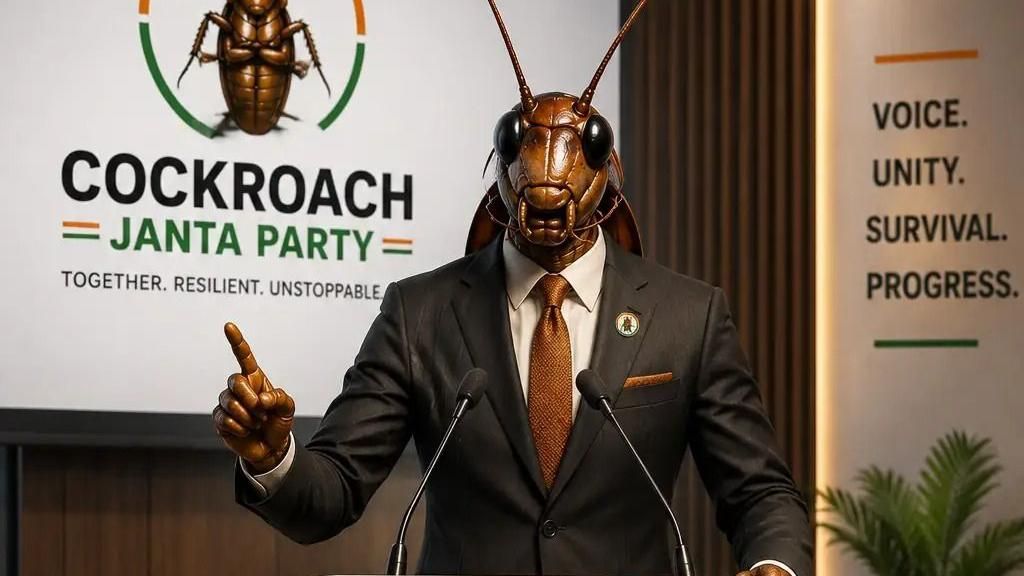
In the crowded landscape of Indian political symbols, where the ruling Bharatiya Janata Party claims the lotus and the opposition Congress relies on the iconic hand, an unlikely new mascot has exploded into online consciousness: the humble, reviled, notoriously indestructible cockroach. What began as a throwaway offensive comment from India’s Chief Justice Surya Kant has evolved into a viral satirical political movement that has upended conventional Indian politics and given a voice to millions of frustrated young Indians.
The controversy that sparked the movement ignited last month, when Kant made headlines during a public court hearing. He was accused of comparing unemployed young people who gravitated toward journalism and activism to cockroaches and parasites. The judge quickly issued a clarification, stressing his remarks were aimed exclusively at individuals holding fake academic credentials, not the broader Indian youth population. But by the time the clarification was issued, the original comment had already spread like wildfire across Indian social media, sparking a mix of public outrage, dark internet humor, and eventually, the creation of a spontaneous online uprising: the Cockroach Janta Party (CJP), or Cockroach People’s Party.
Far from a traditional, registered political party, the CJP is a satire-driven online collective founded by Abhijeet Dipke, a 30-year-old political communications strategist and current Boston University student who previously worked with India’s anti-corruption born Aam Aadmi Party, a group renowned for its sophisticated social media outreach. Dipke originally conceived the CJP as a lighthearted joke, telling BBC Marathi that he simply wanted to create a space for disillusioned young people to gather. What unfolded far outpaced his wildest expectations.
Within days of launching, the CJP racked up tens of thousands of membership sign-ups via a simple Google form, spawned the viral hashtag #MainBhiCockroach (translated “I too am a cockroach”), and earned public endorsements from high-profile opposition politicians. The movement soon crossed over from online to offline, with young volunteers donning cockroach costumes to appear at public clean-up drives and protest events, leaning into the reclaimed label with theatrical, unapologetic energy. By last Thursday, the CJP’s Instagram account hit 10 million followers – surpassing the official BJP account, which counts roughly 8.7 million followers, even as the BJP claims the title of the world’s largest political party by formal membership. While the CJP’s X account, which boasts more than 200,000 followers, is currently withheld for users in India following an unspecified legal demand, the movement’s momentum has shown no signs of slowing.
For its growing base of supporters, the CJP represents a much-needed break from India’s rigid, heavily managed mainstream political culture that often shutters out dissent. Backing for the movement has come from across the political opposition, including prominent figures like MP Mahua Moitra, veteran politician Kirti Azad, and senior lawyer Prashant Bhushan. Critics, however, have pushed back against framing the CJP as a spontaneous grassroots rebellion, pointing to Dipke’s past ties to the AAP and arguing the movement is nothing more than opposition-aligned digital political theater, carefully packaged rather than organically born.
Beneath the memes and insect-themed jokes, the CJP’s rapid rise exposes a deep well of generational frustration among India’s massive youth population. Roughly half of India’s 1.4 billion people are under the age of 30, making it home to the youngest national population on the globe, yet formal political participation among young Indians remains strikingly low. A recent national survey found that 29% of young Indians avoid all forms of political engagement entirely, while only 11% hold formal membership in any established political party.
“People are frustrated because they don’t feel heard or represented,” Dipke explained.
Across South Asia, the past half-decade has seen a wave of youth-led protest movements that have toppled sitting governments in Sri Lanka, Nepal, and Bangladesh, all fueled by widespread public anger over lack of job opportunities, skyrocketing living costs, and stagnant economic mobility. India has not yet seen a mass uprising of comparable scale, but the underlying economic and social pressures mirror those that drove unrest across the region. Even as India posts impressive headline GDP growth, anxieties over employment, widening economic inequality, and rising cost of living have not eased. For many young Indians entering the workforce, a college education no longer guarantees financial stability, and the long-held promise of upward social mobility feels increasingly out of reach.
While Dipke rejects comparisons between the CJP and the mass upheavals that shook neighboring countries, noting India’s unique political context, he agrees that the frustration among young Indians is tangible – it is simply expressed differently, fragmented across online spaces rather than concentrated in mass street protests. “Gen Z has given up on traditional political parties and wants to create its own political front in a language they understand,” he said.
That distinctly internet-native language is on full display on the CJP’s website, which reads far less like a traditional political manifesto and more like a product of meme culture. The collective describes itself as “the voice of the lazy and unemployed,” boasts “zero sponsors” and “one stubborn swarm,” and invites people “tired of pretending everything is fine” to join its ranks. The site features satirical mock forms, intentionally unpolished design, and a visual identity that feels more like an inside internet joke than a formal political institution. Yet tucked between the self-deprecating jokes about doomscrolling, unemployment, and widespread political burnout are clear, concrete political demands: greater government accountability, media reform, electoral transparency, and expanded political representation for women.
This balance between parody and sincere grievance is core to the movement’s broad appeal. The jokes resonate because the underlying frustrations are universal for young Indians: stagnant job markets, growing inequality, systemic corruption, and a pervasive sense of political alienation. Even the choice of the cockroach as a mascot carries deliberate meaning: far from a heroic or aspirational symbol, the cockroach is defined by its resilience, adaptability, and ability to survive in hostile conditions with minimal resources, a metaphor that hits close to home for many young Indians.
The merging of political satire and organized politics is not a new phenomenon globally: in Italy, comedian Beppe Grillo turned anti-establishment humor into the Five Star Movement, a major force in Italian politics, while in Ukraine, Volodymyr Zelenskyy parlayed a career playing a fictional president on television into winning the actual presidency. In the United States, the rise of Donald Trump sparked long-running debates over whether political satire has become obsolete in an era where political reality often feels like parody. The CJP, however, offers a distinctly Indian, internet-first iteration of this trend: a meme-driven, insect-themed movement shaped by viral hashtags, widespread youth burnout, and ironic despair.
While the CJP strikes many observers as an unusual development in Indian politics, it fits into a long history of political spectacle in the country. Indian politicians have long embraced dramatic public displays, from staged meditative retreats in Himalayan caves to high-drama party switching that sees legislators whisked between locations on buses and hidden in hotels to avoid defection. Mainstream Indian political campaigns already rely on tightly choreographed viral content and punchy slogans designed to maximize social media reach. Against that backdrop, an insect-themed satirical movement feels far less out of place than it might seem.
The CJP’s rapid spread is less a sign that young Indians want another formal political party, and more evidence that they are desperate for a new way to express their deep-seated frustration with the status quo. Dipke believes the CJP is just the start of a larger youth-led political shift. “Young people are fed up with the current political system, and more youth organisations will come forward,” he predicted. Skeptics, however, argue the movement is a viral flash in the pan that will fade as quickly as it emerged.
Regardless of its long-term fate, the CJP has already achieved something unprecedented in modern Indian politics: it has, for the first time for many young Indians, made them feel seen and heard. Where past generations of politically frustrated young Indians produced formal manifestos and organized mass movements, 2026 has given rise to a meme-driven party with an insect mascot – a reflection of how a new generation is reimagining political expression for the digital age.